Douglas Hyde – saviour of the Irish language
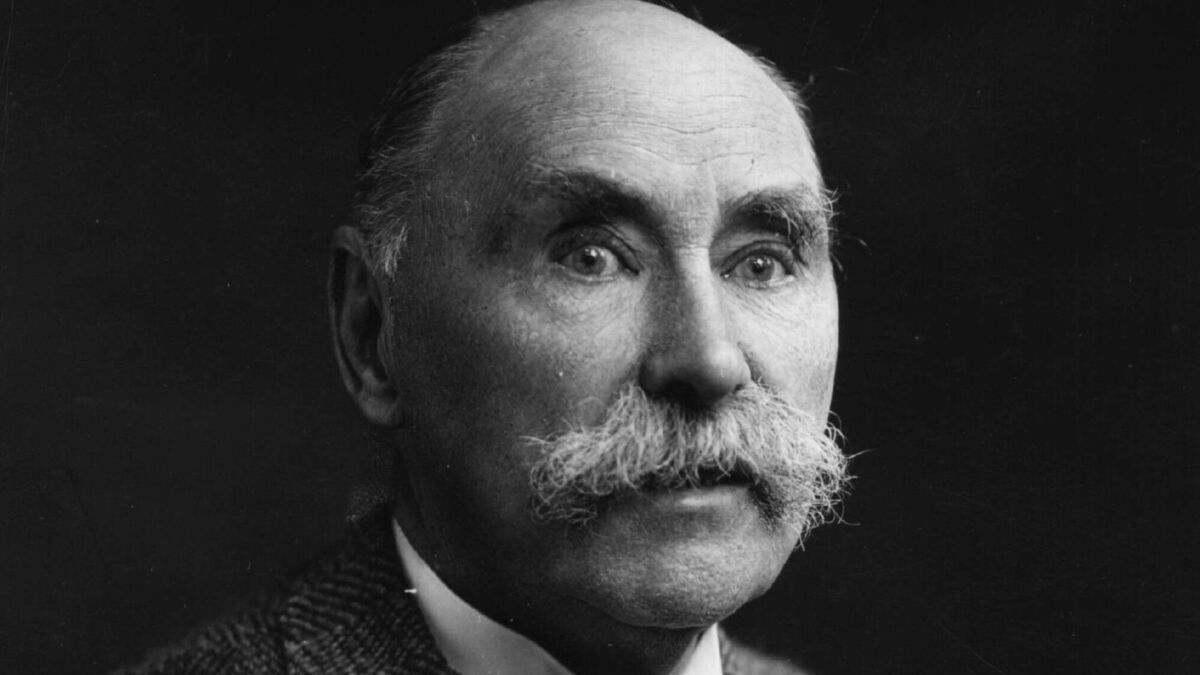
The Irish poet, philologist, historian and a founder of the Gaelic League Douglas Hyde pictured in 1940. Picture: Hulton Archive/Getty Images
Up to the time of the Great Famine, Irish was the language of the common people. Many of those who left the Ox Mountain region at that time arrived in New York and Philadelphia speaking a language that only themselves could understand. In the years that followed the Famine, our native language was not among the top priorities for most country people. In fact, it was seen by many as a kind of curse, limiting communication and impeding progress.
However, from the ashes, out stepped a man who saw the impending loss of our native language as a great tragedy. Only for him, our unique language, that had lasted for thousands and thousands of years, could well have been lost forever. That man was Douglas Hyde.
Douglas Hyde was born on January 17, 1860, in Castlerea, Co Roscommon. Hyde moved permanently to Frenchpark in 1867 when his father became a rector there. He spent much of his boyhood exploring the Roscommon and Sligo countryside while being home-schooled by his father and his aunt - brought about through Hyde having some childhood illness. In his youth, he became fascinated by hearing the old people in his locality speaking Irish. He was influenced in particular by the local gamekeeper, Séamus Hart.
Aged 14, Hyde was devastated when Hart died. This devastation was as much to do with losing his connection with Irish as it was to do with the loss of the gamekeeper. As a result, his interest in the Irish language floundered for a while. However, a few years later, while on occasional visits to Dublin, he discovered that there were many others, just like himself, who were also interested in reviving the native language.
Rejecting family pressure that he should follow tradition and become a clergyman, Hyde opted instead for an academic career. He went to Trinity College Dublin where he became fluent in French, Latin, German, Greek, and Hebrew, graduating in 1884. Later, his passion for the revival of the Irish language led him to help found the Gaelic League (Conradh na Gaeilge) in 1893.
Within his academic career, Hyde was soon recognised as particularly brilliant and he began to mix with people such as WB Yeats and Michael Davitt, the elites of the Gaelic Revival. In a speech in New York in 1891, Hyde talked about “the need for speaking Irish if the language was to be kept alive” and asked “what stronger or more lasting bond might be found to weld together the Irish nation”.
American scholars, Janet and Gareth Dunleavy, remind us that in an address delivered by Hyde to the Irish National Literary Society in Dublin in 1892, he spoke of “the necessity for De-Anglicising Ireland”. They go on to describe Hyde’s ability to lead and inspire.
A year later, serving as its first president, the Gaelic League (Conradh na Gaeilge) was founded in Dublin. Subsequently, the Gaelic League had success beyond all expectations, appealing to not just those interested in the language but also to those in the wider community. Douglas Hyde, through the good example of the Gaelic League, had proved a hugely influential figure. His work sounded the starting gun for new departures and proved inspirational in the formation other organisations such as political Sinn Féin and the co-operative movement.
Throughout his lifetime, Hyde published many works under the pen name An Craoibhin Aoibhinn, which translates as 'The Pleasant Little Branch'. It was little wonder, given his many abilities and achievements, that Hyde was seen by many as a most appropriate candidate to become Ireland’s first president in 1938. One of his successors, Erskine Childers, penned a glowing tribute to Hyde in later years.
Portahard Church and Interpretative Centre Church of Ireland was built in 1740 and restored in 1988 by Roscommon County Council. Its original function was preserved and an interpretative centre telling the life-story of Dr. Douglas Hyde (1860-1949) was installed. Hyde's contribution to modern Ireland is highlighted in the exhibition by the use of charts, maps and photographs.
Through audio-visual material you can capture the spirit of his dream and celebrate the achievements of a dedicated life. Also on display is the original letter nominating him as first President of Ireland, signed by members of the two main political parties in Dáil Éireann - Fianna Fáil and Fine Gael - along with many other items of historical interest.
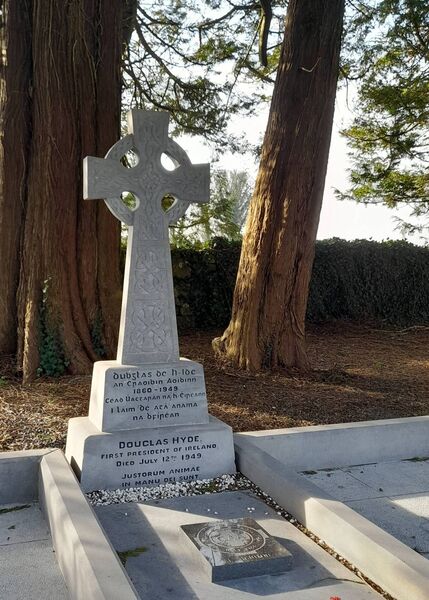
The Douglas Hyde Centre, near Frenchpark, is now bypassed by the recent realignment of the N5 but travelling on the old road in recent months, I stopped to visit the grave of Ireland’s first president. Hyde is laid to rest alongside family relations in a neat row of unremarkable headstones.
I was a bit underwhelmed by Hyde's own grave. I had imagined that such an inspirational and influential figure, given all he had done for the Irish language and all the service he had given to the Irish people, might have been rewarded with a more substantial monument. On further reflection, maybe this neat corner, along the wall of a country churchyard, overhung by leafy trees, was just what he wanted for his final resting place; a setting reflecting his gifted yet unassuming personality, his life’s work finally complete.
Next time you are passing Frenchpark, take the short detour to visit the Hyde Centre there. Entry is free but donations are welcome, and before you leave, take a few minutes to visit the grave of one of our most visionary founding fathers.
With the renewed interest in speaking the Irish language, the laneways and homesteads of the Ox Mountains might once again ring with the lilt of our native tongue. Irish is no longer seen as the burden of times past; more enlightened opinions now see it as a joyful display of heritage and pride. Take a class this autumn, learn the cúpla focal and use them regularly.
Douglas Hyde, folklorist, academic, linguist, founder of the Gaelic League and the first President of Ireland, An Craoibhín Aoibhinn, go raibh maith agat.