Keeping track of time through the centuries
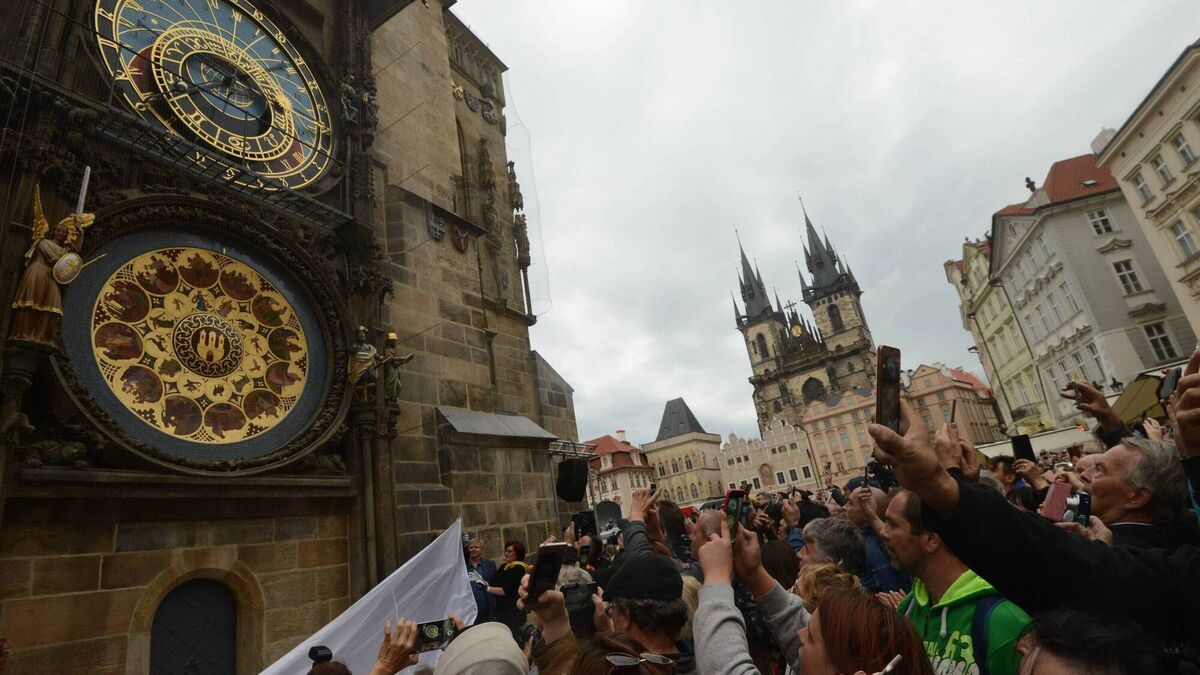
People attend the unveiling of Prague's restored astronomical clock on the Old Town Square on September 28, 2018. The 608-year-old clock was removed earlier that year for its first major repair since World War II. Picture: Michal Cizek/AFP via Getty Images
If you ask most a cross section of Ox Mountain people what they find most difficult to come by these days, they might suggest money as their No 1 thing. If you ask for their second choice, they will likely say, time. It just seems so difficult to find time and, once found, knowing how to manage it. We live our busy lives by the clock and all too often, the 24 hours in each day are never enough.
There was a time however when time didn’t matter quite so much; a time, in fact, when time hardly mattered at all. Early man had neither a clock nor a watch; he simply measured time by observing the sun, the moon and the stars.
The earliest timekeepers in human history relied on natural celestial cycles. Later, simple shadow-casting or flowing-water devices were devised to help put order on people’s days and eventually, but only in relatively recent centuries, mechanical clocks were invented.
Early humans tracked time by watching the sun, moon, and bright stars. Civilisations like the Sumerians created lunar calendars with 12 months based on the phases of the moon. These early civilisations didn’t have a train to catch, but they did have food to collect. In order to do this, they simply got up shortly after sunrise, allowing themselves enough time to gather what they needed to sustain them for that day. Their smallest unit of time measurement at that times was a day - sunrise to sunset.
Their next smallest unit of time was a week, a phase of the moon’s cycle. A full lunar cycle gave them a month, three of these gave them a season and four seasons gave them a full year. And then their basic time cycle started over again. Variation in daylight and the changing seasons were the only influencing factors on how people juggled their chores. It is little wonder that our ancient monuments reflect these powerful influences; many such monuments depicting ancient timetables; the arrival and departure of certain seasons, calendars of ancient festivals.
The number 60 was central to an ancient Babylonian number system, developed around 3500 BCE. It seems, according to research, this system was based in the nearest things to hand, hands themselves. They simply counted up to 12 by using the thumb of one hand to touch the three segments on each of the other four fingers. They multiplied those 12 segments by the five fingers of the other hand to reach a total of 60.
The number 60 is a superior composite number. It can be cleanly divided by 1, 2, 3, 4, 5, 6, 10, 12, 15, 20, 30, and 60. Beginning to sound familiar? This made fractions and division much easier than a system based in the number 10 - where dividing by 3, for example, results in a recurring decimal.
This measurement system, using 60, was then harnessed by early astronomers who tracked the movement of the sun across the sky and divided a circular orbit into 360 parts (the degrees in a circle), mirroring a 360-day year. We know now that that calculation wasn’t perfect, but hey, it was early days. They then used the same system to divide hours into minutes and minutes into seconds. Readers old enough to remember Imperial coinage will remember that it was similarly calculated, 12 pence in a shilling and 20 shillings in a pound.
Later civilisations, such as the Greeks and the Romans, and eventually the creators of mechanical clocks, kept this ancient system based on the number 60 and that is why modern timekeeping still uses 60 seconds in a minute and 60 minutes in an hour. So maybe those early astronomers weren’t that far off the mark after all.
Water clocks were first developed as far back as the 16th century BCE in Egypt. These simple devices measured time by the steady, regulated flow of water from a vessel. This was man’s first attempt at segmenting their days and was necessitated by population growth and societal advances. Later, fire and Incense were used to track time by the controlled burning of marked candles or incense sticks.
Around 3,500 BCE in ancient Egypt, shadow clocks and sundials used to cast shadows and divide the day by using the position of the sun Beginning around the 5th century, church and monastery bells announced certain prayer periods. In turn these ringing sounds were picked up and used by the common people, to mark the important events in their lives, such as market opening time and night-time curfews. At that time, hearing the sound of a bell mattered much more than seeing a visual clock face.
The first reliable mechanical clocks emerged in monasteries in 13th-century Europe. This advance was brought about to manage strict daily prayer times. The invention of the ‘verge and foliot escapement’ around 1275 allowed the internal workings of a clock to move at steady intervals. This verge and foliot escapement “converts the continuous falling force of a weight into a regulated, back-and-forth ticking motion”. This development marked the birth of modern mechanical timekeeping.
One of the world's oldest surviving mechanical tower clocks was built around 1386 in England. Prague’s stylish astronomical clock, installed in 1410 on the Old Town Hall, is a famous landmark that tracks the sun, moon, and calendar cycles in addition to the hours of the day.
Strangely, early mechanical tower clocks had neither hands nor dials; instead, they used a hammer type mechanism to strike bells to announce the hours. Large external clock dials only emerged in the 15th and 16th centuries, allowing citizens to check the time directly from the street below. Large public clocks required heavy weights, gears, and regular manual winding by dedicated clock keepers.
Before the arrival of the railways, towns operated by their own local time. This meant that clocks in different towns and villages told different times; noon in Ballina could well be 11.30am in Sligo. The arrival of rail travel and industrial factories in the Victorian era demanded synchronised, exact time rather than loose local schedules. Iconic structures like Big Ben in London brought reliable time to workers and the general public who did not own portable pocket watches. But these are stories for another day.
I often heard my father talk about men who only knew the time of day by listening out for the sound a passing train or the ringing of the angelus bells at Tubbercurry. Men that might have left home, for the meadow, after the morning's milking and only knew it was time for dinner when the train passed between Coolaney and Carrowmore. These were simpler times, times when time didn't really matter and yet, there seemed to be time for everything.