Depth of Irish rugby support set to be tested
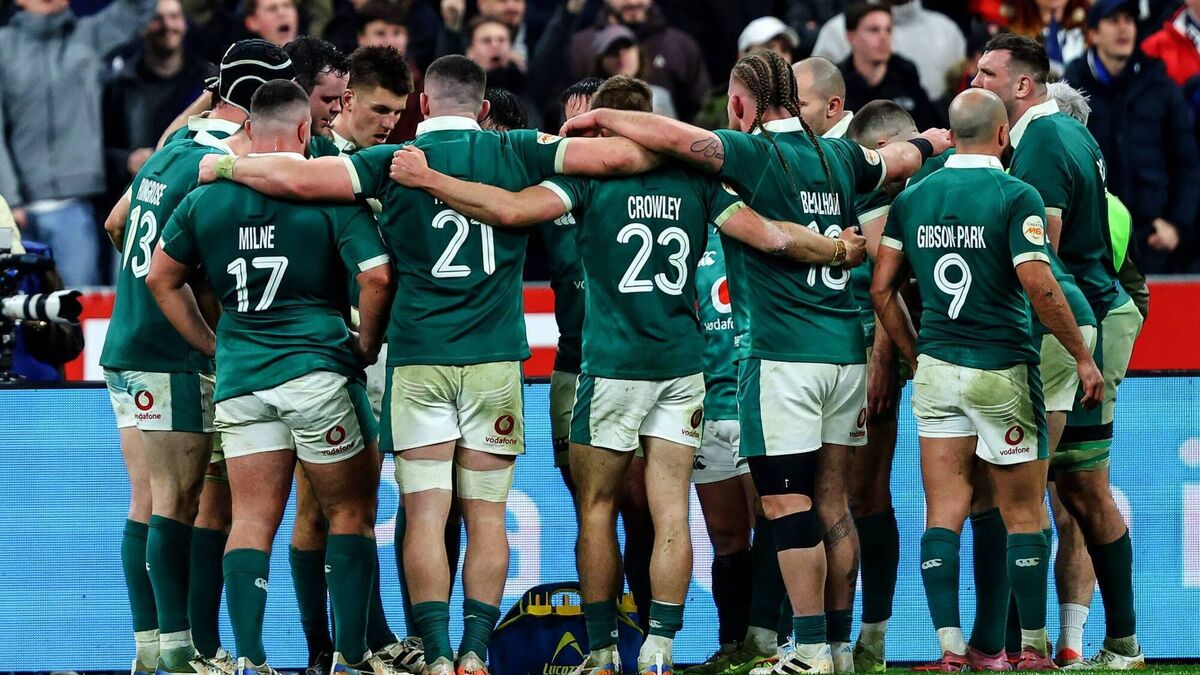
Ireland players huddle after their defeat to France in last Thursday night's 2026 Guinness Six Nations Championship first round match at Stade De France, Paris. Picture: INPHO/Ben Brady
Canada and Denmark once disputed ownership of a rock by swapping flags and leaving each other whisky.
Hans Island is a rocky island in the Arctic – inhospitable, mostly pointless, and yet claimed with quiet determination by both countries for decades. No sabre-rattling. No diplomatic fury. No threat of nuclear war. A delegation would instead land, raise a flag, leave a bottle and depart. The opposing side would arrive later, return the courtesy, change the colours and top up the drinks cabinet. A territorial dispute conducted like a polite house visit, with alcohol doing most of the heavy lifting instead of Spitfires and Panzers Possession, in this case, was symbolic rather than enforced. Whoever’s flag happened to be fluttering could claim the bragging rights, but nobody ever felt the need to hang around and defend it.
For much of the last ten to fifteen years, Irish rugby has occupied a similarly uncontested patch of ground in the national psyche. Its flag planted firmly, but its authority never threatened. While football drifted into administrative fog and competitive irrelevance, rugby became the sensible option – the reliable one, the sport that justified emotional investment. It won. It travelled well. It spared us all depressing Monday morning chats in the office.
Nobody seriously challenged the claim.
But flags flap differently once the weather turns.
And last Thursday night in Paris, Irish rugby was hit by a proper gust.
Ireland didn’t just lose to France; they were thrown about, forced into errors, made to look unsure of where exactly they were standing. The scoreline will tell you it finished 36–14, but that was mildly flattering for Andy Farrell’s side. A half-time lead of 22–0, a 29–0 margin early in the second-half and a French side that spent the closing quarter playing as if the job had already been completed will have made for sobering reading in the post-match team briefing.
Ireland’s late rally offered just enough cover to soften the narrative. But it came after France had eased their grip. It was the sporting equivalent of straightening the pictures after the roof had already been lifted.
Most troubling of all, it brought a sense of the certainties of recent years doing more cosmetic work than structural.
The pole remains upright, though you wouldn’t lean on it the way you once might have.
Irish rugby’s ascent came at a moment when football was drifting into a long exile – managerial churn, false dawns, campaigns that fizzled before they ever caught light. Other sports had their moments, but none with the regularity or authority required to hold national attention. Rugby, meanwhile, offered something rarer than brilliance: sustained competence. It planned. It delivered. It brought consistency.
And so it became the default – the sport you could follow without bracing yourself, the one that rewarded investment with reassurance. Away trips felt less like pilgrimages and more like expectations. Supporting Ireland stopped feeling like an act of faith.
But rugby didn’t so much force its rivals into submission as find itself standing alone. The island wasn’t seized; it was vacated. With no competing flag in sight, rugby’s presence hardened.
That dominance, impressive as it has been, probably hasn't stretched its tentacles into other areas of the Irish game as much as it should have. While the national team became a travelling advertisement for order and efficiency, at ground level the domestic club game remained largely untouched by the boom. And while there was some success for provinces, it could hardly be said that tickets to their games were frequently like hen’s teeth.
This has led to accusations of Irish rugby’s growing support being built on flimsy foundations. And the real challenge is maintaining access to this support once lean times return.
For Irish sport has always had a healthy relationship with momentum. Irish people like something to get behind, to feel the ground moving in the right direction. That’s not a flaw – it’s how a small country amplifies success and turns it into atmosphere.
But there is a difference between support that travels and support that waits, between filling flights to Paris for a World Cup quarter-final and sticking with a team through a February that goes nowhere. Irish rugby, for much of its golden run, has mostly known the former. It has been followed enthusiastically, loudly and often expensively. It has not often been required to test patience.
That distinction matters now. This isn’t about fickleness or faith. It’s about exposure, about whether the attachment was built deep enough to hold when the view changes and the certainty slips. Some loyalties are forged in habit, others in success. Only one of those stays put when the weather turns.
And now, the island no longer looks quite so empty.
Irish football has begun to stir again with belief and a sense of direction. And the Republic of Ireland are within touching distance of getting to the first World Cup since 2002.
Football, when it’s alive in this country, does something rugby never quite has. It escapes its lanes. It spills out of pubs and onto streets. It turns strangers into accomplices. Italia ’90 wasn’t remembered for its footballing purity, or even its success, but for the release it provided to the nation. Rugby has delivered brilliance, trophies and even legitimacy. What it has never truly delivered is that.
That’s not a criticism. It’s a difference of character. Rugby, for all its excellence, remains a structured joy. Even an Irish Rugby World Cup victory would likely be followed by jubilant analysis before anarchy, pride before frenzy.
If football follows through on its promise – if qualification is secured and the summer fills with colour and chaos and noise – what happens then? What happens to rugby’s place when attention is finite and emotion migrates? What happens when the island no longer belongs to one flag by default?
This isn’t about competition or conquest. It’s about whether rugby’s support was something patiently built and deeply rooted, or something generously loaned while its natural rival wandered off. This is about whether the attachment survives when excellence wobbles and certainty thins. This is about whether people stay because they always have, or because there’s nowhere more urgent to be.
The coming weeks won’t decide Andy Farrell’s future, or Ireland’s World Cup prospects in 2027, but they may begin to answer a quieter, more revealing question: was this support earned, or merely borrowed?
By the end of the year, it should be obvious which whisky bottle the nation has been quietly craving. And that will tell us far more than any scoreboard ever could.