United spiral right back to where they started
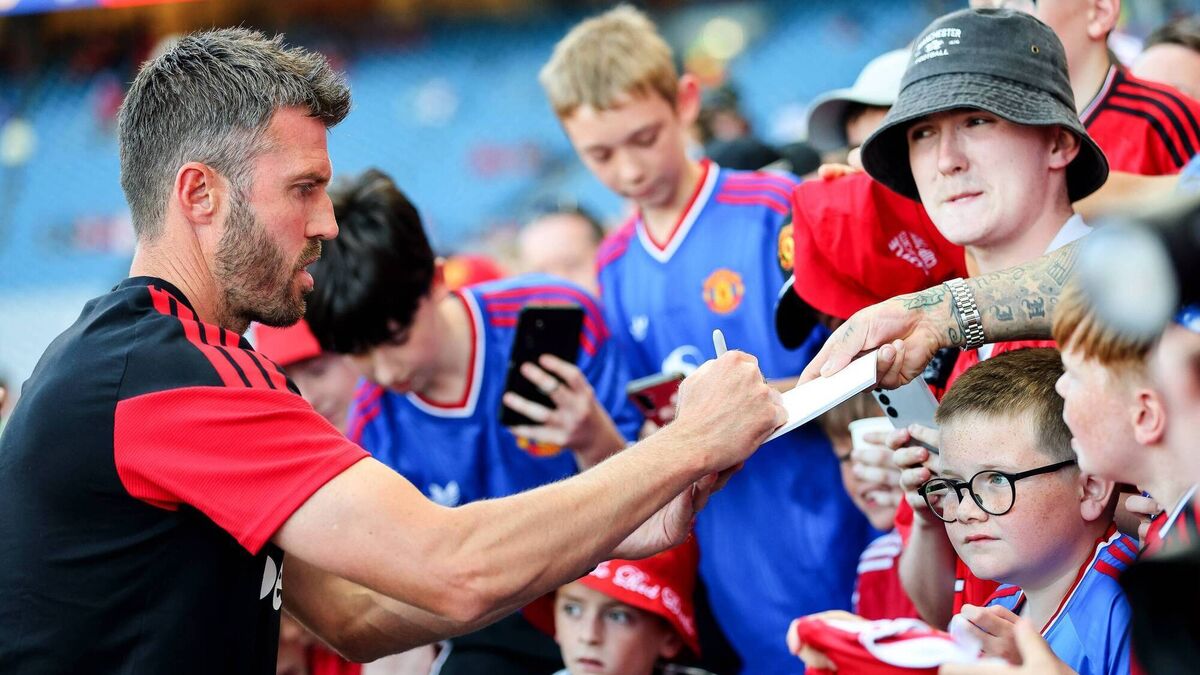
Michael Carrick signs autographs for fans at his side's pre-season friendly against Leeds United at Croke Park last August, when the world seemed full of possibilities for the Manchester United manager. Picture: INPHO/Ryan Byrne
‘Insanity,’ the German-born physicist Albert Einstein famously said, ‘is doing the same thing over and over again and expecting different results.’ Einstein is generally considered to be one of the most intelligent humans to ever grace the planet, yet even he may struggle to conjure up a theory to solve the malaise that has set in at Manchester United. This was on show in full view again last week as the club lurched into another crisis.
Sunday's defeat to Bournemouth was awful, but the real damage was done in the 4-1 Champions League defeat to Como midweek.
The scoreline was generous on a United side that looked utterly listless from the get-go. Lethargic and lacking any semblance of fight, the horror show on the pitch was compounded by Bruno Fernandes’ post-match comments, questioning the tactical approach of his manager, Michael Carrick.
“It's a decision from the staff to not press man-to-man and sometimes leave a little space in behind and try to get the ball in the first moment, to wait for them, to give them the ball,” the Portuguese midfielder said after the game.
“But sometimes when you give too much the ball to these teams they get confident, they have so many bodies behind the ball that make you run a lot, make people get frustrated, and then obviously when you recover the ball the legs are, and the brain, much more difficult to make it work.
"That's on the manager and on the staff to see it, it's not on me.”
Coming just days after Lisandro Martinez was similarly critical of the club’s hierarchy and their transfer policy, Fernandes, as club captain, knows what he’s doing. He was trying to get the manager sacked.
Fernandes’ class as a player is not in question and he was superb last season, deservedly winning the PFA Player of the Year award. But he is not the type of figure that Manchester United need wearing the captain’s armband.
His utterances in that post-match interview in Italy last week underlined that very fact after his body language displayed a real level of petulance during the 90 minutes on the field, too.
Michael Carrick, who at the time of writing is still Manchester United manager, cut a broken figure after that match and went as far as apologising to the United fans in the stands after the game.
Many will question his tactical approach – and rightly so – and his qualification for the job, given his stint at Middlesbrough did little to advance his managerial credentials. But, it’s still hard not to feel sorry for yet the latest victim of a toxic culture at Manchester United. The club has failed to show any sort of desire for long-term planning in the post-Ferguson era.
Like any club, their goal remains to win football matches, but the way in which they wish to do so does not seem to have any sense of cohesion about it. Recent managerial appointments have clearly underlined a lack of unity in terms of the direction of the club on the pitch, as has their work in the transfer market.
As another change in management looms, I find it hard to escape one departure off the field over recent seasons that points to a general air of disfunction at Old Trafford.
Dan Ashworth left as the club’s Sporting Director in December of 2024. It brought an end to a bizarre few months. With his stock sky-high after a productive stint with Brighton and latterly the FA, Ashworth then planned to take Newcastle through an arbitration process before eventually securing his exit from Newcastle to move to Manchester United. Having spent months on gardening leave before eventually taking up his new post, Ashworth then only spent five months in situ before leaving United in a chaotic set of circumstances – his departure cost the club a reported £4.1 million or thereabouts.
Ashworth developed his reputation with the FA as the Director of Elite Development and is widely credited with creating a pathway for talent around England to progress through to the senior team. His work has clearly had a positive impact; England have won the last two European Under-21 Championships and their senior side have remained consistently competitive amongst the top nations in world football for a good portion of the last decade.
Allegedly, Ashworth was unhappy with the appointment of Ruben Amorim as United boss after Erik ten Hag was sacked, owing to Amorim’s religiously held belief of playing three at the back, which was utterly unsuited to the players United had at their disposal at that time.
In hindsight, Ashworth's displeasure at Amorim's appointment was well-founded.
One has to wonder, then, what he and others who have had ideas about long-term stability at Manchester United must wonder about the possibility of Antonio Conte being one of the front runners to fill any potential vacancy at Old Trafford.
The Italian is a winner, having claimed league titles with three different clubs in Italy and a Premier League crown with Chelsea a decade ago. The problem is, however, wherever he has gone, short-term success is soon followed by a major bust up. He has had eleven managerial jobs, yet the longest he lasted in any of them was three years at Juventus between 2011 and 2014. His period at Tottenham was particularly explosive, where an astonishing press conference tirade criticising the club's historic lack of success prompted his departure after less than eighteen months in the gig.
Conte has already fluttered his eyelids towards Manchester with a social media post last week emphasising his availability. United would be best to steer clear of his short termism and also refuse to indulge the possibility of Julian Nagelsmann, who endured an uninspiring spell in charge of the German national team.
Ironically, Dan Ashworth was understood to be keen on appointing Eddie Howe as manager during his short stint at the club. The bookies favourite to succeed Carrick now as the next boss is, you guessed it, Eddie Howe.
Changing manager – again – may well be justified off the back of recent results. But when you consider the last 13 years at Old Trafford, it hasn’t led to much of a change in the trajectory of the club when it has happened before.
History is merely repeating itself again. Insanity.