Panenka’s lesson for Ireland in Prague
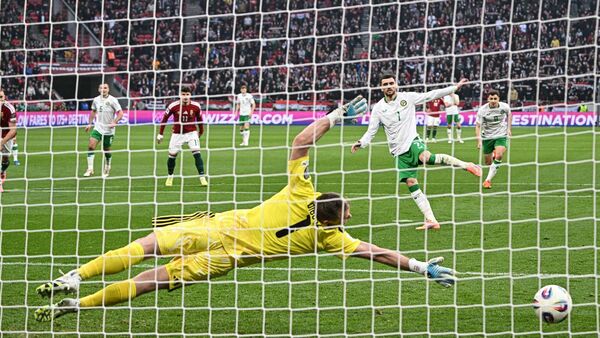
Troy Parrott scores a penalty during the FIFA World Cup 2026 Group F European qualification match between Hungary and Republic of Ireland at the Puskas Arena, Budapest last November. The Boys in Green play Czechia this week in a crucial playoff. Picture: Getty Images
It wasn’t much of a kick.
There was no thunderclap of leather on laces, no convulsive swing of the leg. There was no sense, even, that anything irreversible had just been set in motion. There was just a man in a red shirt, executing a lung-bursting run-up before effortlessly lifting the ball, almost apologetically, into the Belgrade air.
The goalkeeper had already gone, throwing himself to the side with all the dignity of a waiter slipping on a wet floor with a full tray. Because that is what finals ask of you. You pick a corner, you strike through the ball hard and you live with the consequences.
But the ball did not so much travel as drift. It rose softly and dropped into the centre of the goal with the insolence of a man strolling into Mass at the Gospel. For a split second, the stadium failed to react. Even the net seemed unsure whether to ripple.
This was a European Championship final, balanced on the edge of a single kick, and the solution arrived not with force, but with restraint. Not with certainty, but with something far more dangerous – belief dressed up as nonchalance.
Because anyone can strike a ball hard. That’s instinct. That’s what a major moment demands, what it practically begs for. But this was something far rarer. The willingness, in the most pressurised instant imaginable, to do the one thing the occasion explicitly forbids. To resist the noise. To refuse the obvious. To stay soft when everything around you screams for violence requires a particular kind of nerve.
And as a result, Czechoslovakia won the Henri Delaunay Cup.
But that unforeseeable kick also changed the game.
Antonín Panenka would later speak about that night in plain terms. He said that if he had missed, the punishment might have been thirty years in the mines.
This was Cold War Europe after all, where failure could follow you home, where the consequences of public error were not readily dismissed. Czechoslovakia was still living in the long shadow of crushed hopes. Eight years earlier, the Prague Spring had been rolled over by Soviet tanks. Behind the Iron Curtain, a mistake could travel. It could stick. It could follow a man home. So, when Panenka spoke about the mines, he was not reaching for some dramatic flourish. He was speaking from a part of Europe where the cost of failure could feel larger than football.
Today, a missed penalty brings noise. The phone lights up. The mentions fill timelines. Strangers arrive with their verdicts, their outrage and their fleeting cruelty. It is relentless, but it is also weightless and gone as quickly as it comes.
That wasn't the consequence facing Panenka.
The Republic of Ireland, meanwhile, never made it to Euro ‘76. They had been edged out in qualifying by the Soviet Union, the same Soviet side Czechoslovakia would later dispatch on their way to the final – and so the whole thing passed them by at a distance.
At that point, they had never reached a major tournament. And they wouldn’t make it to one for another decade. History, for the Republic of Ireland, was still something happening elsewhere.
And in the end, it all turned on a single touch of a ball.
The penalty has been replayed so often it risks becoming less an act of nerve, and more a familiar trick.
It has become football’s most visible test of composure.
Every season, players stand over the ball and make the same decision. That tension that faced Antonín Panenka hasn’t gone away. You see it in every attempt – the pause, the slight check before contact, the unwilting confidence. It’s a look that tries to project certainty even when the pulse says otherwise. Some take it because they believe the goalkeeper will move. Some take it because they want to look fearless. Some take it because football, more than most games, has always admired the man willing to appear calm in a place of chaos.
That is why the Panenka has outlived the 1976 final. Many who use the term scarcely know where it came from – like quoting Nietzsche after reading his work on Instagram.
Most are lucky to leave with a medal or a story. Panenka left the game with a piece of vocabulary. That is how deeply the act lodged itself in the sport’s imagination. It ceased to belong to that night in Belgrade and entered the game’s bloodstream instead. The years have changed the scenery, but not the test. The crowds are louder now. The analysis is more exhaustive. The punishment is public rather than political. Modern football has made hysteria a cottage industry. Yet the essential question remains simple: when the moment comes, can you stay clear-headed enough to do the thing you decided to do before fear arrived?
The game’s great moments are not always seized by the strongest man, or even the most gifted. Sometimes they belong to the player who can keep his balance while the occasion tries to tip him forward. Sometimes they belong to the one who can hear all the noise, register all the danger and still choose touch over force.
On Thursday night in Prague, the Republic of Ireland may be faced with a similar moment.
For years, Irish football has watched these moments from afar. Form matters, until it doesn’t. Systems matter, until the game breaks shape. What remains is decision-making under pressure. A pass played too early or too late. A finish snatched at. A clearance made with panic rather than conviction. These are the margins that usually decide whether a campaign keeps moving or stops dead.
That is why Panenka still feels relevant. Not because Ireland are likely to need a chipped penalty in Prague, but because his kick remains one of football’s clearest examples of composure overriding instinct. It showed that the defining act in a high-pressure game is not always the most forceful one.
For Heimir Hallgrímsson’s side, that is a useful lesson ahead of this play-off semi-final. The challenge is not simply to compete with Czechia, or to match the occasion emotionally. It is to recognise the moment that matters when it arrives, and to respond to it with control rather than haste.