Nothing gets easier for league’s western pair
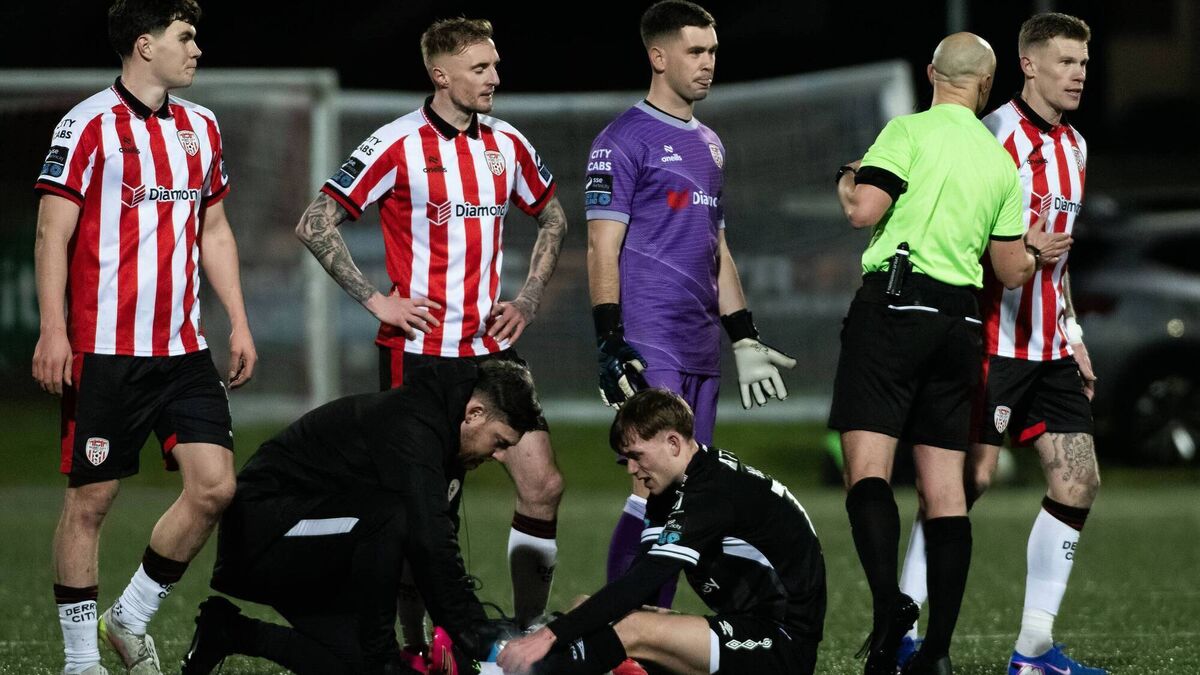
Derry City’s Carl Winchester, James Clarke, Brian Maher and James McClean appeal to referee Neil Doyle after an injury to Sligo Rovers’ Alex Nolan at the Ryan McBride Brandywell Stadium last Friday night. Picture: INPHO/Evan Logan
Much like the weather, the opening weekend of the new League of Ireland season proved to be something of a damp squib. First off, reigning champions Shamrock Rovers had a false start when their meeting with Dundalk was postponed due to a waterlogged pitch on Friday and, then, the marquee event of the weekend failed to ignite as Bohemians and St Patrick’s Athletic played out a nil-all draw at the Aviva Stadium on Sunday.
Unlike last season’s event at the home of Irish football, when Bohs edged out Shamrock Rovers in a game that did capture the imagination, Sunday’s fare in front of just north of 21,000 fans did little to advance the notion that, even though there’s a sense that the league is in a new era, the standard remains average at times.
Maybe it’s a case of the league being a victim of its own success that 21,000 fans in the Aviva didn’t feel like as big an occasion this time around. But, for both sets of fans, it was a terribly frustrating watch.
The action on the pitch never threatened to spark into life and, perhaps, it was down to the poor weather and the fact it was the first game of the campaign, but both sides looked rusty. Both sets of fans were left annoyed by last season’s campaign; they will, rightly, demand a better run of form this season from their respective teams.
The league appears to have three distinct groups of teams this year.
Shamrock Rovers, Derry City and Shelbourne will all harbour genuine ambitions of winning the league title. St Pat’s, Bohemians and Drogheda United will feel they have the ability to certainly make Europe and, with a bit of good luck, make a push for silverware. Then comes the third group of clubs, with Waterford, Sligo Rovers, Galway United and Dundalk all likely to be happy enough with retaining their league status, even if they won’t outwardly admit that at the outset.
Speaking of frustration, John Russell must be tearing his hair out already – and we’re just one game into the new season.
Not only did the Sligo Rovers boss enter the new campaign without two of his best players, with Owen Elding and Patrick McClean both leaving the club in the latter stages of pre-season, he then watched his team concede twice late on at the Brandywell to suffer a scarcely deserved 2-1 defeat to Derry City on Friday night.
City have directed quite significant resources towards this season, with the arrival of James McClean a case in point, but Rovers dominated the exchanges for large periods and were full value for their 1-0 advantage, courtesy of Jad Hakiki’s opener.
To be fair to the visitors, there was little they could do about Derry’s equaliser – a cracking shot from range from Alex Bannon – while Josh Thomas netted a tidy winner in the 91st minute.
For Russell, who is now almost four years into his tenure at the Showgrounds, it is not getting any easier.
The Galway native, who enjoyed an extensive playing career with the club before succeeding Liam Buckley in the middle of 2022, has done an admirable job relative to the resources available to him. Several top players have left the Showgrounds in recent seasons and it will always be thus, with other clubs within the league offering bigger money and clubs from overseas seeking to snap up the best rising talent.
Russell, you can be sure, is aware of the club’s place in the footballing food chain, yet it is also a case of what might be if they could hang on to their best players for an extended period of time.
Rovers’ dreadful start last season was offset by a good finish to the campaign. With just four points from nine games last term, they turned that into a seventh placed finish. I suspect they would snap your hand off for a similar outcome this time around and, on the evidence of Friday night, they look well organised and drilled for the upcoming campaign.
The aforementioned Hakiki is a stylish ball player while Will Fitzgerald has developed into a real leader. Cian Kavanagh led the line in Derry but he faces a big task in trying to replace some of the goals lost by the exit of Elding, who netted twelve times in the league last season.
Unearthing a goal threat will be crucial in the early part of the campaign but that could also be offset by being a tad more solid defensively, with goalkeeper Sam Sargent offering a stable presence in between the sticks on which to build a sturdy defensive unit. However, the loss of Patrick McClean from that area will be keenly felt this season.
With the redevelopment of the Showgrounds on the way in the coming years, retention of top tier league status is absolutely vital so that, when the new ground does come on stream, supporters have Premier Division football to attend.
It might be early days, but there is a sense that the relegation picture this season could have a distinctly western flavour, with Galway United also destined to be in the mix. John Caulfield is a highly experienced manager who has been there and done that in the league, but his squad for this season looks lighter than in recent campaigns.
The vastly experienced Greg Cunningham has retired while Moses Dyer was in flying form last season before leaving the club. His departure didn't help, with United suffering up front for goals in the latter part of the campaign.
A 1-0 defeat to Drogheda United on home turf was a tough one for Caulfield and co. to take last week. This week, they travel to Inchicore for a meeting with St Pat's, where Caulfield will renew his old rivalry with Stephen Kenny.
Like us all with the weather, Sligo Rovers and Galway United will be hoping there are brighter days ahead.