Tooreen can prove that failure isn't always the end
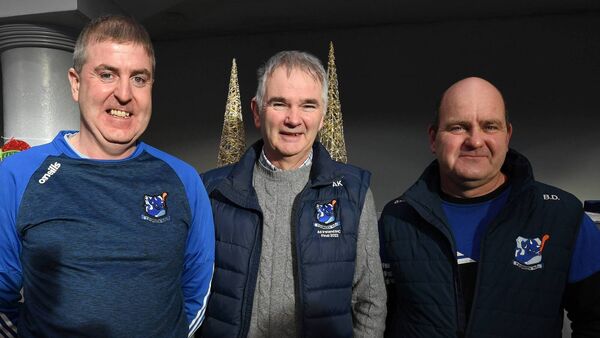
Tooreen Hurling Club officers Pat Freyne (chairman); Austin Kenny (secretary) and Brian Delaney (selector) at their club’s Meet and Greet event in Tooreen Hall last Sunday morning in advance of the AIB All-Ireland Club IHC Final. Picture: David Farrell Photography
Some days in sport are meant to happen once and once only. They arrive after a smorgasbord of small favours – a kind draw here, a bounce there, a season when injuries behave themselves and the timing falls just right. When those opportunities pass, they close the door behind them. All Ireland club finals at Croke Park are like that. You’re allowed in briefly, before the keys are then abruptly taken back.
Most clubs never return. Not because they’re weak or cursed or lacking in courage, but because the road back is too narrow and too crowded with ghosts. Getting to that stage once takes a minor miracle; getting there twice, after it’s gone wrong the first time, borders on the unreasonable. The season that carried you there doesn’t repeat itself. Players move on. Bodies age. Momentum dissolves. And the loss itself tends to settle like sediment, clogging the gears of ambition.
That’s what makes a defeat in a club final so uniquely cruel. You don’t just lose a match; you lose a moment that may never present itself again. Jerseys are folded with the knowledge they won’t be worn there next year. And somewhere in the back of every mind is the unspoken truth: what might have been.
But after losing an All-Ireland decider in January 2023, Tooreen have somehow managed to defy the odds and surge their way all the way back to GAA HQ just after Christmas.
Three years ago, Tooreen spent most of that wintry night in Croke Park being the better team. They built an early lead, maintained it throughout most of the contest and did so with the quiet authority of a side that had judged the occasion correctly. Nothing frantic. Nothing forced. The game bent their way and stayed there.
That’s what made it so cruel when Monaleen made their move. Finals rarely announce the moment they turn. There’s no hooter or rupture – just a faint sense that something has shifted.
Tooreen were still ahead when the ground began to feel different beneath their feet. Monaleen didn’t steal the game; they absorbed it. They waited patiently, until Tooreen loosened its grip on the game. It was the sort of loss that doesn’t fade with time. It doesn’t roar or rage. But memories of that day will have been swirling around Adrian Freeman Memorial Park ever since.
Life resumed. Training nights returned to their usual rhythms. Fields were lined in the same places. And yet the loss will have felt like an extra kitbag nobody remembered packing and yet everybody had to carry.
That’s the part the glossy narratives skip. There’s no catharsis in it. There's just the slow seep of a day that didn’t finish right into all the ordinary days that follow. Every wide in April gets compared to one in January. Every lead surrendered in June carries a faint echo. The past doesn’t shout – it clears its throat at inconvenient moments.
For most clubs, that’s where the story tapers off – not with a collapse, but with a gentle resignation. The sense that something rare was missed and won’t circle back. Players drift. Seasons blur. And perhaps worst of all, nothing about the club game is forgiving. It doesn’t offer grace periods or second chances. It doesn’t pause while you process disappointment. It simply moves on, dragging everyone with it, whether they’re ready or not.
That’s why these defeats usually harden into baggage rather than fuel. They don’t sharpen ambition; they blunt it. They turn ambition into caution, memory into restraint. Most clubs don’t fail at Croke Park and return wiser. They fail there and return older.
What’s striking about Tooreen’s return to Croke Park isn’t just that they survived the disappointment of 2023, but that they seemed to have developed as a team. This isn’t the same team that walked out of Croke Park three winters ago carrying a narrow defeat and a heavy heart. It’s a team that has quietly edited itself into a greater version of itself.
The edges are sharper now. While the 2023 side played with fluency and courage, this one plays with judgement. That was clear in their convincing semi-final win over Éire Óg, Carrickmore. There’s a better sense of when to lean into a game and when to step back from it. There's less urgency for urgency’s sake, less of that restless need to prove the day belongs to them. They look more comfortable in themselves.
Recent performances have had the feel of a team that understands that leads are no longer invitations to press harder, but responsibilities to manage. There’s patience where there might once have been haste; control where there was once momentum. The scoring bursts still arrive, but they’re timed now, released like something held back rather than stumbled upon.
That’s the subtle difference between a team that reaches a final and one that returns to it. The former is fuelled by momentum and mood. The latter is defined by learning. In that sense, this run hasn’t been about exorcising 2023 at all. It’s been about outgrowing it.
When the club walks back into Croke Park this weekend, they won’t be trying to fix January 2023. They’ll be applying the lessons that were taken away from that night. And that, quietly, is what makes them a more dangerous proposition than the team that got there the first time.
There’s a tendency in sport to treat failure as a verdict rather than a draft. Before becoming US President Abraham Lincoln famously lost elections, lost jobs, lost money, lost standing in his own community. He was viewed as an out-and-out failure by everyone that knew and heard of him. He failed so publicly and so often that by the time he finally rose to power, the surprise wasn’t that he succeeded, it was that he’d stayed motivated long enough to finally succeed.
Those failures didn’t disqualify him. They calibrated him. By the time the moment arrived that mattered most, he had already been sanded down by disappointment, stripped of illusion and taught the patience that power requires. What looked like a catalogue of failures turned out to be preparation in disguise.
There’s a quiet parallel here for the East Mayo club. Abraham Lincoln spent years being told he wasn’t good enough before becoming perhaps the greatest president the United States ever had.
Tooreen, too, can prove that the right kind of failure doesn’t end a story, it earns the right to continue it.