This isn’t bonus territory, this is a real chance
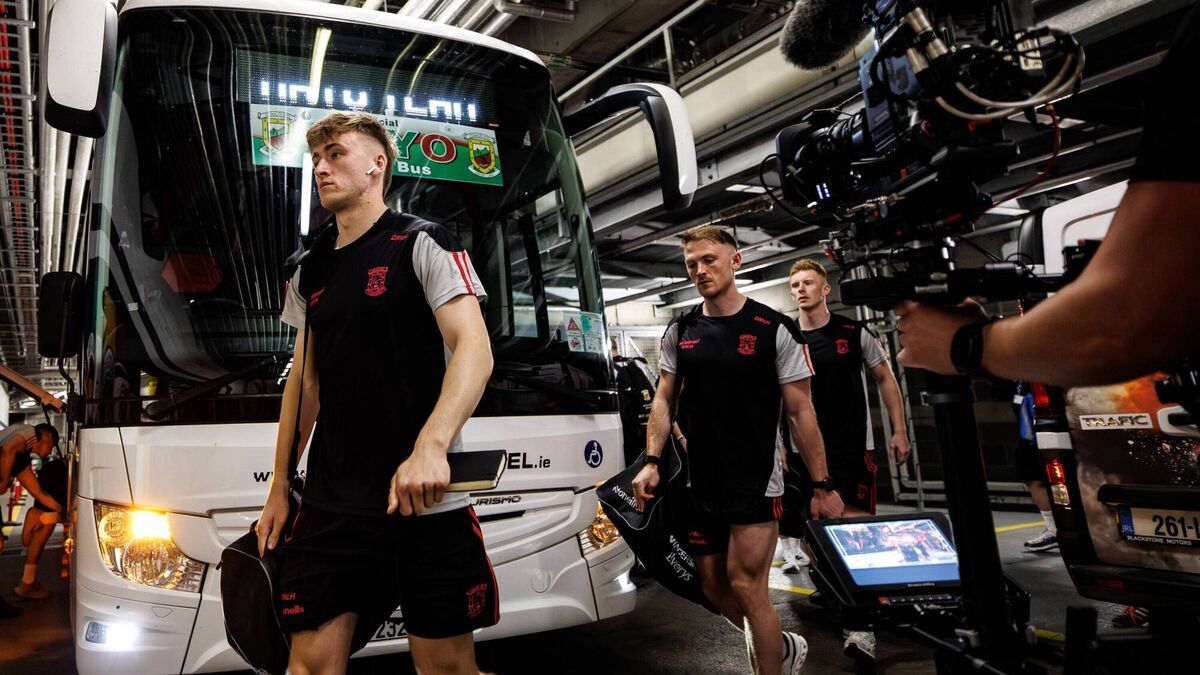
Mayo defender Donnacha McHugh, followed by injured vice-captain Darren McHale and David McBrien, arriving to Croke Park ahead of the All-Ireland SFC semi-final victory over Louth. Picture: INPHO/James Crombie
It’s not that long since a Gaelic football discussion lit up social media.
It wasn't yet another tedious debate about championship structures, or the intercounty calendar, or refereeing, or the 'new' rules that really aren't that new anymore.
Rather, it was something different – what was the best ever individual performance by a player in a losing team.
Plenty of options were put forward with a strong case being made for Diarmuid Connolly's tour de force for Dublin in the 2014 All-Ireland semi-final against Donegal.
But, given the context of the game involved, it was agreed that nothing would match Bernard Flynn's performance for Meath when they lost the 1991 All-Ireland final to Down.
The context? This was a decade before the advent of the qualifiers or All-Ireland quarter-finals so you could conceivably get to the All-Ireland final having played just three or four games.
But Meath needed four games to get past Dublin alone. They needed another replay to beat Wicklow.
In the All-Ireland semi-final, Meath had to come from seven points down to see off Roscommon.
Colm O'Rourke was one of their key men but couldn't start the All-Ireland final because of pneumonia. Robbie O'Malley, one of Meath's most important defenders, was out with a broken leg.
A cagey enough start to the game just paved the way for a Down avalanche. Between the 19th and 47th minute, they outscored Meath by 1-9 to 0-1.
But Down only ended up winning by two points. O'Rourke made an impact off the bench, Liam Hayes got an important goal, Gerry McEntee was a colossus in midfield, but the main reason why Meath got so close was Flynn.
He ended up with six points from play. Flynn was unplayable that afternoon in Croke Park.
Flynn was one of the main reasons why Meath won All-Irelands in 1987 and 1988. When they won their last Sam Maguire under Sean Boylan – in 1999 – one of the main reasons was Ollie Murphy.
What do Flynn and Murphy have in common? Both were corner-forwards.
Why does that matter? I can't help thinking of a conversation with Andy Moran in 2021. In my job at the time with the , I had arranged an interview with Moran. He had retired from playing for two years and had dipped his toes in the coaching waters with Ballaghaderreen and the Mayo Under-20s.
A few months after our chat, he'd take the reins with Leitrim but, at the time we talked, Mayo were on his mind, and there was something nagging at him.
“We in Mayo are obsessed with right and left half-backs, because we trust hard-working people and players. The Mayo nature is to go as hard as you can for as long as you can,” he said.
“You look at the Donie Vaughans, Lee Keegans, Paddy Durcans, the list goes on and on — Fergal Costello, Noel Connelly, they are our sort of players, but why aren’t we producing 13s and 15s?
“You look at Kerry. They are producing Mikey Sheehy, Maurice Fitzgerald, Colm Cooper, David Clifford. They trust the talent. At 14 and 15, are we trusting that talent?''
Five years on, Moran is the Mayo manager and preparing for an All-Ireland manager. One of the main reasons why they are still standing is the form of Darragh O'Beirne and Kobe McDonald.
A 13 and a 15. When I spoke to Moran, O'Beirne was 14 and McDonald was 13. It seems the trust in young attacking talent that Moran craved was there.
Remember all that guff from the 2010s about Mayo not having a 'marquee forward', whatever that is. Nobody says that anymore but upsetting Kerry could depend on their back six and goalkeeper Jack Livingstone.
Between 1971 and 1973, Ajax won three European Cups in a row.
That was the Ajax of Johan Cruyff, Ruud Krol and Johan Neeskens – one of the greatest teams soccer has ever seen.
The goalkeeper for all of those victories was Heinz Stuy who, strangely, never won a cap for Holland.
He has the distinction of being the most decorated club player never to have played international football.
Instead, Holland looked to Jan Jongbloed of unfashionable FC Amsterdam – and he played in both the 1974 and 1978 World Cup finals.
Jongbloed was only 5'10, but Cruyff always put pressure on successive Dutch managers to pick him because of his football brain.
By 1981, Jongbloed was 40, and few felt he had anything left to offer.
Not Cruyff, though. “I still think Jan is always incredible value for a team,” he said.
“You can never take away a person's vision and goalkeeping at a high level is largely a question of vision.
“Goalkeeping isn't just about saves and anticipation. It's also about initiating attacks.” That was never really part of a Gaelic football goalkeeper's job description for decades, but it's very much the case now.
Winning the kick-out battle has never been more important. Much depends on the players in the middle eight, their movement, physicality and willingness to scrap for breaking ball. But if your number one's kick-outs aren't on point, you're facing an uphill battle.
Moran has shown he isn't afraid to make big calls. Putting Livingstone between the sticks was one major one. Let's hope he has a big game.
During my time with the , James Horan was a columnist and he's a man who knows all about preparing Mayo teams for All-Ireland finals and to face Kerry in big games.
I was the ghostwriter of Horan's column and something he told me in 2015 has stayed with me.
“When you take on Kerry, you're not just taking on 15 men,” wrote Horan.
“You're taking on the weight of their tradition, the clout of ex-players talking them up in the media and the impact which that can have.
“Definitely with Kerry, it's as if there's an unwritten rule where everyone rows in behind the Kingdom juggernaut.” If Kerry win, it will be a landmark All-Ireland – their 40th. And it's nearly two decades since Kerry retained Sam. So they will be fired up, and they tend to perform in All-Ireland finals, even when they lose.
Many feel Mayo are in bonus territory and have a shot to nothing. David Brady has put forward the view that this bunch have to lose one to win one. I don't buy that at all.
Go through the list of breakthrough or unexpected All-Irelands in the modern era. Down in 1991, Donegal in 1992, Derry in 1993, Armagh in 2002, Tyrone in 2003, Donegal in 2012, Armagh two years ago. None of those teams were fuelled by the hurt of a losing All-Ireland final.
McDonald may never play for Mayo again after Sunday. Beirne may never play in an All-Ireland final again. That's the reality. There are never any guarantees of another big day out.
So I'll leave you with the words of Seamus Heaney from his long poem 'Station Island'.