Ruairí is ready to transform the future of a county
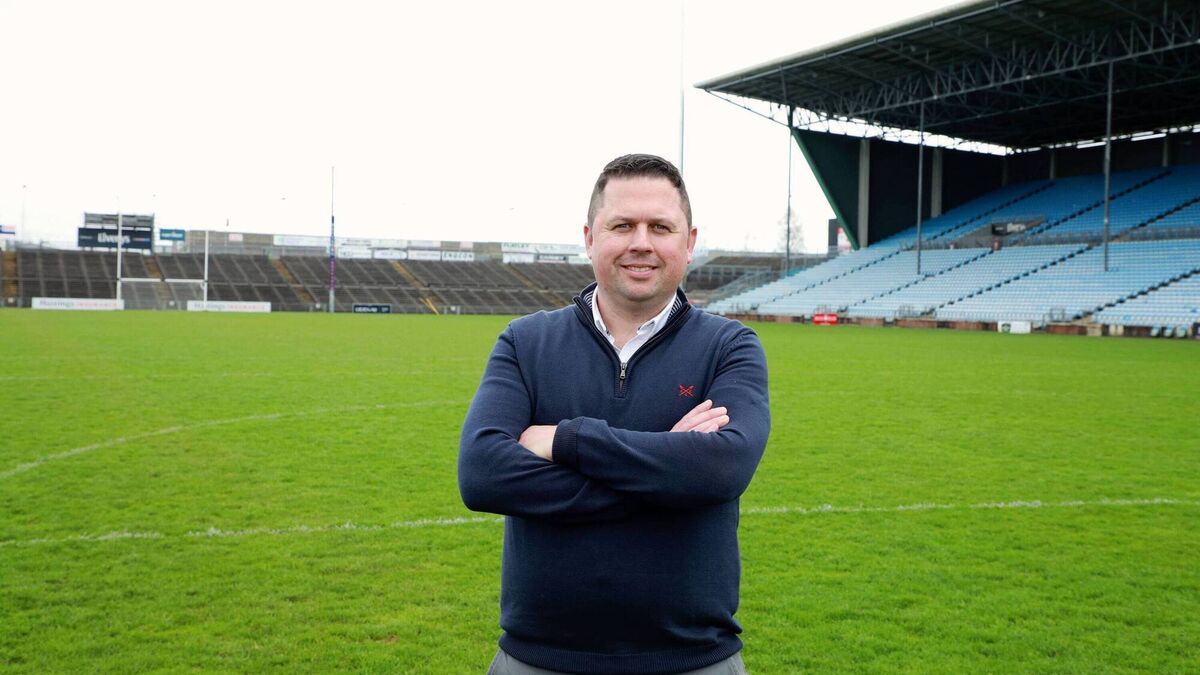
Ruairí Conroy has officially begun his role as chief executive officer of Mayo GAA.
Ruairí Conroy says it was a love of fly fishing that inspired his father to move the family from Castlebar to Tourmakeady in the 1980s. 30 years later it was a want for their children to experience that same sort of idyllic rural childhood that Ruairí and wife Rita decided against extending their Greystones home and to move lock, stock and footballs from east coast back to west instead.
But 11 years later the decision is one that Ruairí Conroy has never regretted.
He hopes the same will be true of his decision to accept the job as Mayo GAA’s first ever chief executive.
“A leap of faith? Yes it is, but would I have regretted for the rest of my life if I didn’t throw my hat in the ring for the role? I absolutely would have,” says Conroy, who took office earlier this month. He left behind a role as vice president of global sales development at US software company Diligent after a 20-year career in the tech industry that began with Google.
“I definitely thought long and hard about it but I suppose I want to be involved in something that can live long into the future and something I'm personally very passionate about.
“The way I look at it, the world has changed dramatically and communities have never been more fractured around the world than they are today but one of the very few things that hold communities together in this country is the GAA. There’s very few things an eight and 80-year-old have in common and for me that is the essence of the GAA. The volunteers turning up on Sunday morning with the under-8s and everything that goes into it, that’s what it’s all about.”
Mayo County Board is following in the footsteps of only Dublin, Cork and Tipperary in appointing a full-time chief executive officer to oversee its affairs. With the demands upon volunteers within the GAA ever increasing, chairperson Seamus Tuohy described the appointment as coming “at a critical time” for Mayo GAA. Ruairí Conroy is in agreement.
“It will be providing a professional arm at both a county level, but also supporting the clubs and associated volunteers as to how, from a professional perspective, we can support them to be able to run their own operations as effectively and efficiently as possible, to be able to attract and engage and appreciate the volunteers that we have to ensure that we’re continuously addressing that pinch point, which is the volunteer strain,” explains Conroy who himself has been actively engaged as a coach with Tourmakeady GAA club for the past decade having previously played for the club from under-10s right up to senior.
“These pressures are at board level too and that's where my role is; very focused on overseeing the strategic and sustainable commercial operations to help ensure that we navigate and bring to the forefront, Mayo GAA, from a county perspective.
“I've been super impressed at just how open-minded the county board and the executive have been in terms of wanting me to understand everything before making a decision or recommendation as to what needs to be done.
“Ultimately, it's about ensuring you have the right culture, you have the right values, and you have the right prioritisation because there's 100 things we could be doing maybe today, but there's one of them that's much more important than the rest. So taking the time to understand what is important and ensuring that we prioritise rigorously those things that matter most, that’s why I've spent a lot of time over the last couple of weeks out with the clubs.”
Ruairí Conroy has already held workshops in the north, south, east and west divisions, the chief purpose of which has been to gauge the feelings of Mayo GAA’s rank and file on where the county is, where they think it could be, the challenges and threats to clubs, their ambitions – “if we’re at our absolute best in ten years’ time, what does that look and feel like?” – and their core values.
“They have been incredibly eye-opening,” says the 45-year-old. “I think one of the biggest untapped resources we have is working with each other as clubs. We might compete on the pitch but off the pitch we’ve got so much more in common and I was really encouraged to see that brought to life in front of me over the last few weeks.
“The nucleus of what came out is that volunteering needs to be kept at the core of what we do, retaining the volunteers we have, ensuring that we appreciate them and that we make the experience an enjoyable one, where they want to stick around.
“But there’s also the big challenge of how do you attract a 20-something-year-old volunteer that has maybe looked at mam or dad or their aunt or uncle who's been a volunteer all their life but who feel they can't commit the same so end up doing nothing, often because they don't want to let people down. This is where modern volunteerism needs to continue to evolve within the GAA: how you give people an opportunity to get involved without necessarily having to commit for the next 10 years of their life.
“I don’t think the healthiest clubs and counties out there are measured by silverware, they are measured by engaged volunteers, participation numbers, and the end product of healthy clubs are good strong communities.
“Ultimately, clubs, volunteers, supporters and players must be at the core of everything we do. And if we're putting plans in place or strategies, whether they’re to drive commercial growth, or they’re from a systems improvements perspective or automation perspective, whatever that kind of investment might be, it can’t lose sight of that key audience of ours, which is the clubs, the volunteers and the supporters,” stresses the CEO.
Despite not reaching the All-Ireland SFC quarter-finals in 2024 or 2025, the financial income of Mayo GAA County Board at the end of last year had jumped 11% on the 12 months before to just over €4.2million, which was driven by a 21% increase in gate receipts and a 30% increase in sponsorships and TV rights. Ruairí Conroy believes however there is not only scope to enhance existing deals but that Mayo GAA can begin to create new commercial partnerships that start to focus a little differently than traditional GAA sponsorships, taking a lead from the likes of Connacht Rugby.
“A major piece of our evolution will be that digitisation of how supporters and businesses all around the world can feel connected to Mayo, to their clubs, to their county, feeling that they have a voice in terms of giving feedback, and also feeling that they have access; that they might be sitting in Dubai but feel like they know how the team are and how they’re getting on.
“There’s lots of different ways, both online and offline, that we’re exploring to see how our supporters and our business partners can get closer to the team and to our vision of what we’re trying to build, which again, at the core of it is going back to improving our volunteer experience, improving our communities and doing that through the avenue of healthy clubs that are flourishing.”
While oft times the main revenue driver, senior inter-county teams have also become sponge-like in terms of the amount they take to finance year on year. That is a problem far from unique to Mayo GAA, but in Mayo County Board’s case in particular, between their inter-county teams at all grades, their responsibilities towards club activities, the substantial debt that remains following the MacHale Park redevelopment, the €16million-plus plan to develop a Mayo GAA Centre of Excellence, plus the growing number of paid employees, there is a tremendous balancing act to be struck in terms of the distribution of its income and the transparency thereof. Ruairí Conroy says that as CEO, he’ll be committed to demonstrating to supporters and sponsors from across the world exactly where their money has gone and what is has been used for.
“As we develop these new opportunities to get behind the county, whether it's an individual supporter, a membership program or whether it's a business partnership, I’m very keen that there’s a real purpose behind that initiative in terms of where money raised is going to impact; that at the end of the year we are able to say this is the difference it made.”
He says that while a major focus will inevitably be on raising funds to establish the Centre of Excellence in Bohola, it’s also his plan to introduce revenue streams that allow supporters and businesses an “eyes wide open” level of control with their donations so that they could, for example, “siphon off some of that money into grassroots” and “fund what is most important to them as a person or a business”.
“I’m very committed to doing that, it’s the way that I operate too. If I’m giving something, I’d like to know where it’s going and the difference it makes. And I think that’ll be a big role for me to play, to help tell that story in as transparent a way as possible. And then at the end of it, this is the impact it had.”
Conroy could have built that house extension in Greystones and stayed east – “it’s probably not too controversial to say that there’s probably more professional opportunities in Dublin than there might be living in Mayo, but that isn’t what we wanted” – but instead is now entrusted with the development and delivery of one of the greatest GAA infrastructure projects west of the Shannon. One thing he is very strong on however, is that the clubs of Mayo will not end up burdened by the Mayo GAA Centre of Excellence and that actually, the facility will be financially self-sufficient. Indeed Conroy says he has already made the long-term commercialisation of the CoE a requirement of the tendering process.
“What is Bohola in five or 10 years’ time after you open it up? Is this a big structure with loads of pitches? You could do that, but what I really want to think about is, we’re going to have a very important and very large investment made and that investment, in my view, should be able to wash its own face and generate income to ensure it stands alone on a balance sheet to service itself, to upgrade itself, and to ensure that we protect any risk of financial burdening going back into the clubs.
“I’m expecting to see that coming back from the tendering process; different ideas and initiatives of how the infrastructure on the Bohola site can help us monetise on an ongoing basis and ensure that beyond just a games perspective, it’s a hive of activity from 9 to 5 Monday to Friday.”
Submissions by five separate tenderers for the project are imminent, according to Ruairí Conroy, and independent professional experts have already been engaged to support the process of deciding on the preferred tender, which it’s expected will have happened by the end of summer.
“The expectation then is that we work with that successful tenderer on a final plan and their vision for the Centre of Excellence. We’ll build on that vision to the point of going for planning permission and the expectation is that we’re breaking ground in early 2027.”
While there is no timeline for an opening date, Conroy says the intention would be for a phased approach whereby facilities come on stream “on a periodic basis” as the construction of the Centre of Excellence hits its milestones of completion.
“Bohola’s going to be a club facility as well, it’s not purely going to be for only the elite teams,” he stresses. “Like we have huge challenges in the county because of the split season. With the weather conditions as you're hitting into September, October, November and deeper, the Centre of Excellence is going to give us an opportunity to run a predictable schedule of events at both club and county level. That’s a huge asset for everyone.”
And something that can live long into the future, just like Conroy intended it.