Mitchels can't afford to blink against Galway’s great escape artists
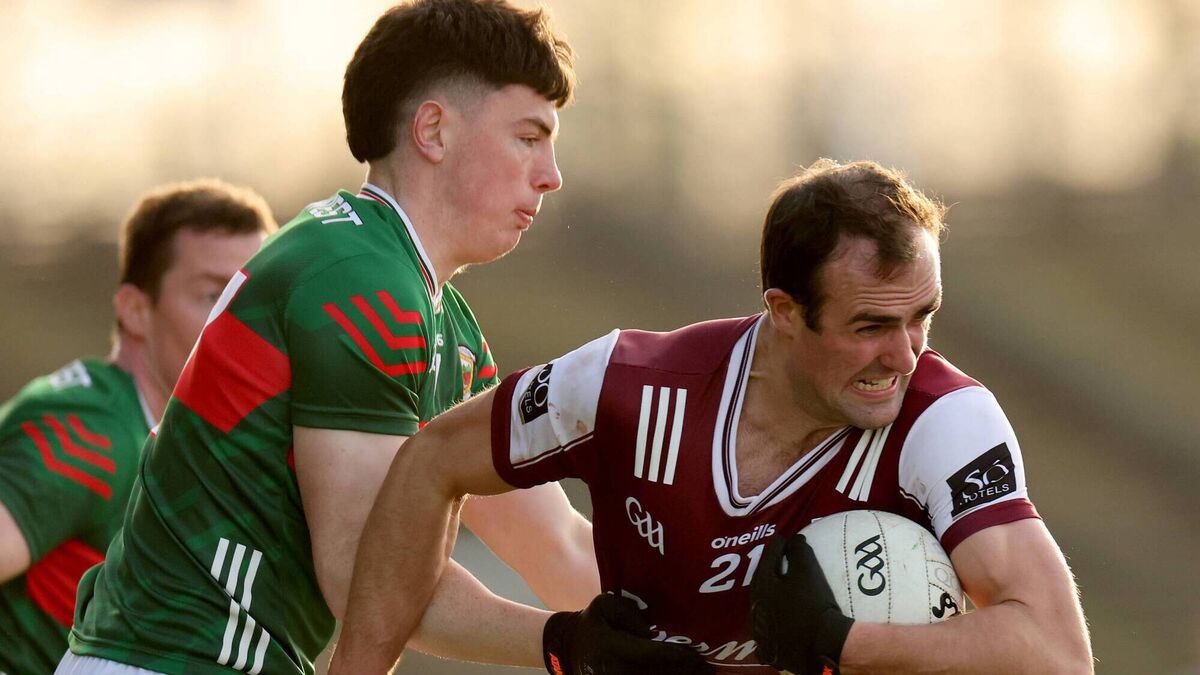
Mayo’s Bob Tuohy and John Maher of Galway will swap their county jerseys for their club jerseys next Sunday when the midfielders come face to face in the AIB Connacht Club SFC Final clash of Castlebar Mitchels and Salthill-Knocknacarra. Picture: INPHO/James Crombie
Sport can be a cruel business, but few men have ever suffered the indignity of having their worst moment cast in bronze for the world to admire.
John Landy has.
On a sweltering afternoon in Vancouver in August 1954, the Australian was hurtling towards the finishing line of what would become known as the Miracle Mile. More than 35,000 spectators had gathered at the Empire Stadium to watch two of the fastest men on earth settle a question that had captivated the athletics world. Landy was leading. Roger Bannister, the Englishman who had first conquered the four-minute mile, was somewhere behind him.
Three laps had come and gone. The lungs were burning. The legs were screaming. And with barely 90 yards separating him from glory, Landy committed a tiny, almost imperceptible act of self-sabotage.
He looked over his left shoulder.
Unfortunately, Bannister was coming on his right.
In a fleeting moment of misfortune, the Englishman swept past his rival and into immortality. Landy was left with a silver medal, a broken heart and a photograph that would eventually inspire a bronze statue in Vancouver, capturing the precise moment his race unravelled.
The Australian, mercifully, retained his sense of humour. Lot's wife, he observed, had been turned into a pillar of salt for looking back. He was probably the only man ever turned into bronze for doing the same. Ordinarily, a moment of sporting misfortune earns a man a fortnight of merciless slagging. Landy got a monument that still stands over 70 years later.
It was a rather extravagant punishment for one momentary glance. But sport has always been merciless towards those who lose sight of what is directly in front of them.
Landy's fateful glance lasted scarcely a heartbeat. But as Salthill-Knocknacarra have demonstrated twice in recent weeks, a heartbeat can be an awfully long time in sport.
In the Galway county final, Maigh Cuilinn were on the cusp of glory when Tomo Culhane conjured a goal from the dying embers of the contest, snatching a one-point victory for his side. Then came St Brigid's in the Connacht semi-final. Once again, the Galway champions found themselves staring down the barrel of defeat. Once again, the clock was running out. And once again, somebody produced a moment of improbable brilliance. This time it was Mark Mannion, whose magnificent two-pointer on the stroke of full time turned another apparent defeat into a one-point victory.
Twice in the space of a few weeks, the Galway club have escaped the jaws of defeat with seconds to spare.
Once might be attributed to good fortune. Twice suggests something more deeply ingrained in their collective temperament. They have an almost unnerving refusal to accept the verdict of the scoreboard, and an uncommon ability to punish the slightest lapse in concentration when the finishing line is in sight.
For Castlebar Mitchels, that presents a peculiar psychological conundrum. It's difficult enough to beat a good football team. It's another thing entirely to beat one that has developed an apparent immunity to despair.
And therein lies the real danger for the Mayo champions. Salthill-Knocknacarra’s reputation now precedes them. The Galway champions have become rather accomplished practitioners of the last-minute heist, and the knowledge of what befell Maigh Cuilinn and St Brigid's will surely be lurking somewhere in the Castlebar subconscious if Sunday's final enters its closing stages with the result still in the balance.
There is a curious frailty in the human mind when victory comes into view. The closer a team gets to the finishing line, the more conscious it can become of the possibility of stumbling. Players who have spent the previous 55 minutes playing with conviction suddenly become custodians of a lead they're terrified of surrendering. Passes grow tentative. Decisions become hurried. The clock, previously an irrelevance, becomes a mortal enemy.
Salthill-Knocknacarra, meanwhile, have every reason to regard those dying minutes with a peculiar serenity. They've been there before. They've stared defeat in the face and found it remarkably accommodating. And with the two-point arc capable of reducing a comfortable advantage to a nervous twitch in the space of a single kick, no lead is quite as impregnable as it might once have appeared.
Perhaps the Galway champions’ greatest weapon isn't their ability to conjure extraordinary scores at the death; it's the knowledge, planted in the minds of their opponents, that another one might be inevitable.
And as Landy discovered all those years ago, the moment you become more preoccupied with the man behind you than the finishing line ahead, you're inviting trouble.
That being said, there is another way of looking at Salthill-Knocknacarra’s recent exploits. For all their remarkable resilience, the Galway champions have been flirting with disaster so frequently that one wonders how much longer they can expect to emerge unscathed. There's something admirable about a team that refuses to accept defeat. But there is also a fundamental flaw in the business of miraculous escapes. Sooner or later, you encounter a predicament from which there is no way out. The trouble with celebrating an escape artist is that nobody ever asks quite enough questions about how they keep ending up in handcuffs.
Castlebar Mitchels have taken a rather different route to this Connacht final. Their eight-point victory over Garrymore secured a first Mayo title in nine years, before Fulham Irish were dispatched by 13 points in London. Neither performance required a last-minute act of divine intervention. They were victories built on quality and conviction and the assurance of a team increasingly comfortable in its own skin.
And the Mayo champions have enough accomplished footballers in their ranks to justify that confidence. These are not men who should be unduly troubled by the prospect of a difficult final five minutes.
Of course, their opponents will have their moments. They possess too much quality and too much conviction to be dismissed as mere beneficiaries of good fortune. But their late heroics should serve as a warning to Castlebar, not a prophecy of what is to come.
There is a danger in granting an opponent powers they have yet to demonstrate against you. And Castlebar Mitchels have the experience and the advantage of playing on familiar ground at MacHale Park. More importantly, they have accumulated enough evidence over the past few months to trust themselves when the pressure is greatest.
Not every great victory requires a grandstand finish. Sometimes the most impressive thing a team can do is deny the opposition the opportunity to write one.
And after all the late drama Salthill-Knocknacarra have provided this autumn, Castlebar will be perfectly happy to deliver an anticlimax.