Mayo saved by Livingstone's Hand of God
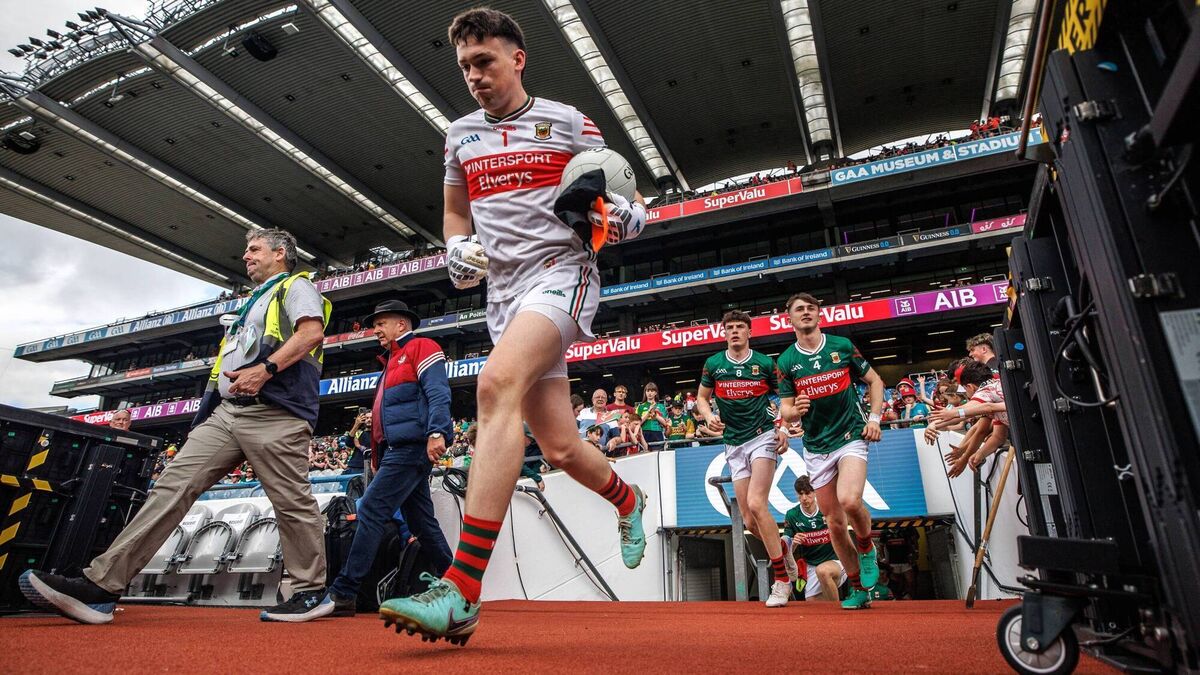
Mayo goalkeeper Jack Livingstone takes to the field in Croke Park ahead of last Saturday's victory over Cork in the All-Ireland SFC quarter-final. Picture: INPHO/James Crombie
Brian O'Driscoll rose beneath a ball that seemed to hang over Croke Park like a seagull caught in an updraft. There wasn't another soul near him as he gathered the ball as effortlessly as a whale breaching the Atlantic, before dropping back to Earth with the game suddenly opening at his feet. His boots had hardly settled back onto the turf and the ball was already gone, slipped into the hands of a teammate with the urgency of a man who sensed the tide beginning to turn.
From there, Cork jerseys ran into the heart of a Mayo defence that had become momentarily unstructured.
For much of the second-half, Mayo's defence were stubborn and disciplined. They tackled with patience rather than panic, shuffled across the pitch with precision and closed doors that, earlier in the championship, had too often been left ajar. But even the strongest walls can lose a stone and fall apart. For one fleeting passage, the shape loosened. O’Driscoll’s run went unchecked. Cork, sensing vulnerability, attacked the crack before it could be sealed again.
Conor Corbett became the decoy, drawing Mayo jerseys as though stitched to invisible threads. Defenders shuffled. Heads swivelled. The shape that had held firm for much of the second-half opened by the width of a shoulder. O’Driscoll drifted towards a gap outside Corbett, and waited for the game to find him again.
It did.
The return pass arrived perfectly into his stride. There was no settling touch, and no glance towards the posts. He simply trusted his instincts and lashed through the ball with the kind of conviction that empties lungs in packed stadiums. It climbed viciously, screaming towards the roof of the Mayo net.
Jack Livingstone had no right to stop it, even if it was the right height for him.
Goalkeepers are taught to make themselves big and narrow angles. But there comes a point when a shot is struck too cleanly and fiercely to ask anything of the man on the line. The Breaffy man nevertheless planted his feet, threw up a left hand and held it as firm as an oak branch in a winter gale. The ball exploded off his palm and away to safety.
The moment was quickly forgotten, but it was the defining moment of the game.
Had O'Driscoll’s effort nestled beneath the crossbar, the teams would’ve been level. More importantly, the momentum of the contest would’ve swung instantly. Cork would suddenly have found themselves charging downhill with belief coursing through every attack. Mayo, who were finally putting daylight between the sides, would have been left staring into the familiar abyss of doubt.
Instead, Jack Livingstone closed the door and quenched hope.
Within moments, Mayo were breaking towards the Canal End and had won a free. Ryan O'Donoghue split the posts from a straightforward free and what had threatened to become a siege instead became a procession. One moment belonged to Cork. The next belonged to Mayo. Sometimes the distance between those two realities is nothing more than the width of a goalkeeper's palm.
Yet that is the peculiar fate of goalkeepers. Their finest work rarely survives in the memory as vividly as a score. Fans and pundits recount the two-pointers, the audacious catches and the impossible angles from which forwards somehow manufacture points. Saves, meanwhile, have a habit of disappearing into the spaces between those stories.
Less than five minutes had elapsed when Livingstone was first called into action on his Croke Park debut. Chris Óg Jones found himself in on goal after Cork sliced through Mayo’s spine. The effort was instinctive, drilled low towards the goalkeeper's right, the sort of strike designed to disappear into the corner of the net before a goalkeeper can get to the ground. Livingstone got there anyway. He flung himself to the turf, reached down with a strong right hand and diverted the ball away from danger.
From a goalkeeping perspective, it may even have been the finer save. It demanded explosive speed, flawless footwork and immensely sharp reflexes. But the stop from O'Driscoll demanded something different. It demanded incredible composure at a critical moment.
There is a temptation to think of goalkeeping as a position built on reaction, but the very best rarely look hurried. They don't fling themselves about in desperation. They arrive where the ball is going to be, hold their shape for a fraction longer than seems possible and trust that good positioning will make the impossible appear routine. Livingstone's greatest quality isn't simply that he saves shots – it’s that he rarely looks surprised by them.
Four championship appearances is barely enough time to learn your teammates’ names, never mind putting yourself at the front of the All-Star queue. Yet here he is. More than anything, he has brought a quiet certainty to a defence that, only a few weeks ago, too often looked like it was always in survival mode. Great goalkeepers steady the pulse of everyone in front of them.
There is a reason children spend evenings pretending to be the player who kicked the winning score rather than the goalkeeper who prevented the losing one. The names that echo longest are usually attached to moments of attack – the impossible point from the touchline, the goal that shook a stadium, the catch that seemed to defy gravity. They are the images replayed on television, framed on clubhouse walls and recounted in pubs for years afterwards.
Yet championships are just as often built by quieter acts.
A hand held firm. A foot planted in the right place. A decision made in the split second between instinct and panic.
Livingstone's afternoon contained two outstanding saves. The first from a Jones shot displayed every quality a goalkeeping coach would want to bottle – speed, sharp reactions and flawless technique. The second, from O’Driscoll’s rasping effort, looked almost understated by comparison. There was no sprawling leap or acrobatics. It was built instead on impeccable positioning and the sheer strength of a left hand that simply refused to buckle.
Darragh Beirne deserved every ovation. Kobe McDonald waved his wand and left everyone speechless. Ryan O'Donoghue once again carried the burden of leadership with distinction.
But sometimes the most important touch in championship football is the one that leaves the score exactly as it was.