Mayo pay the price for their passive approach
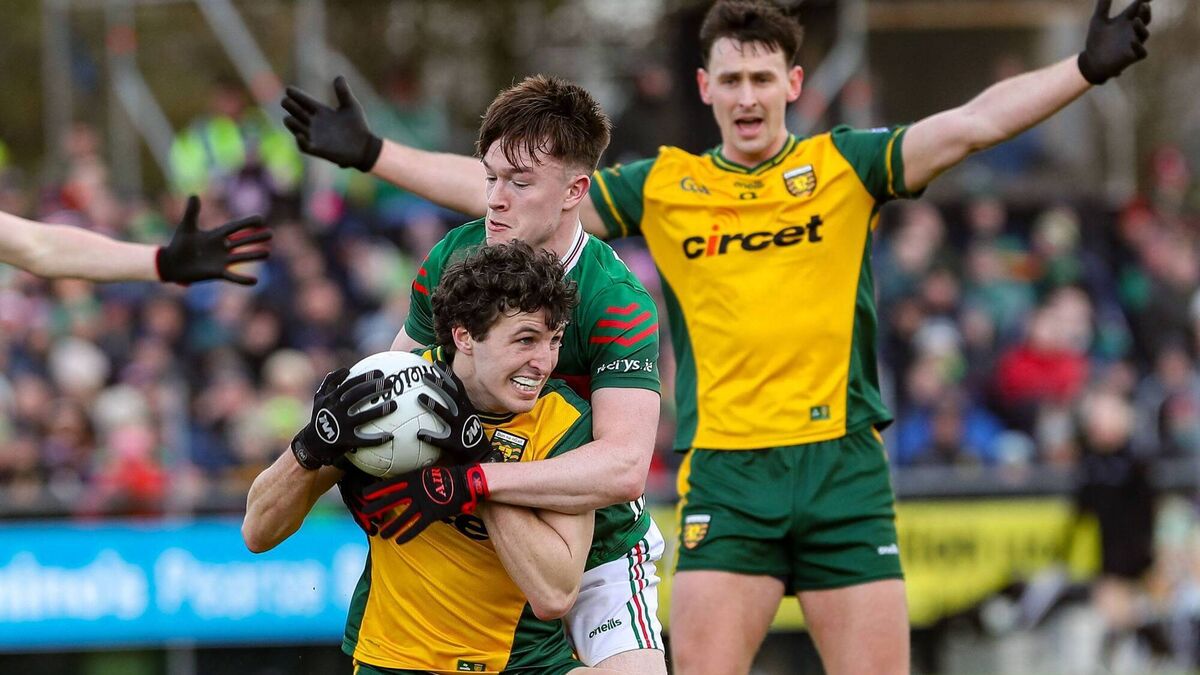
Donegal wing-back Finnbarr Roarty is tackled by his opposite number Fenton Kelly of Mayo.
Fourteen years ago, Mayo travelled north to Ballyshannon and were on the receiving end of a chastening defeat by Jim McGuinness’ Donegal.
The final scoreline read 0-17 to 1-7 but that was kind to a Mayo team who had an extra man for almost half an hour yet only scored two points in the second-half.
“We were terrible in every aspect of the game. We got a bad beating today and we need to react the right way to it. It could be a thousand little things. We will have to figure it out. But when you put in a performance like that, something is not right,” said Mayo manager James Horan after the game.
There only looked like one team that day who would contend for All-Ireland honours in 2012 yet the two sides ended up against each other in the All-Ireland final – and we all know how it went.
But the league fixture was a case study in how league displays come with a health warning for it is hard to know what type of training teams have behind them, what sort of training loads they are in the midst of and the importance with which each applies to a particular game and the competition as a whole.
But right now, it is hard to escape the view that on Sunday in Letterkenny, we saw two teams at very different stages of their development.
After all, this is a Donegal team under Jim McGuinness who reached the 2024 All-Ireland semis and the 2025 final. Donegal dumped Mayo out of the championship in the All-Ireland group stages last year while Derry applied the killer touch in a penalty shootout in the preliminary quarter-finals in 2024.
Donegal looked so much more comfortable in their style of play than Mayo who are adjusting from a possession-based game to a more direct style. That’s not to mention that Sunday’s wintry weather conditions were made for Donegal’s running game and Mayo needed to be more circumspect with kick-passing than they were, particularly in the first-half.
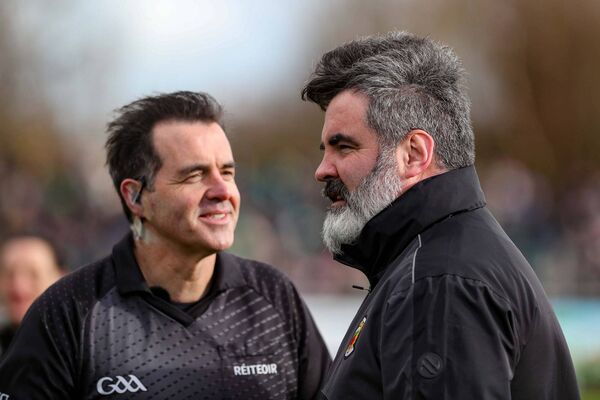
Physically, in the tackle, Donegal looked stronger too. They brought much more intensity to their play than a Mayo side who were very passive with the wind at their backs in the first-half.
Mayo were passive defensively too. There is much to praise Donegal for with regard to their shot efficiency. After Conor McCahill put them 1-16 to 0-8 up, their accuracy dwindled with the game won but McCahill’s third point gave them a staggering 84 percent conversion rate to that point, 16 scored from just 19 shots.
But with such numbers, you have to wonder about the pressure on the shooters and the eye test will confirm it was poor. Donegal moved the ball at will across the Mayo cover, waiting for the opening and found it all too easily. Far too many scores were kicked with little to no pressure.
Mayo’s numbers were much lower, a 52 percent conversion rate across the game, a combination of forcing shots and poor execution from good positions.
The start of the second-half showed this in microcosm.
Mayo started with much greater intent than at any stage in the opening half. Key to this was the returning Conor Loftus, comfortably Mayo’s best player on the day despite not starting.
They created three goal chances but all were saved and all Mayo had to show from six very promising attacks were three points.
Compare that to Donegal who, with their first three shots of the half mined a goal, a two pointer and a point. Six points from three shots compared to three points from six shots.
Having played with the wind in the first-half and went in at the break trailing 0-11 to 0-5, it was hard to see Mayo forcing their way back into it. The contrasting performances in front of the posts in the ten minutes after half-time erased any faint hopes.
Conor Loftus was Mayo’s brightest spark while they can be happy with the return on kick-outs, winning 70 percent of Rob Hennelly’s restarts and 52 percent of Donegal’s.
That possession platform would ordinarily be a template for victory but Donegal’s efficiency and confidence in possession as well as their ability to win turnover ball, with Mayo’s assistance, made the kick-out stats redundant.
It might be wishful thinking to see the result itself as redundant despite the fickle nature of league form and more of a reality check in the early stages of Andy Moran’s management tenure.