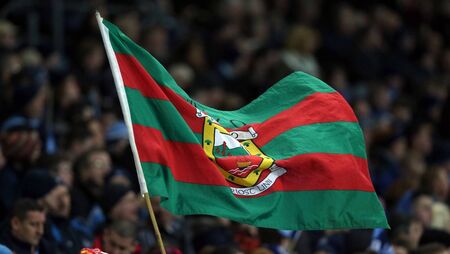
Mayo finally banishes history to history
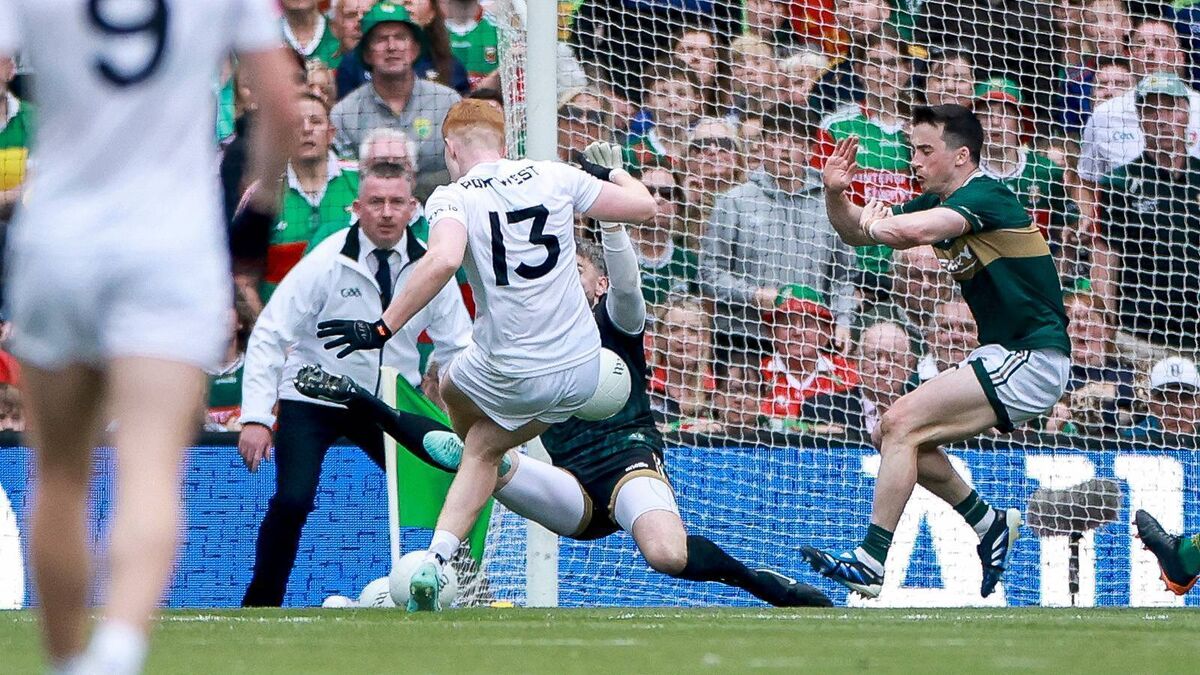
Darragh Beirne scores Mayo's precious second-half goal that helped set them on their way to victory. Picture: INPHO/James Crombie
At 63 minutes and 12 seconds, the crossbar made the most Mayo sound imaginable.
Jordan Flynn had done almost everything right. The opportunity had been carved open, the chance presented itself, and with Sam Maguire beginning to shimmer somewhere over his shoulder, he punched the ball towards to the Kerry goal.
The ball, alas, kissed the underside of the crossbar and came back into play.
It was only a piece of metal ringing in the Dublin air but, for one dreadful heartbeat, it sounded like 75 years.
It sounded like another strange bounce, another cruel twist, another chapter preparing to rhyme with every one that came before it. Mayo supporters have spent generations learning to distrust moments like that. They know that football can be a wonderfully inventive form of cruelty. They have seen balls bounce over crossbars, off posts, into nets and into folklore. They have learned that calamity rarely announces itself. It usually arrives disguised as something ordinary.
And as Kerry stirred, finding fresh breath where none had seemed to exist moments earlier, the old story began to creep back into Croke Park. David Clifford clipped over a two-pointer. Paudie Clifford followed. A comfortable lead suddenly looked fragile. Around the stadium, old ghosts cleared their throats.
Except this time they were left without a speaking part.
History is gravity with a memory. It pulls on some counties more heavily than others. It whispers in moments of doubt, leans on tired legs and turns the ordinary into the ominous. Mayo had spent three quarters of a century discovering that the higher they climbed, the harder history seemed determined to pull them back.
On Sunday, for the first time in a lifetime, it loosened its grip.
There were still times when the old anxieties came knocking once again. They just no longer got the final say. Seven points down against Kerry in an All-Ireland final is meant to change a team. It shortens passes. It encourages the safe option. It persuades players that the next mistake will be fatal.
Mayo never accepted the premise. They continued to squeeze Kerry's kick-out. They kept committing bodies forward. They kept trusting the same instincts that had carried them through the summer. Most strikingly of all, they refused to abandon the two-point shot.
They kept shooting.
That wasn't recklessness. It was freedom.
For years, Mayo's greatest opponents were said to be memory, expectation and the weight of all that had gone before. Yet here they were, seven points down against the most decorated county in Gaelic football, playing with a clarity that belonged to a team who had never heard those stories. Every decision suggested the same quiet conviction: the next play mattered more than the last one.
And that, more than any score or save, was what made this Mayo team different.
Most All Ireland finals have a passage that belongs to the champions. It usually arrives immediately after half-time. The game is still close enough to matter, but one team suddenly finds another gear. Legs grow heavier at one end of the field and lighter at the other. The contest tilts almost imperceptibly before, all at once, it doesn't.
Mayo had seen enough finals to recognise the moment. This time, they claimed it.
There was a confidence to everything they did. When Kobe McDonald won a '45, he wandered towards the 45-metre line with the unhurried assurance of a man who knew exactly where the afternoon was heading. He seemed in no rush because Mayo no longer were. The panic had evaporated.
Then came the goal.
Ryan O'Donoghue burst from midfield with the scent of blood in his nostrils. His pass floated over the cover to David McBrien, whose first touch was not towards the posts but across the face of goal. Darragh Beirne arrived on cue, caressing the ball past four Kerry jerseys to raise a green flag.
Jack Carney supplied the exclamation mark. His thunderous effort from beyond the two-point arc stretched the lead to five. It was a score every bit as consequential as the clinker he landed in the opening half when Mayo were gasping for air at 1-5 to 0-1 down. The first kept them alive. The second told everyone, Kerry included, that this was now Mayo's final to lose.
When Martin McNally’s final whistle eventually arrived, the reaction was unlike anything Croke Park has witnessed in generations.
Mayo players crumpled where they stood. Around them, the green and red that had filled the stands and terraces dissolved into an ocean of embraces. Bodies shook uncontrollably. Tears came in torrents. Faces disappeared into shoulders. Grown men cried with the commitment of toddlers denied an ice cream. For a few precious moments, nobody seemed capable of finding the words.
There had been tears after Mayo defeats. Plenty of them. But there were more tears after this victory than after any of those losses. Mayo supporters had become experts in losing gracefully, but winning had caught them completely unprepared.
Because defeat asks you to carry something home. Victory finally allowed people to put it down. In the midst of the embraces, thoughts drifted instinctively to those who should have been there. Parents who had made the pilgrimage to Croke Park year after year. Grandparents who had listened on crackling radios. Friends whose seats in the car are now empty. They were present without ever appearing in the photographs.
Perhaps that was why one Kerry supporter found exactly the right words: “What a beautiful loss.” For once, everyone in Croke Park understood that the afternoon belonged to more than the winning team.
Generation after generation had invested their hearts in Mayo football knowing that, more often than not, they would leave Croke Park with little more than another story of what might have been.
Not anymore.
The greatest gift this team has given Mayo is not a trophy. It is uncertainty. Nobody knows when the next All-Ireland will come, nor should they. That is the privilege every successful county enjoys. The future has become unknowable again.
For decades, Mayo football lived in conversation with its past. Every final was measured against another final, every opportunity against another missed opportunity. Sunday’s victory doesn't erase those memories. Nor should it. They are part of the county's story.
They are simply no longer the ending.
And perhaps that is what victory does at its very best. It doesn't rewrite history.
It allows history to become history.