Kick-out battle could define Mayo's semi-final
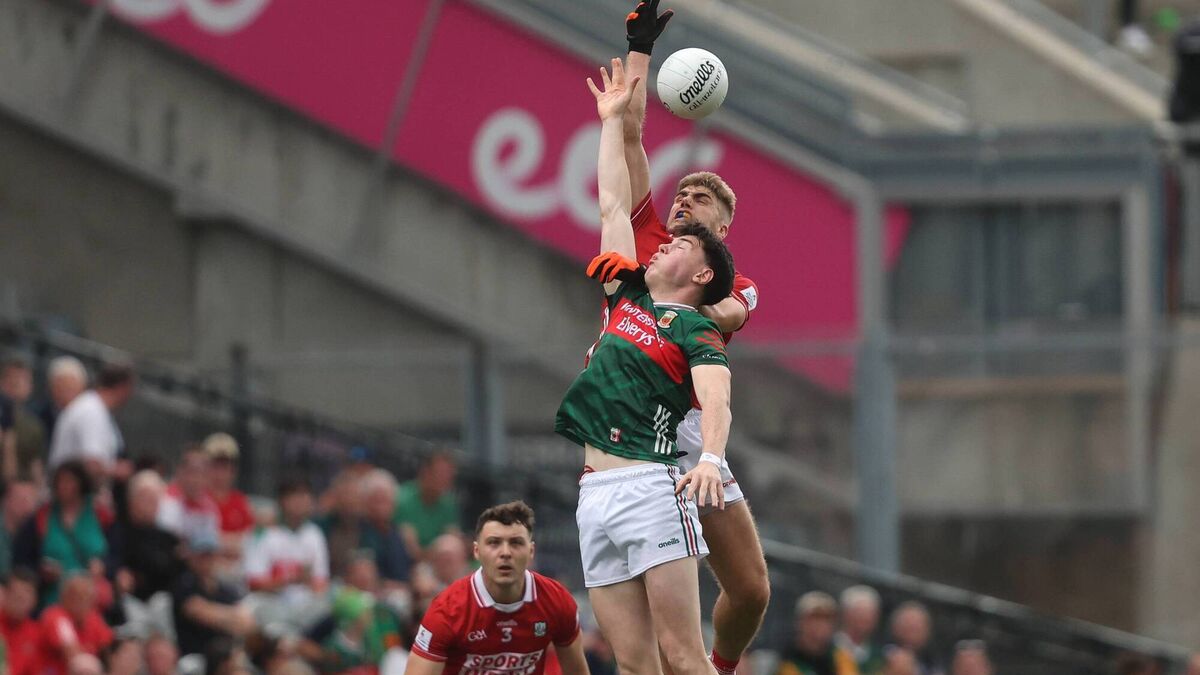
Cork's lan Maguire and Bob Tuohy of Mayo in an aerial contest during the recent All-Ireland SFC quarter-final in Croke Park. Picture: INPHO/Bryan Keane
Ever since the All-Ireland quarter-final, much has been made of Mayo’s struggles in the battle for primary possession against Cork.
The consensus heading into Saturday’s game with Louth is that Mayo will struggle even more against a Louth middle eight with plenty of big men – the ‘wee county’ is a misnomer on this front.
Mayo won 52 percent of their kick-outs against Cork. At the other end, Cork won 67 percent of theirs. For comparison, Louth won 77 percent of their own kickouts against Monaghan, some achievement for 14 men.
That 67 percent combined with pretty much breaking even on Mayo’s kickouts gave the Rebels a possession platform that better teams would forge to victory on. Mayo’s better forward play, including shot efficiency and the ability to take on and score enough two-pointers, proved critical.
But where does this leave Andy Moran and Co heading into the Louth clash?
The immediate conclusion has been that Mayo lost the midfield battle. But a closer look at the kick-out stats tells a different story. Mayo were actually more than competitive when Cork were forced to kick long. The real issue lay elsewhere – short kick-outs at either end of the field.
In the first-half, Patrick Doyle went long with his first three kick-outs – and Mayo won each of them. Stephen Coen and Paul Towey won breaking balls on the first two while Bob Tuohy picked up clean possession for the third.
Cork quickly adjusted. They only went long once more before half-time and Mayo won that too through Jack Carney. But Cork's willingness to go short transformed the picture. They retained all seven of their short kick-outs, enough to post a 64 per cent return on their own restarts (7/11) despite losing every long kick-out.
In the second-half, Cork won 69 percent (9/13) of their own kick-outs but, again, short kicks were vital in that regard.
Of the six that went long, Mayo won three. Cork, though, managed to get seven short kick-outs off, winning six of them. The one they lost was more a kick to space than short. Doyle’s attempt to find Seán Walsh in space was badly overhit and Jack Carney won it easily. We’d consider this more a short one than long.
So while the stats show that Cork won 67 percent of their own kick-out, a highly relevant breakdown of that is that when Cork had to go long, they only won 30 percent of those kicks.
For a Mayo middle eight perceived by some as lightweight, that is a very impressive figure. There is no guarantee that figure will be the same for Niall McDonnell’s long kick-outs but it certainly is something to build towards.
However, whether won long or short, a kick-out is still possession. Under the new rules, teams should generally expect to create a shooting opportunity from any retained restart.
The reality is that Mayo only won 43 percent of kick-outs in total in the Cork game and that’s a number rarely good enough to win a game.
When we look at the opposition kick-out, you have to ask the question should Cork have been able to get so many short kick-outs off? They won 16 of their own restarts but 13 of those were short.
There is a skill in this too from both the goalkeeper and in terms of movement in front of him.
Mayo might be questioning if the work-rate from their forwards was of the level required on the Cork kick-out. There is also the significant possibility that Mayo eased off on the Cork kick-out in order to be better set defensively, especially against a two-point threat.
The reality is probably a bit of both.
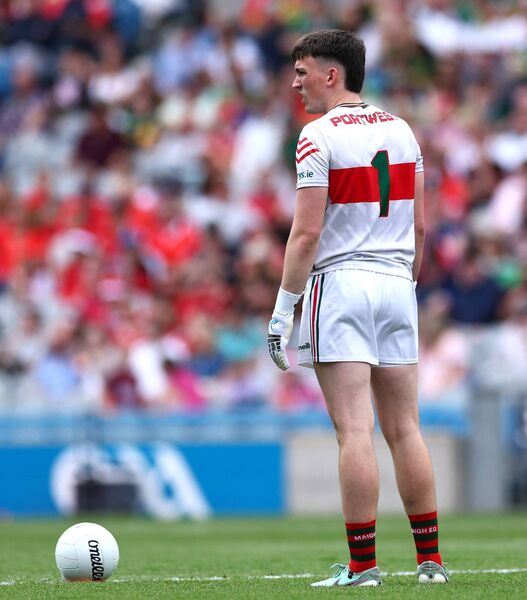
Another problem for Mayo though when looking at this issue is when you examine their own kick-out.
The standout figure is that Mayo won 52 percent of Jack Livingstone’s restarts, 15 out of 29.
Mayo were not great on breaking ball (won seven and lost nine) on their own kick-out and their positioning on some breaks is definitely something that needs work. Some kicks in the final quarter missed the intended target area too.
The Cork kick-out data shows that sometimes the attacking team can have the upper hand on long kicks to contest as they are facing in the direction they want the ball to travel – it is much easier to break a ball forward than break it over your head.
Livingstone has repeatedly shown his ability to pick out runners in narrow enough spaces. He found David McBrien, Enda Hession and Jack Carney with excellent deliveries against Cork. One to Stephen Coen went over the line but it may have been as much a misjudgement by Coen as Livingstone.
Game circumstances come into it too. When you are in front like Mayo were in the second-half, conceding occasional kick-outs short makes sense. Cork, chasing the game, couldn’t countenance such an approach.
Still, the fact remains that Mayo only took two short kick-outs against Cork, both in the first-half. Jack Coyne won one while the second one, to Paul Towey, broke loose for Cork.
It continues a trend. Livingstone came in arguably on account of a bad short kick-out from Rob Hennelly against Roscommon and he has more than earned his place and is rightly in the All-Star debate after a series of exceptional displays.
His selection has also coincided with a more rudimentary approach on kick-outs.
We’re not sure if this is a philosophical change or down to personnel, particularly a goalie in his first year. But Livingstone can certainly deliver decent, short kick-outs.
Mayo’s approach has served them reasonably well but at this stage in the season, shying away from short kick-outs will present challenges in terms of winning sufficient primary possession. And certainly if the opposition can get a good blast of short kick-outs off at the other end. Thirteen short kick-outs for Cork to two for Mayo (and only one won) is a big gulf.
Louth, whose own kick-out numbers against Monaghan were outstanding despite playing with 14 men for the vast majority of the game, will almost certainly have examined this aspect of Mayo's game.
Going long so often also presents other consequential challenges.
Galway have not been able to incorporate a short-kick out approach into their game. The feeling was that with big men like John Maher, Cein Darcy, Matthew Tierney, Cillian McDaid and Paul Conroy, they could overcome it.
But when it is quite clear you are going long most of the time, the opposition can be far more set for it and ready for the aerial battle – as Dublin, and others, proved.
If it is less predictable what you are going to do, then when you do go long, there is more of an element of surprise and a greater chance of finding a one-on-one battle that might be to your advantage.
Short kick-outs also depend on defenders being willing to receive under pressure. The risks are obvious, as Mayo discovered against Roscommon and in last year's Connacht final, but so too are the cumulative rewards.
But if Mayo want to win a 50 percent or more share of possession against Louth, they are going to need to get better at securing their own kick-outs, whether that is short or long; and not allowing too many short kick-outs at the other end.
Kevin McStay once said Mayo traditionally never respected possession because they can win it so easily – wides were trivialised because Mayo were confident they’d win the kick-out anyway and go again with so many high fielders. Now, with the forward line Mayo have, getting even a 50 percent share of kick-outs will have them well on the way. Against Louth, that may prove the defining battle.