All-Ireland Final countdown: There’s nothing so strong as belief
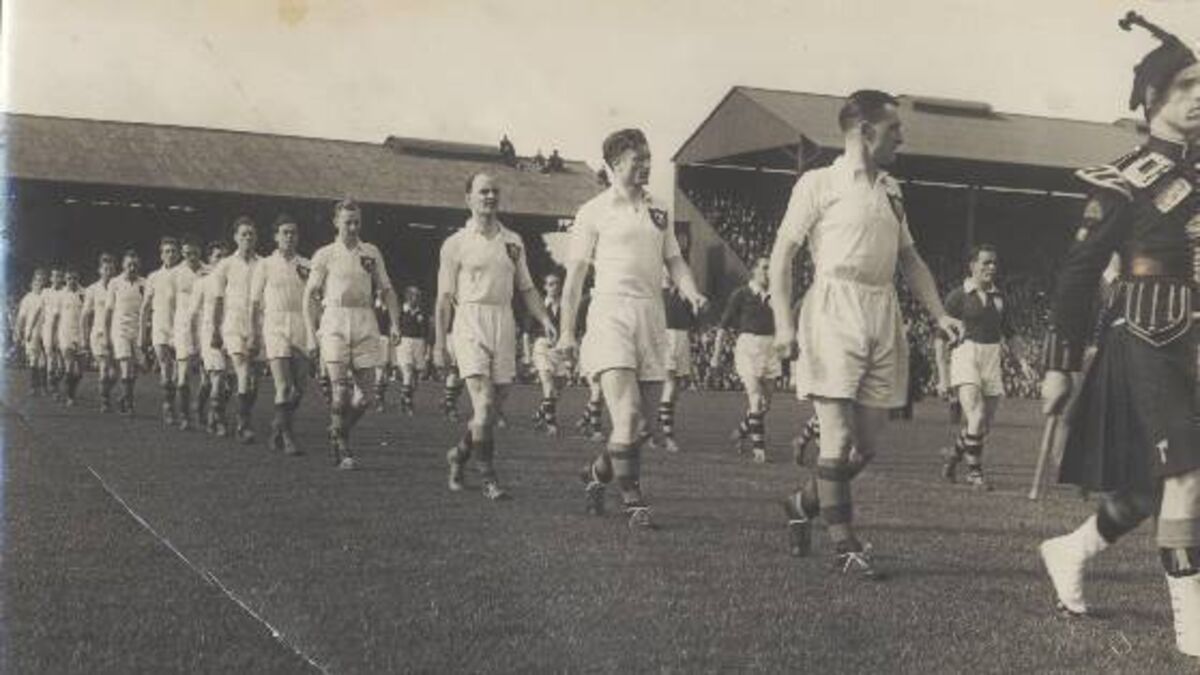
Sean Flanagan, Padraig Carney and Eamonn Mongey at the head of the parade in Croke Park for Mayo's 1951 All-Ireland senior football final against Meath.
“You have great courage to go out on the same pitch as Kerry tomorrow.” It was one of the doormen who made that remark as we filed in to see a film in the Regal Cinema in Dublin the night before we played Kerry in the 1948 All-Ireland semi-final. In fairness, he had a point.
Kerry had won the All-Ireland final in 1946 and were unlucky to have been beaten by Cavan in the 1947 final, which was played in New York and in which Kerry had two goals disallowed. On the other hand, Mayo hadn’t won even a Connacht title for nine years and had been beaten by Kerry in a National League match in February.
It wasn’t clear whether the doorman was being serious or just provocative but Sean Flanagan immediately transfixed him with a glare as he responded in his most emphatic voice – “We’ll beat Kerry by at least six points.” None of the rest of us demurred but I think it was the first time I appreciated what an important element belief is for success in sport. Years later I remember when some journalist asked Jack Nicholas if he thought Padraig Harrington would win a golf major, his response was crisp and to the point – “Does he think he can?” So, belief is paramount.
Sean was a great believer in psychology. When we took the field next day against Kerry we were slow to settle – but not Sean. In the first ten minutes he played the best football I had ever seen in Croke Park, which included literally throwing himself on the boot of Batt Garvey to save a certain goal. It was as if to say to the rest of us – “This is how you do it. This is what I meant.” As belief grew in us all over the field, so did defiance. At the time, Kerry still favoured the old-style catch-and-kick. Our centre half back was Pat McAndrew, almost 6’6” in height. The higher Kerry kicked the ball the higher Pat rose to fetch it, snorting defiance out of both nostrils as he returned to earth clutching the ball. Thus the legend of “The Mighty McAndrew” was born. We never relented. In the end we won by ten points and for the first time in the history of the GAA a Kerry team failed to score in the second-half of a championship game.
Sean was a keen student of football and, particularly, how to win; his approach was an interesting study in itself. On the field of play he actually welcomed the challenge, not only for the personal satisfaction which accompanies the trial of strength, but because of the psychological impact of the successful challenge on his own team-mates and, even more important, on the opposition. And when things were not going well he would set off from his corner-back position on a solo run (which was never the most elegant, but certainly the most inspiring and effective) to rally his team.
Then there was the time in the dressing-room in Croke Park when he gave a rousing call to arms before we played Meath in the 1951 All-Ireland Final. Just as he finished there was a loud knocking on the door. When it was opened there was a representative outside from the company which usually filmed all the finals. It was the practice to use two cameras to film the teams coming out on the pitch but this day, for whatever reason, they had only one so it was decided that the two teams would emerge from the same dressing-room and that that would be ours.
Now, you would think that it would be simple enough to let Mayo out first and then let Meath follow through an empty dressing-room. But, no! We were told that the whole Meath team with subs, mentors and other officials had to come out first and we would then follow them. As soon as he heard this Sean jumped up on a table and addressed us all to the effect that none of us was to speak to, or even acknowledge, any Meath man who passed through. It was eerie. We knew them all but as they came smiling through the door they were met with a sullen silence. It then looked as if they could not get out quick enough. As it transpired, we beat them by five points and thus won our second All-Ireland title.
Of course, on rare occasions the use of psychology can be light-hearted. In one match we played in New York Sean challenged his opponent so strongly that he wound up in an unceremonious heap on the ground. Jumping to his feet he ran menacingly at Sean and enquired if he “would like a puck in the mouth.” Sean left him speechless with his response – “Not unless you feel you must.” The incident ended there while the injured party tried to work it all out.
For success then, there must be belief, defiance and inspiration, to which you could add passion and pride. So, what were we thinking as we marched around the pitch before the big battle began? As captain, Sean led the team, closely followed by Padraig Carney, both bursting with pride, with chests sticking out that would do credit to Dolly Parton. We used to look across at our opponents and I’d like to think we said to ourselves – “We’re as good as you! We’re better than you! You won’t beat us! You see, we’re Mayomen!”
Of course, we had a tactical-cum-psychological approach as well. In the 1955 semi-final we met Dublin who had utterly destroyed Meath in the National League final and in the Leinster final, with Kevin Heffernan scoring a hatful as a roving full-forward on Paddy O’Brien. We were total outsiders but we recognised that Dublin’s half-back line was the launching-pad for most of their attacks which were generally finished by Heffernan. So, our half-forwards were detailed to tackle the Dublin half-backs and Paddy Prendergast to follow Heffernan wherever he went. To the astonishment of many, we drew with Dublin, Heffernan was held scoreless and we missed a 21 yards free in the closing minutes.
That night when we arrived back in our hotel Sean was stretched out on his bed, fully clothed. As we gathered around for a chat he was obviously still pondering the events of the day. Eventually, he spoke – “When a player who has already appeared in an All-Ireland final gets a free 21 yards out to win a semi-final, it is not an accomplishment for him to score, it is a duty!” Sean even worked something like that on me, too. We used to exchange letters before any big game about tactics and what was required to win. In one of his letters he wrote – “We will win on Sunday. Much will depend on you but I know that, as the occasion presents itself, you will will the ball over the bar!”
He wrote to me after games, too. I think I should quote from the one he wrote after our 1950 All-Ireland victory, as I believe it has some resonance for the Mayo lads in this year’s final. It commenced – “It is curious that the events through which we have passed should lead me to such a distant belief, but it has emerged in my mind more clearly than ever in the past few days that Shakespeare was a genius. He said there is a tide in the affairs of men which taken at the flood leads on to fortune... In the last analysis, men must take or leave their fortune. It thrusts not at them. I feel some small pride in the fact that I used the wisdom of Shakespeare as a lever on you, for in the event his wisdom was confirmed. Never before did I feel so strongly that the fault would not be in our stars but in ourselves if we were underlings. Something super-normal was required to win.”
Modesty precludes me from quoting further, but the message is clear for our lads this year. Don’t be underlings. It is up to you and to you alone to take or leave your fortune. You have displayed all the attributes of belief, defiance, inspiration, pride and passion. You will want to do it again – and more! You can do it. You have the unique opportunity now to show the world what it means to be Mayomen!