All-Ireland Final countdown: Colm Mac and the men of '96
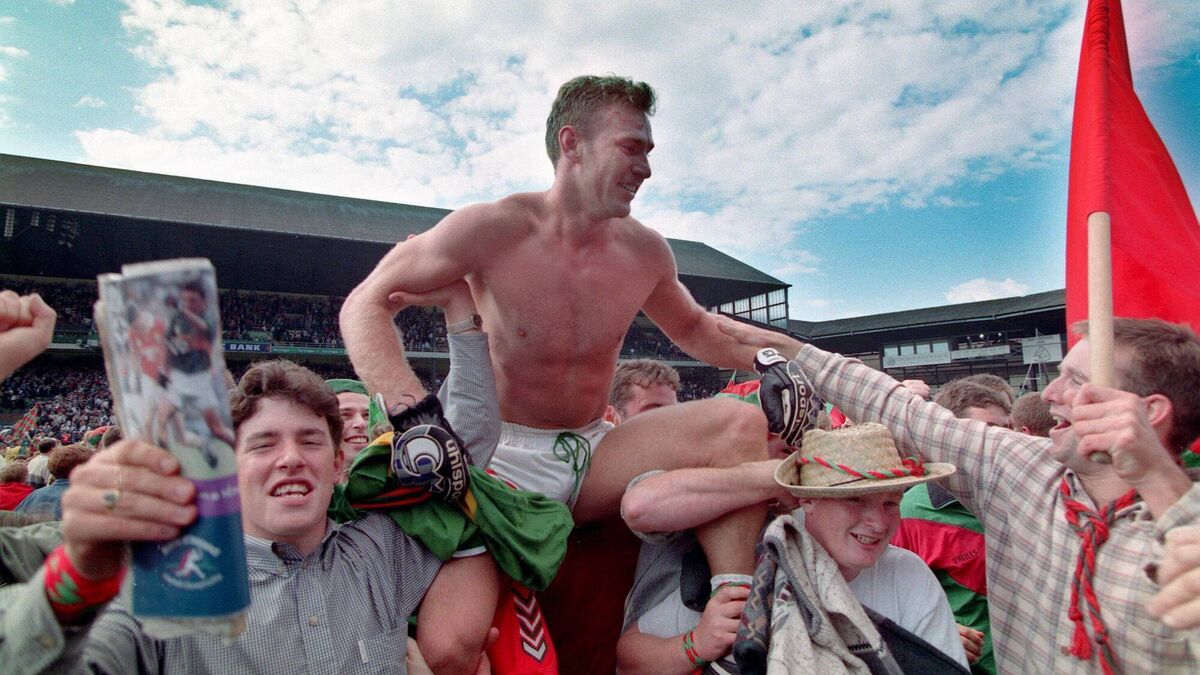
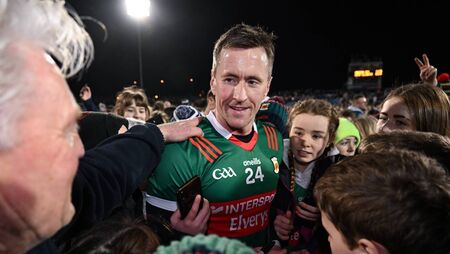
Colm McManamon celebrates with Mayo fans following a breakthrough victory over Kerry in the 1996 All-Ireland SFC semi-final. Picture: INPHO/Patrick Bolger
He can scarcely believe it is 30 years ago since that incredible summer of 1996. Time is sometimes a thief and for Colm McManamon, continuous involvement in the GAA ever since makes the gap seem much shorter.
There are striking parallels between 1996 and today in terms of barren years beforehand, an infusion of youth, a young manager and former Mayo player in his first year, an unexpected All-Ireland appearance and facing a big Croke Park date against Kerry.
While Mayo won Connacht titles in 1992 and 1993, a disappointing All-Ireland semi-final loss to Donegal in ’92 and a humiliation at the hands of Cork in ’93 showcased where Mayo were at in the national picture.
There was a revolving door for managers from Brian McDonald to Jack O’Shea and Anthony Egan before John Maughan took over for 1996.
“There were a couple of years where Mayo football just seemed to get lost. There was a lot of change of management. A lot of players from the 1989 (All-Ireland final) team were still playing but didn’t seem to gel with new players. It was a strange one. Mayo definitely got lost for a time,” he said.
Maughan arrived at a good time – like this year, Mayo had a crop of talented young footballers coming on stream. Many of the class of ‘96 had been in Under 21 All-Ireland finals in 1994 and 1995, losing to Cork and Kerry respectively.
“It was a case of gelling those footballers with the existing panel and obviously we went to a different level with training standards. He got the best out of us fitness wise and the team was gelling. Physically, I’d say we were one of the most physical teams in the country,” he said.
In the 1995/96 league season, Mayo were in Division 3 but emerged and went to the league quarter-finals (where the top teams from various divisions faced off) and beat Meath in Hyde Park before facing Derry in the semi-final in Croke Park.
“Derry beat us but we got a taste of Croke Park and that was important for us,” McManamon recalled.
Like in 2026, their championship started with a win over London in Ruislip but they went one better in their Connacht semi-final against Roscommon than the team of 2026. It was just as well as this was the era of the straight knockout championship.
They beat Roscommon in Hyde Park setting up a Connacht final with an emerging Galway team.
“We were both in building mode. There was damn all between us,” he said.
Mayo were the better team on the day though, emerging as winners on a 3-9 to 1-11 score.
The reward was an All-Ireland semi-final with Kerry, who had won their first Munster title in five years and only their second in ten. It was a veritable famine for the Kingdom. But there was very little sense that Mayo could pull it off.
“There was no serious expectation in the county. A lot of the talk was that if Mayo could go up and give a good account of themselves, that would be good enough,” recalled McManamon.
After the ‘lost’ years that preceded 1996 and the 1992 and 1993 semi-final experiences, that is somewhat understandable.
But John Maughan and his squad went up preparing to win.
“It probably wasn’t the best ever Kerry team,” McManamon admitted. “We seemed to get a run on them and James Horan got a goal from 40 yards out late on. We had a little bit of luck on the day but it was a huge win for us and instilled belief in us,” he added.
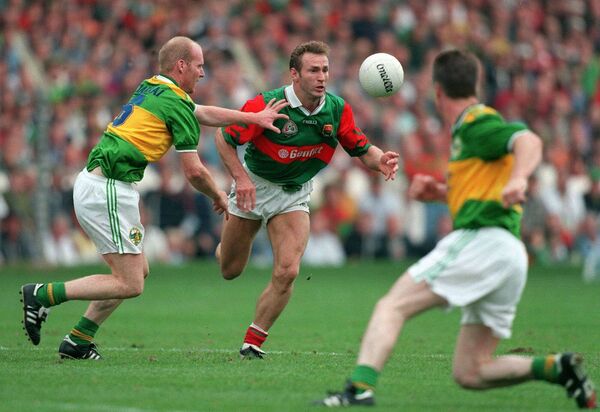
McManamon gave a tour-de-force that day in Mayo’s 2-13 to 1-10 win with both Ivan Neill in the and Padraig Burns in using the same description – that he must have covered every blade of grass in Croke Park that day. It was a summary that could be used in many games the Burrishoole man featured in.
“I played all my football with the club at midfield and you’d be used to being up and down between the two 21s. With Mayo, I was playing centre-half forward, not a role I was used to but John Maughan gave me the freedom of the pitch to get around and it seemed to work well that day,” he said.
Of course, one of the more infamous All-Ireland finals followed, not just with the fight in the replay but Mayo being six points up in the final quarter in the drawn game only for Meath to rein them in.
Whether he likes it or not, that final still follows Colm McManamon around.
“It is hard to move on from it when people bring it up all the time! It is one that got away. It was there to be won, twice. We were six points up with just over ten minutes to go,” he recalled.
When he looks at his Mayo career as a whole, the positives far outweigh the negatives. He played from the winter of 1990 to 2002.
“I wouldn’t change it for the world. The lads you meet and the teams you were involved with. Some of us are very good friends to this day and we had some good days.
“Getting to finals is grand but you’d like to have got over the line once. But when you are representing your county, your club and your family at that level is something I will always treasure.
“I wouldn’t change anything – except maybe a couple of final results,” he said.
*****
McManamon – known almost universally simply as ‘Colm Mac’, sees the parallels between the group in 1996 and 2026, not least a big game against Kerry in Croke Park.
“You’ve young lads coming in like we had in 1996 full of confidence. They play with a freedom and are a real boost to the rest of the team,” he said.
Though he has finished playing, McManamon’s commitment to Gaelic football has not waned. He has been involved with various Burrishoole teams in the men’s and ladies clubs at all ages every year since he retired. There are very few of his contemporaries who can rival his commitment and very few who look more like a man who could still tog than the man hewn from granite from Tiernaur.
“There is nothing more I’d rather be at than down at the pitch, training kids, showing them what to do. The game has evolved so much but I love being involved,” he said.
He will do whatever is asked of him. Earlier this year he played the role of Dessie in for the club’s Oskars fundraiser – well out of his comfort zone but always willing to help in whatever way he can.
He gets to as many Mayo games as possible and has been pleasantly surprised by the progress this year, especially after witnessing the crushing defeat by Roscommon in the Connacht semi-final.
“Walking out of MacHale Park after the Roscommon game was not a nice experience. The way they’ve turned it around is very impressive.
“They got over the line by a point against Monaghan and the Tyrone defeat could have went either way.
“From there, if you’d hand-picked the draw, you probably would have chosen exactly the teams they got. They’ve been able to build and the draw suited them. Leaving MacHale Park after the Meath game, you could see them coming together. They controlled the game for long stages against Cork and in the Louth game, it was strange to be able to relax halfway through the second-half for a Mayo game in Croke Park. Normally we’re biting our nails!
“The three boys up front are shooting the lights out,” he said.
And so a familiar foe awaits, Kerry in a final.
“They are hot favourites. I think this Mayo team are playing out of their skins and really gelling together. Kerry will score plenty but I think we’ve enough firepower to match them. There’s a big question over trying to curtail the Cliffords.
“But midfield will be huge. Both forward lines are lethal so supply will dictate it. We’ve been written off ahead of some games at midfield but have still contested quite well. We will need everyone firing,” he said.
“Andy says no one will give them a shout. But they know themselves inside the camp how they are playing. They’ve turned it around since the Roscommon game, you have to hand it to them.”
*****
McManamon is very familiar too with the journey Kobe McDonald is making as it echoes his own Aussie Rules adventure 37 years ago.
In 1989 strong performances for the Mayo Vocational Schools team – who lost an All-Ireland final to a Peter Canavan inspired Tyrone in Croke Park – and with the Mayo minors, who lost the Connacht minor semi-final to Galway by two points, brought him to the attention of Aussie Rules scouts.
One of them was the former Galway footballer and, subsequently, Roscommon manager, John Tobin. The interest Geelong – Oisín Mullin’s club – had in him was well flagged before a training camp in the old Pearse Stadium in Salthill.
McManamon went along even though ‘the deal was half done’. Three players got signed up – McManamon and two other stars of the 1990s, Colin Corkery from Cork and Anthony Tohill of Derry.
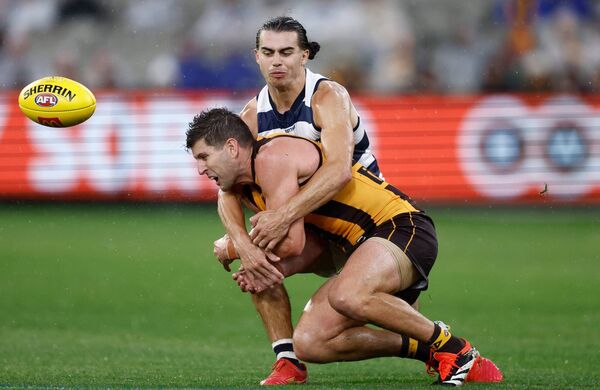
So it was in January of 1990 that the Tiernaur man headed across the world to the port city of Geelong, some 50 miles south-west of Melbourne.
It was a trip down under far removed from the modern day.
“It’s much easier for players now. There was no Facetiming, no Snapchat. Now if you walk down the street in some parts of Australia, it is like being in the middle of Castlebar or Westport but Irish people going for a year in Australia wasn’t really a thing then,” McManamon recalls.
And while there was a cultural gulf, there was also a new game to learn.
“The difference in the ball was a big thing but the hardest part was getting rid of the ball before you were tackled or it would be a free against you. It is a hard thing to adjust to when you’d be used to carrying the ball into contact in Gaelic football.
“There was lots of one on one coaching too most days and we did a lot of gym work and running,” he said.
By this point, Dubliner Jim Stynes was already establishing himself as a legend of the game, having arrived in 1987 and won the Best and Fairest (Brownlow Medal) in 1991, the only ever non-Australian to do so.
His brother Brian Stynes and Seán Wight from Kerry were all there too but it was the early days of Irish talent spotting.
“We were very well looked after, flights there and accommodation was paid for. It is usually only after a year or two that you’d be considered for the seniors but I was playing with the under 19s and played a few games with the first-team reserves,” he recalls.
McManamon was making good progress. Anyone who saw his athleticism, power and competitiveness with club and county in latter years will testify that he would have been very well suited to the game.
Then everything changed.
His father, Brendan, died suddenly aged just 62 in May of 1990.
“That was the last time I saw Australia. A month or so after I was home, I got a call from John O’Mahony to go in with Mayo. Séamie Daly from Mulranny, who was a selector, called. Between that and a few different things, I decided to stay,” he said.
While Mayo’s gain was Aussie Rules’ loss, McManamon does harbour regrets.
“I never really got a good run at it. I do wish I had given it another whirl but I didn’t have much time. The pre-season was just finishing and we were just in the thick of it when my Dad passed away. I decided not to come back but I would like to have given it a bit longer,” he admitted.
Fate would deny him the chance to play in Australia with the Irish Compromise Rules team too. His quality with the Irish team in the late 1990s underscored his suitability for the game but while he represented his country for home tests in Ireland in 1998 and 2000, he was injured for the 1999 trip down under.
Time moves on and now, 37 years after his own Australian odyssey, McManamon is watching a son of a former teammate, Ciarán McDonald, prepare to head down under.
Kobe McDonald has lit up this summer’s Gaelic football championship, belying his tender age of 18 but is due to link in with St Kilda later this summer.
“Every Mayo supporter will be heartbroken to see him go but you cannot stop the lad. He is a serious talent and everything they want, he’s got. Athleticism, pace, fielding a ball, he has all the attributes.
“You can see him flourishing out there. It is not good from a Mayo point of view but you can only but wish him luck. Is it the right thing for him at his age? I think so. He can always come back but I think he will get a taste of it … The professional game, a good lifestyle, doing something you love and getting paid, it is a dream come true,” he said.