You can't have it both ways in a democracy
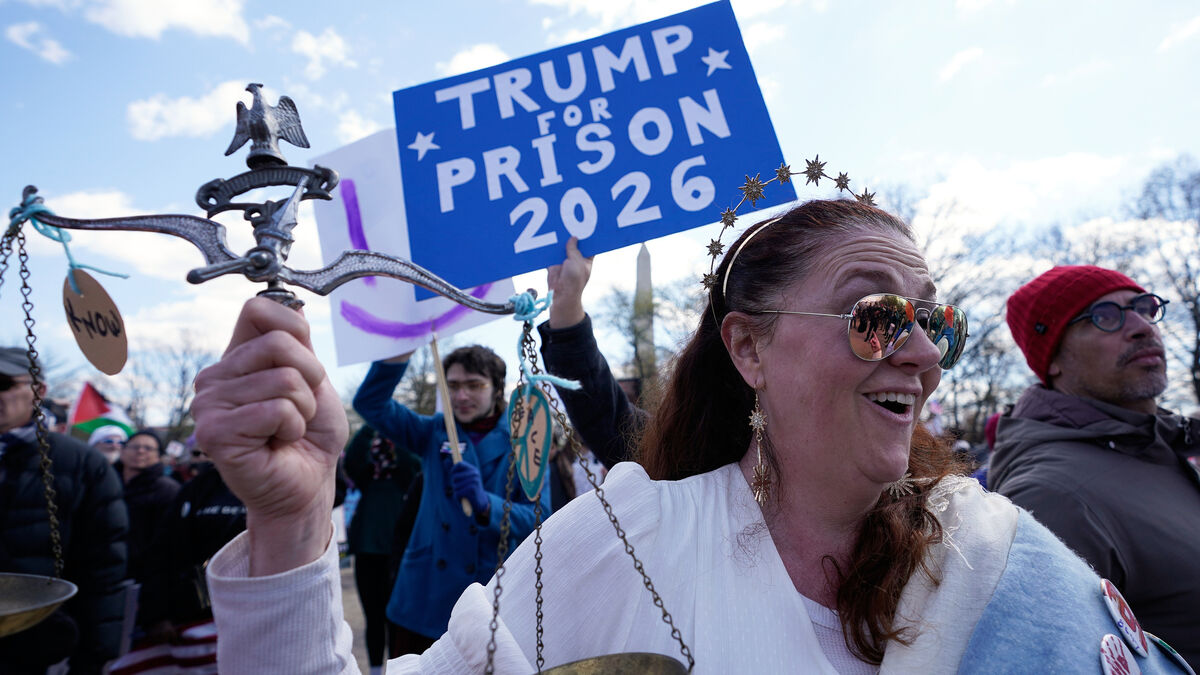
Demonstrators rally near the Washington Monument during the 'No Kings' protest in Washington, on Saturday, March 28, 2026. Picture: AP Photo/Jose Luis Magana
There’s a phrase that has become fashionable in recent years, particularly in the United States: “Not my president”.
I heard it again recently during an acting class on Zoom where a bunch of Americans, Irish, British and a few actors from across Europe were introducing ourselves.
“Include where are you calling from,” the casting director asked us.
One eager young actor pounced first with “I just want to get out of the way that I’m calling from L.A… in the United States….but Trump is not my president!”
A ripple of laughter and a few head nods.
Our host smiled diplomatically and moved on. But the “Trump is not my president!” wormed its way into my thoughts. Because on the surface, it sounds harmless. Even principled. Her way of meaning: I don’t agree with this man so don’t judge me for what his administration has said and done.
But that’s not quite what it says.
Donald Trump is the President of the United States. That is not a slogan. It is a fact. He won the election. This time, compared to 2016, maybe even more so as he won the popular vote. However uncomfortable that may be for many, it is the democratic outcome of free and fair elections.
To say “not my president” is not just disagreement. It edges into something more troubling: a suggestion, sometimes subtle and sometimes not, that the result itself lacks legitimacy, that the person in office has no real right to be there. And once you step onto that ground, you are in dangerous territory. Because imagine, for a moment, the reverse.
If Kamala Harris were now president, and MAGA conservatives across America began declaring “not my president”, how would that be received? It would be (rightly) condemned as divisive, anti-democratic, even institutionally destabilising. A refusal to accept the election outcome. Akin to the very disrespect for democracy that Donald Trump has shown with bogus claims that Barrack Obama was not born in America, that the 2020 election was rigged with widespread voter fraud, and that the January 6th rioters are heroes for storming the capitol.
You cannot have it both ways. You cannot claim to defend democratic norms while casually undermining the legitimacy of outcomes you dislike.
And yet, there is another comfort embedded in the phrase. It allows people to step away and avoid having to do deal with the reality.
If he’s “not my president” then his actions are not mine. His decisions do not reflect on me. I can distance myself from the consequences. It is, in effect, a moral disclaimer.
But democracy does not work like that.
In places where people truly have no say, in Gaza, where elections have not taken place in a generation; in Afghanistan under the Taliban; in Iran, where protesters risk their lives for basic political freedoms, people can say of the undemocratic elected incumbent, with force and clarity, “this is not my president”.
Because they were never given the chance to choose him (it’s almost always a him).
But in a functioning democracy, the burden is heavier.
Even if you did not vote for the winning side, you are still part of the society that produced that result. You are still implicated in its direction. And with that comes responsibility, not to agree, but to engage.
At least with the so-called “No Kings” protests, there is something more substantial taking place. Millions of Americans have taken to the streets in recent months, in one of the largest protest movements in modern U.S. history. These people are getting off their collective asses and expressing genuine opposition to Donald Trump and what they see as an erosion of democratic norms.
That, in itself, matters. But even within that movement, there is an uneasy question about what protest actually achieves.
A friend of mine who attended one such demonstration described it, somewhat uncomfortably, as having the atmosphere of a carnival. People were casually walking, chatting, bringing picnics, dressing up, meeting friends, enjoying the day. That is, of course, only one person’s experience. But it points to a broader risk: that protest becomes not a tool of change, but an outlet - something that makes people feel they have acted, without requiring anything further of them. They are comfortable.
Writing recently in , former US Secretary of Labor Robert Reich made precisely this point. The protests, he argued, are not enough. Solidarity must be turned into political power, into organising, persuasion, and, ultimately, votes.
In other words, democracy does not end at the protest. It begins again there.
And this brings us back to that phrase: “Not my president!”.
Because at its weakest, it risks becoming the rhetorical equivalent of those carnival moments and a way of signalling opposition without assuming responsibility. A way of deflecting from being involved.
There is a difference between rejecting authority and merely signalling that you do. When the iconic Irish singer Sinéad O’Connor appeared on in the United States in October 1992 and tore up a photograph of Pope John Paul II, she did so while declaring, “Fight the real enemy.” It was not a slogan or a social disclaimer. It was a direct challenge to authority, one that provoked immediate global outrage, condemnation across the United States, and long-term damage to her career. That is what real opposition looks like. It is not casual, it is not cost-free, and it does not begin and end with “Not my Pope” designed to distance oneself from judgment.
And in a democracy, that answer cannot stop at words.
Because if you do nothing, you allow it to continue.
He is your President.
Accept it. Let the words sink in.
Now what do you do?