The poignant biography of a rural railway
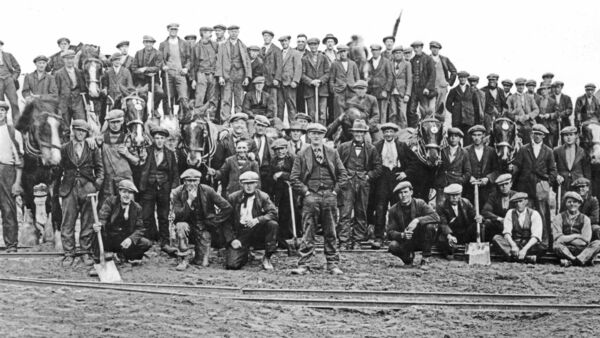
A group of men and boys who worked on the building of the railway line near Tubbercurry circa 1893. Picture: Flannery Archive
This piece is inspired by a photograph taken near Tubbercurry, circa 1893, during the building of the western extension of Waterford, Limerick & Western Railway (WL&W), which extended from Claremorris in Co Mayo to Collooney in Co Sligo.
By comparing this photograph with one taken at the same location in early 2026, a number of stories are revealed; the story of excitement at the railway’s creation, the story of struggle in its daily operations, and the story of disappointment at its eventual decline and death.
According to railway historian, Tom Ferris, the railway movement that grew from colliery tramways to public railways began in the late eighteenth century with ‘the first successful application of steam traction’ taking place in 1812. By 1826, Ireland was welcoming the railway and by 1834, Ireland’s first railway, which ran from Dublin to Dún Laoghaire, was opened. Ireland’s ever-growing railway network eventually arrived in east Mayo and south Sligo in 1890.
The Chief Secretary for Ireland, Arthur Balfour, spearheaded a campaign to kill Home Rule with kindness, and as a sweetener, he secured funds for twelve light railways, culminating in the Light Railway (Ireland) Act of 1889. A Railway Order was later passed under the terms of that Act, allowing for the construction of the 46-mile light rail extension to Collooney. This project was the final stage of what one writer described as, ‘the long west coast route, from Limerick to Sligo, built by a bewildering array of companies’.
The construction of the Swinford to Collooney section, which had been commenced by Worthington, was subsequently finished by Fisher and Le-Fanu. The Claremorris to Collooney line opened in October 1895 with stations that included Kiltimagh, Charlestown and Tubbercurry.
The c. 1893 photograph from the Flannery Archive (Tubbercurry) contains 60 men, three boys and seven horses. Despite it being a light rail construction, the new line nonetheless provided huge local employment and involved massive amounts of building work; there were 42 bridges and 297 road crossings on the length of the route.
The workmen at Tubbercurry were expected to move 20 tons of clay or rock per day. This huge task was completed primarily by hand, using nothing more than shovels, picks, and wheelbarrows. Norman Freeman ( , 2021), in an article, , sets the scene.
Regarding the line itself, there were indications of inefficiencies and limitations from early on. Another writer humorously suggests that the new light rail line was ‘light on everything except time’ and points out that the 145-mile trip, from Limerick to Sligo took over seven hours. After World War II, the Mayo-Sligo stage of line became known as the ‘Burma Road’ because of the difficulties posed by its curves, gradients and enumerable crossings.
The eventual construction followed years of debate, as local interest groups sought to have the railway built through their town. Among the most strident supporters of the railway were two Catholic priests, Fr Denis O’Hara, parish priest of Kiltimagh and Canon Staunton, parish priest of Tubbercurry.
At that time the excitement of the railway era imbued the air over every town and village in South Sligo and East Mayo. The growing tradition of railways would finally arrive in the congested districts of the West. But… there were troubles ahead; troubles, that despite good intentions and hard work, like the railway itself, emerged from poor foundations.
It was obvious at all times that the railway was sought for the benefit of the region rather than for the bank accounts of shareholders. Coupled to that the fact that the line was a light rail design, built cheaply on unforgiving terrain, troubled from the start by overruns and a floundering construction company, and one begins to see a project that struggled into life, and thereafter, constantly struggled for oxygen.
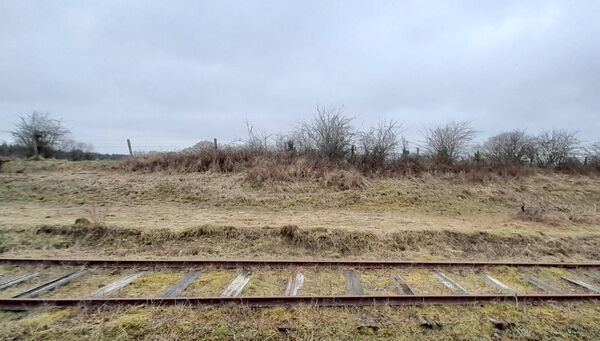
The general tones of the original photograph from c. 1893 are those of expectation and enthusiasm; showing a posse of men armed for work, poised to create a new corridor into an exciting future. The 2026 photograph, captured at the same location, is a scene of decay and desolation. The skeletal whitethorns topping the bank in the background are ghostly reminders of the men and boys who stood there over 130 years ago. Freeman describes the beginning of the end.
John Healy, writing in his famous book, , tells the complete story of the line in one short paragraph.
Passenger services on the line finished in 1963 and the line closed to all rail traffic in November 1975. There is a story with reference to the possible reopening of the line from that time: responding to a question from Jim Fahy on the main RTÉ evening news a senior CIE management representative suggested that the Claremorris to Sligo railway might one day re-open ‘if gold is found in the Ox Mountains'.
It is obvious from the 2026 image that the gold was never found. Comparing the two photographs tells the story of a failed marriage; a marriage based on the promise of all that a railway could bring and the dire needs of an overcrowded, poverty-stricken region. It was a marriage that never really worked; failing in its ambitions to create a sustaining relationship or provide for its children.