The pumps are dry and so is their shame
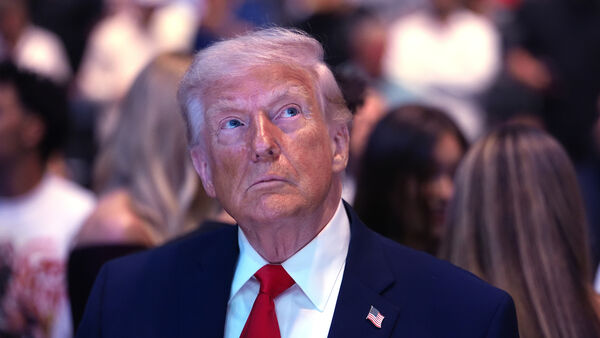
US President Donald Trump attends the UFC 327 at Kaseya Center, Saturday, April 11, 2026, in Miami. Picture: AP Photo/Julia Demaree Nikhinson
It's April 10th and the queue at the filling station in Castlebar stretches the length of a bad political career, which is to say, further than anyone wanted to be standing on a wet morning with the rain coming in sideways off Clew Bay. A hand-written sign, lopsided and damp, taped to the forecourt pump, says: .
The standard Irish apology for catastrophe. Sorry for any inconvenience, as though the entire Middle East had simply mislaid itself and would turn up down the back of the sofa shortly, slightly sticky, smelling of crude oil and sulphur.
So this is what war looks like from the edge of the Atlantic in 2026. It’s not missiles raining over Tehran or the previously ignored Strait of Hormuz, squeezing like a fist around the throat of an already fragile global economy. Not two ballistic armed adjacent powers squaring off with the diplomatic subtlety of drunks at a bachelor festival. From my perch in Mayo, it looks like a handwritten sign, a chilled cup of Centra coffee, and a slowly dawning realisation that somewhere between Washington and Tel Aviv, someone made a decision that ended up costing me sixty euros I really could have preferred to keep in my wallet.
That someone, let's be honest, is Benjamin Netanyahu - a man who has somehow convinced himself, and periodically the United States of America, that he is Winston Churchill, when he is, in fact, considerably closer to that bloke in every office who insists on replying-all. Netanyahu is a political survivor of almost supernatural persistence, a man who has been simultaneously under criminal indictment and running a war, managing a coalition of religious extremists and messianic settlers while maintaining the expression of someone who considers himself the most reasonable person in any room he has ever entered. He is not the most reasonable person in any room he has ever entered. He is the man who decided that the correct response to feeling threatened was to light the entire neighbourhood on fire, and who now stands in the rubble, singed and somewhat bewildered, calling it a historic victory.
There is something almost poignant about Netanyahu's certainty. He wanted Iran broken - humiliated, defanged, regime-changed into something soft and compliant and preferably American-friendly. What he got was Iran radicalised, its moderates sidelined, its new leadership with absolutely nothing left to lose and the Strait of Hormuz as a bargaining chip the size of a continent. This is not a victory. This is a man who went to the casino, put everything on red, watched it come up black, and announced to the room that he'd always intended to lose.
And then there's Trump.
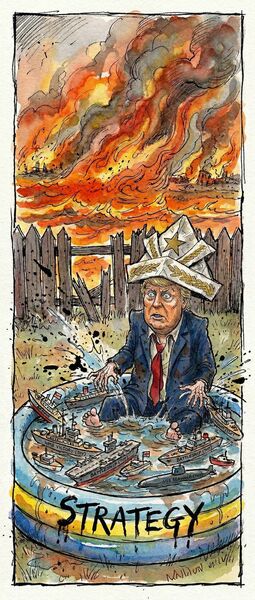
Donald Trump arrived at this conflict the way he arrives at everything - loudly, confidently, and with approximately the strategic buoyancy of a paddling pool. If Netanyahu is the obsessive schemer, Trump is the chaos variable, the man you bring into a negotiation when you want certainty replaced with spectacular unpredictability, and a good sprinkling of treachery. He threatened Iran with language so baroque, intemperate and destructive that commentators genuinely struggled to find historical comparisons that didn't involve the 1930s. He then, apparently surprised that Iran didn't immediately surrender, uttered an expletive on live television, complained that nobody knew what they were doing, and proposed talks. The same talks, more or less, that had been on the table before the bombs started falling. Full circle, except now there are considerably more craters.
What Trump brought to this particular theatre - beyond his customary genius for making any situation appreciably worse - was the genuine, almost childlike belief that overwhelming force produces submission. It's the theory of the schoolyard bully translated into geopolitics, and it works just about as well. You can bomb a country's nuclear scientists. You cannot bomb nuclear knowledge. You can strike a regime's infrastructure. You cannot strike its willingness to endure. Iran has been enduring external pressure, sanctions, assassinations and isolation for 47 years. It has, in that time, developed an almost philosophical relationship with adversity. It's the difference between a country that has read Dostoevsky and one that has merely watched the film.
Which brings us to the Iranians, and here the contrast becomes almost comedic in its starkness.
While Trump was rage-posting ultimatums and Netanyahu was conducting what he presumably considered an expert demonstration of military adventurism, the Iranian leadership was doing something that neither man is temperamentally capable of: it was being patient. Disciplined. Strategically coherent. It was sitting on the Strait of Hormuz like a man who has read all the cards at the table and is in absolutely no hurry, because why would you be, when you're holding most of them?
Iran's foreign minister, Abbas Araghchi, is the kind of diplomat who makes you reconsider your assumptions about the country he represents. Measured, erudite, fluent in the language of international law and international consequence, he moves through press conferences with the unhurried confidence of someone who genuinely isn't worried. He issues warnings in the manner of a man describing the weather - not threatening, merely informative. Should you choose not to heed them, that is, of course, entirely your own affair. He is, in other words, the absolute antithesis of everything happening on the other side of this conflict, and the juxtaposition is so jarring it's almost surreal.
Whatever one thinks of the Iranian regime's domestic record and its history of crushing dissent, they have conducted the external dimension of this crisis with a restraint that has woefully wrong-footed Washington at every juncture.
In the face of mindless fury, Iran’s escalation was carefully calibrated, and every retaliation proportionate enough to make a point without triggering the next catastrophic rung on an already slippery ladder. They warned Qatar before firing at the American base there, a diplomatic nicety so unexpected in the context of active warfare that it caused genuine confusion in the western press. They were shooting at Americans and still observing the courtesies of a civilisation that precedes America’s by millennia. It's the geopolitical equivalent of punching someone in the face, then graciously offering antiseptic and bandages.
With enraged bluster, Trump threatened to bomb Iran's energy sites unless the Strait of Hormuz was reopened by a specific date. Trump is very fond of ultimatums, issuing the kind of deadline that sounds decisive in a press conference and lands like a damp squib in the Persian Gulf. Every political observer involved has noticed that the US doesn't have the ground forces to back it up, the regional bases are within Iranian missile range, and the price of oil is already doing the threatening for them. The deadline passed. The Strait remained on Iran's terms. The price of fuel in Castlebar and Ballina remained, in its own small way, a geopolitical communiqué.
Here's what nobody in Washington seems to have modelled, or perhaps what they modelled and ignored because it was inconvenient: the Iranians are not afraid of this. They have been economically strangled for decades. They have watched their scientists assassinated in broad daylight. They have been sanctioned, isolated, demonised and encircled. And they are still there, still enriching, still financing proxies from the Houthis in Yemen to Hezbollah in Lebanon, still - against all reasonable expectation - standing. There is a word for a people that survives everything thrown at them and emerges, scarred yet strategically coherent, with maximalist demands on the table. The word is formidable. Use it about your adversaries before you start a war with them, not after.
I drove home along the coast road with what petrol I'd managed to scrounge from a station outside Castlebar that still had a trickle left. Croagh Patrick sat against the sky like a rebuke, the Atlantic was massive, grey, and entirely unimpressed by human folly, as it has been since before any of these men were born and will be long after their various catastrophes become footnotes.
Two men driven by ego, fear and the heady delusion of invincibility. And across the table, men who've been losing gracefully for so long they've turned it into something that looks, from here, rather like winning.
God help us all. And someone please send petrol.