Rebels without a clue take a trip to Cuba
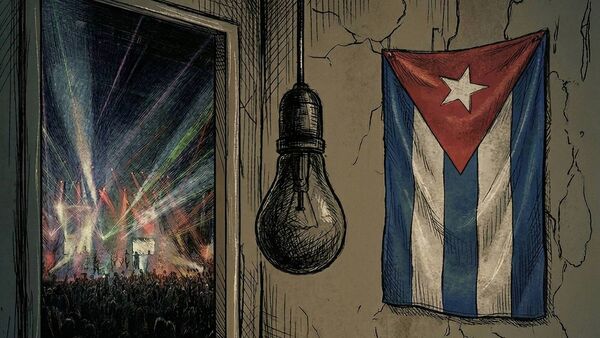
Kneecap's concert - complete with strobe lights - took place at a time when Cuba is suffering severe electricity shortages. Illustration: Conor McGuire
Radical chic has a uniform and old rockers of a certain vintage will recognise it in the slightly-too-considered dishevelment, the radical politics worn like a vintage jacket. The angst expression that signals a grieving band member feels things more acutely than you do and would like you to photograph them feeling it.
Kneecap, Belfast’s Irish-language rap trio and the most thrillingly improbable export this island has produced since Riverdance, flew to Havana on March 21st as part of the Nuestra América Convoy. They brought 300 kilograms of humanitarian aid, medical supplies, solar panels, and food. A noble gesture. Genuinely admirable.
Cuba is in the grip of a catastrophe, its Soviet-era grid collapsing, its streets darkened, its hospitals struggling on the verge of collapse, the Trump administration having engineered a fuel blockade so punishing that the island has endured three nationwide blackouts in a single month. People are suffering in ways that make our own housing crisis look like a minor administrative inconvenience. So yes, the humanitarian impulse was real and the crisis was real.
What happened next, though, is where it gets complicated. And entertaining. Mostly entertaining.
At a press conference in Havana, flanked by a suitable reverent Jeremy Corbyn - still doing the rounds like a revolutionary-themed touring exhibition and basking in reflected glory - Mo Chara declared that as Irish people, they’d grown up with “an understanding of colonialism and oppression and also forced starvation”. This is true, up to a point, but here’s the rub about the colonialism comparison: it’s the hackneyed argument that sounds magnificently worthy in a press conference and falls apart the moment someone starts asking some probing questions.
Cuba’s people aren’t suffering under British imperialism or American boots on the ground. They’re suffering under a government that has, for 60 years, concentrated power, silenced dissent, jailed musicians, and governed with the kind of enthusiastic authoritarianism that makes the Black and Tans look like an inefficient bureaucracy. The US blockade is cruel and counterproductive. The Cuban government is also cruel and counterproductive. Holding both of those thoughts at once isn’t particularly difficult, but it does require a level of nuance that doesn’t photograph well.
Kneecap, to their credit, aren’t stupid. They’re sharp, funny, genuinely talented, and they know exactly what they’re doing. Which is precisely the problem.
They did the press conference. They did the concert - high-octane, strobe lights, the full spectacle. They did the photoshoot at the National Hotel, that gorgeous colonial relic that happens to be owned by GAESA, the Cuban military’s commercial conglomerate, which controls an estimated 60 per cent of the Cuban economy. You genuinely couldn’t make it up. A band who built their entire identity on anti-establishment politics, posing for revolutionary portraits at a hotel bankrolled by the establishment they came to oppose. The optics of that would give a media consultant a nosebleed.
And then the power went out.
Cuba’s grid snuffed out when a generator failed at a thermo electric plant hundreds of miles away, nothing to actually do with the concert. But Kneecap posted online, in the breezy way of people who have a return flight booked, that even with the blackout, the “message of solidarity to Palestine remains the same”. Palestine. Which is, give or take, five thousand miles from Cuba. It was the geopolitical equivalent of someone turning up to your house fire with a bucket of water, the bucket having a hole in it, and then talking about drought conditions in sub-Saharan Africa.
Here’s what they didn’t mention, at any point during their Havana visit: the 1,200 political prisoners currently held in Cuban jails. The 2021 protests, when ordinary Cubans - hungry, exhausted, frightened - took to the streets and were met with a president who went on national television to instruct the army to confront them. The Cuban musicians who remain imprisoned for the crime of making art the government didn’t like. Mo Chara himself was charged under British anti-terrorism laws for his actions during a concert - charges that were subsequently thrown out. He knows, better than most, what it feels like to have the state turn the law into a weapon against you. And yet, with the Cuban deputy culture minister sitting at the same press conference table, he couldn’t find the moment to mention it.
A young Cuban artist, when asked what he made of the whole thing, was succinct. All that propaganda about the Cuban revolution, he said, is a lie that has been maintained for more than 60 years. Cuban journalist Yoani Sanchez was less restrained: “They embrace those who gag us, take photos with those who repress us, and smile alongside those who destroy our nation.” She also noted, with some asperity, that Kneecap’s concert at the Convention Palace consumed enough electricity to light several buildings in her neighbourhood, which was at that moment plunged into darkness. Whether or not that’s technically accurate, as a metaphor it’s pretty much perfect.
I confess to admiring Kneecap, be it at a happy remove. Their inventive creative persona is a compelling concoction of raw creativity and political savvy, with the Irish language charged with provocation, the Republican politics worn without apology, married to the calculated chaos of their public persona. They’re that rarefied breed of anarchic creativity that makes older men in rural Ireland feel strangely proud but mildly, uncomfortably anxious, as if social chaos might ensue in their concerts wake. And the Cuban crisis is real. The blockade is real and ongoing and the consequent suffering is ever present, none of that is in dispute.
But there’s a long and rather glorious Irish tradition of projecting our own story onto other people’s struggles without quite doing the reading first. We see colonialism everywhere because we experienced it so viscerally that it became the lens through which we view everything. Cuba? Colonialism. Gaza? Colonialism. The comparison can be useful. It can also be a way of making someone else’s very specific, very complicated tragedy about us - about our history, our grievances, our narrative. And when you do that, you stop listening to the actual people in front of you.
What’s also hard to ignore, and I say this with no particular pleasure, is the timing. Kneecap’s third album, , lands in April. Rumours of a second biopic are circulating. A summer of festival appearances stretches ahead - Primavera, Roskilde, Reading and Leeds, a headline show at Crystal Palace Park. There’s no better promotional backdrop than a Cuban flag, a gorgeous Havana sunset, and the suggestion that you’ve somehow defied the American empire. The whiff of revolutionary sulphur doesn’t half shift tickets.
None of this means their motives were purely cynical as people often do things for complicated reasons while still achieving some good and the aid they brought was real. The attention they drew to Cuba’s crisis had considerable publicity value and shone a brief light on a largely forgotten injustice. But a solidarity that won’t name the festering jails, won’t acknowledge the dissidents, won’t say one uncomfortable word in front of the minister is not solidarity but an extended PR exercise with clever political maneuvering.
There’s a plaque on O’Reilly Street in Old Havana, in Spanish, English and Irish, celebrating the shared histories of Ireland and Cuba. What it fails to mention is that the man whose name the plaque honours, Alexander O’Reilly, born in County Meath in 1723, was in Cuba as a Spanish military officer. Not a republican revolutionary but a well-heeled imperial administrator. History, it turns out, is always more awkward than the plaque.
Kneecap went to Havana, performed their anarchic hearts out, dutifully posed for the photos before flying home, and the Cuban people are exactly where they were, stumbling around in the dark. Waiting for something more than an electrified gig.