Rural revival as 1800s Mayo cottage comes back to life
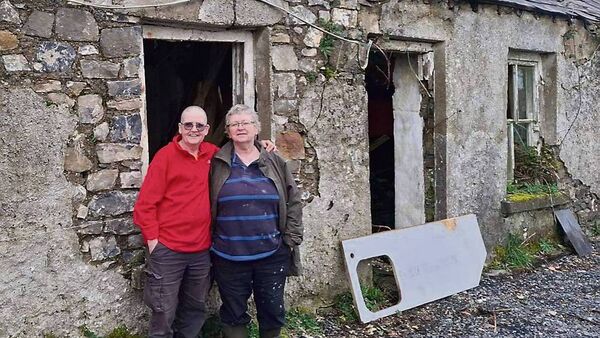
Deb and Pam Mejor outside their cottage at Ballinastoka, near Ballyhaunis.
COMMUNITY NOTES: BALLYHAUNIS - WESTERN PEOPLE (MARCH 24 EDITION)
Much is written about rural depopulation and decline but the lure of life in the Ballyhaunis hinterlands remains strong. Drawn to the peaceful surrounds of Ballinastoka, a townland adjacent to Logboy, English couple Deb and Pam Mejor are refurbishing a cottage built in the early 1800s and vacant for fifty years.
It was April 2025 when Pam first saw the cottage. Back home in Lichfield, near Birmingham, she’d been hunting for Irish rural properties on the property website Daft.ie.
There were three cottages to see during that visit last spring: one in Pettigo (Donegal), another in north Letrim and then the cottage being offered with 12 acres in Ballinastoka.
That same day she was shown the property by Ballyhaunis estate agent Kevin Kirrane she made up her mind and phoned the agent with an offer while on the way to Ireland West Airport for a flight back to England. It was the peace of the site that sold her.
“You barely hear a car pass, just the sound of birds, and there’s a beautiful field at the back.”
The price was fair, she said, and in the summer of 2025 she and Deb moved over.
The once populous village of Ballinastoka, six kilometres from Ballyhaunis, was empty in recent years but the lights are back on after several properties were sold, with a Croatian family moving into a small bungalow next door to Deb and Pam. A family from Claremorris are restoring another nearby farmstead.
The couple’s knowledge and construction skills are proof of how much can be accomplished without waiting on a builder or a mains power connection. Since purchasing they’ve built a cabin residence while they work on the house. They’ve also built a handsome wooden barn for their equipment. Solar panels provide electricity, backed up by a generator. Soon they’ll add more panels to boost their power supply.
Pam spent a career advising contractors on the restoration of old castles and historic structures across Britain.
“I’ve worked on many refurbishments of stately homes,” she explains.
From her professional vantage point, Pam thinks a builder would ask €200,000 for the refurbishment from what a sign on the gate announces as Finnegan’s Cottage.
That’s the name of the family to whom the cottage and fields once belonged. Built in the vernacular style with local stone, the cottage had been thatched but the Finnegans availed of a grant in the 1950s to slate it. A few decades later the house was vacated and a small council house built adjacent to it. That house was also sold recently and is now occupied by a young Croatian family.
The couple will use traditional lime rather than cement mortar in repairing and pointing the stonework and finish the walls with lime harling, a coating similar to what was originally applied to the stones.
Lintels will be replaced with horse chestnut wooden lintels, chosen for the close grain.
“Timber, unlike concrete lintels, will flex,” explains Pam.
A second chimney added belatedly to the left gable wall will have to come down, having already stressed the wall with a crack.
The walls are two-foot wide but a three-foot-wide wall carries the main chimney in the kitchen. A large wooden beam built into the wall on the reverse of the house marks where the hag, an alcove off the kitchen, was added. The wall was boarded up where the hag once stood but the rotting of the beam has prompted some subsidence in the wall.
Also on the back wall where the anchor of a cattle crush was pulled out, ivy roots are visible, the sinuous plant having worked its way into the middle of the wall. In this section the Mejors plan to take the perimeter walls of the house down to the height of the window lentils and rebuild.
The first thing they’ll do is erect scaffolding and take off the chimney on the gable wall. Then slate by slate they clear the roof. They may opt for a tin roof which, with modern insulation products, offers the same comforts as slates.
They’ve decided not to go for the state’s refurbishment grant for derelict properties, which can be worth up to €70,000. This is because they want to do it themselves and don’t want to be under a 13-month timeframe.
“They will let you extend up to 19 or 20 months but still, we’d prefer to work at our own pace,” explained Pam.
There’s plenty of room for their three dogs to roam. Deb plans to continue her practice as a dog behaviourist, taking in dogs for training. She’s already printed leaflets to advertise locally.
Out on the 12 acres, some 690 saplings have been planted by local schoolchildren, partly for biodiversity and partly as a natural means of drainage. As we walk the field, the couple marvel at the primroses in the hedge, the harbingers of spring on the traditional clay ditches that divide fields and offer some space for wildlife lost on larger farms where such ditches have been removed.
Both Deb and Pam grew up on farms.
“Both of my parents were dairy farmers and some of my family are farmers. There’s plenty of rushes and docks too in Derbyshire,” said Pam.
Visiting with them gives one hope that rural Ireland, its vernacular homes and its fauna and flora are, in this patch of East Mayo, in good hands.