End of an era as Frank parks up his thresher
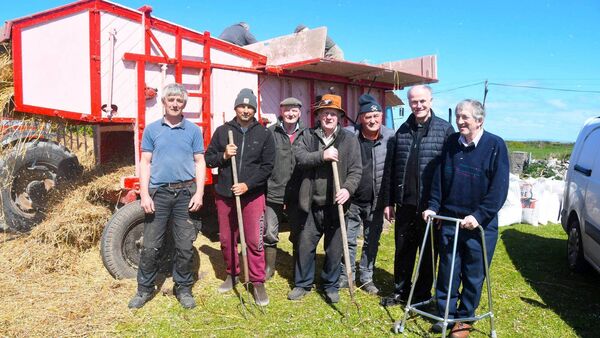
Pictured beside the thresher at Rathlee in Easkey were, from left: Jim Long, Joe Lacken, Keith Usher, Frank Flannelly, Paddy Joe Walsh, Fr Joe Hogan and PJ Curley.
A crowd came out in Rathlee recently to mark the parking up of Frank Flannelly’s thresher after 50 years of shaking the grain from sheaves of oats and barley across Sligo and north Mayo.
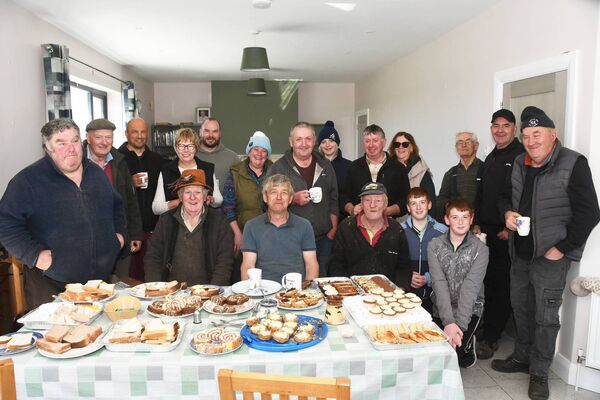
The final two acres took two hours to thresh. Friends and colleagues from a lifetime of working the land came for the camaraderie, the tea and the unmistakable sound of the thresher, sieving and shaking the grain. A low droning hum partly drowned out by the engine of a vintage blue tractor, the sound of the thresher from Frank’s yard was a communal beckoning in decades past, drawing the dozen or so farmhands required to run it efficiently.
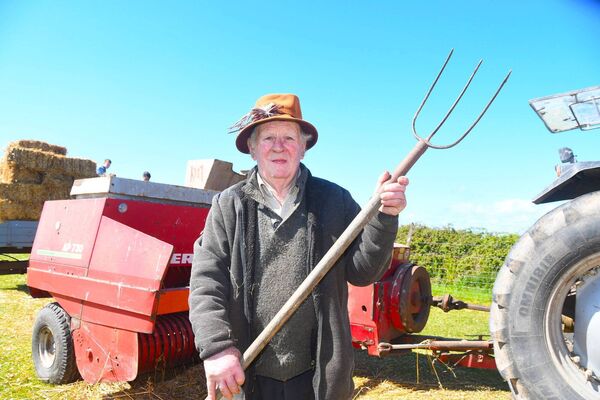
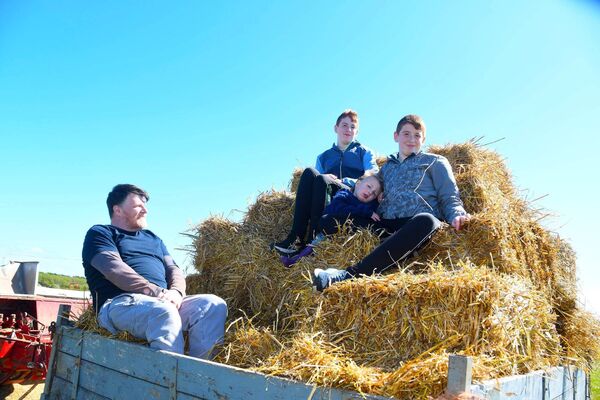
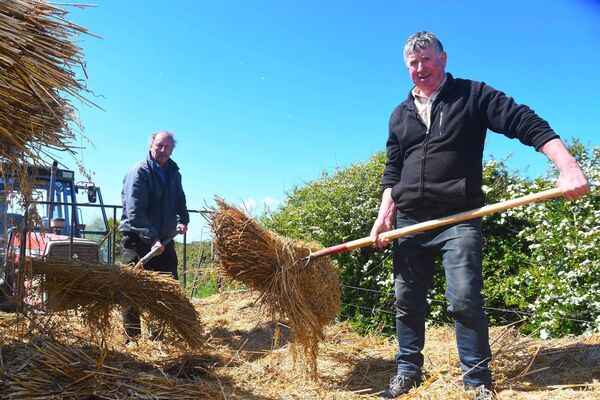
“You have one man on the bags, two on top feeding the machine and two forking. And you’d want one or two taking away the straw from the mouth of the machine,” explained Frank, whose red square baler was parked nearby to bale the straw.
The oat sheaves stacked for Frank’s final threshing yielded 30 bags of oats, weighing a total of 30kg
“That was meant to be threshed in autumn but the weather was too bad. An awful lot of people came to see it, they came from all around, some came from Dublin.”
And what now for the thresher?
“Someone might buy it. I would sell it. I’d be sad to see it go but there comes a time when you have to raise the white flag.”
Frank, now aged 75, bought the thresher from a man called Keaveney in Ballina when he was 24.
“It was just before Ireland joined the EU. I had done all of Galway and Clare and Mayo in a Morris Minor with Willie Keaveney looking for a thresher.
“There was no Done Deal then. We’d get a number and hit the road. There were a lot of threshers being sold in Tuam by people switching to combines.”
He eventually settled on the machine in Ballina, having come close to buying a machine in Kiltimagh.
“I nearly bought one in Clare, it was a very good mill, it was sold for 800 or 900 pounds, it was a lot of money then.”
Frank’s thresher still bears the name of its builder, Ransomes (Ransomes, Sims & Jefferies), who built the machine in Ipswich, England in 1945.
“We were three or four days fixing it up after bringing it from Ballina.”
The thresher was a product of the Industrial Revolution, arriving in the 1800s to relieve farmers of the back-breaking work of flailing grain sheaves with a stick. These stationary machines were driven by coal-eating steam engines whose role was later taken by diesel-run tractors.
By the 1960s however, Ransomes were focusing on mowers and combines were able to cut and de-grain as they moved through the field. Self-propelled combines, which had arrived on the American plains in number from the 1950s, began to appear in western Europe over the following two decades, displacing the stationary thresher.
Back in the 1970s, Frank drove his newly acquired thresher with a Massey Ferguson 35 tractor bought in the Roscommon village of Ballinagare for £375.
“I bought a Massey Ferguson 165 a year or two later," he adds.
The thresher was the latest acquisition for a nascent contracting business being built by Frank who had quit a promising showjumping career to focus on machinery, having started to go out on hire at 22.
“I was cutting hay, ploughing, and rotavating,” he recalls.
Threshing had started to die out.
“People doing big lots of grain were getting the combine harvester.”
But Frank had plenty of his own oats to thresh.
In his prime, Frank spent his youthful energy reclaiming farmland for tillage.
“It was bad land with rushes, I dug drains six or seven foot deep and I put in grain. He rented land too, ploughing and tilling it.
“When I was ploughing 40 years ago I’d be ploughing for two weeks.
“I bought a binder, cutting it in sheaves that you’d stook. I went on hire with the binder too for a few local farms.”
Come the Autumn he took out the thresher.
“We started threshing in September, if was a good year we’d start from September 15 or 16 onwards.”
Depending on the weather threshing season was usually over in a few months.
“Some of them would be finished in November,” explained Frank. “At one time there were plenty of threshers operating in and around Ballina. The coastal strip from Ballina to Dromore West gave good conditions for growing barley. As a youngster I saw fields of grain. There were 20 people in a field tying sheaves, boys and girls.”
Frank’s Ransome has aged well. He also spent €6,000 on it ten years ago to update the belts which drive the wheels that in turn work the internal drums, blowers and sieves that detach the grain from the straw and chaff.
“We took out the drum and put in a new one... The parts came from the east coast. There’s plenty of belts in Wicklow.”
The timber frame of the Ransome has also been replaced in recent years by Michael Farrell from Culleens, Sligo.
“He’s a right good carpenter,” explained Frank. “He was three winters at it. We replaced a lot of the timber, it was dozed. We replaced a lot of the walkers and the riggers. It’s a very complicated series of fittings and gadgets which drive the machine.”
Frank’s brother invested in a combine harvester 30 years ago. You could go in with the combine at noon and have 10 acres done at 8pm.
In the damp west of Ireland climate there was a practical reason however for threshing.
“If the moisture is too high you can’t cut with a combine, on a bad year you’d be better off with a thresher."
A Sligo draper with horses, Kieran O’Hara, bought Flannelly’s oats.
“He kept top of the range horses, and he found that grain coming from the combine had too much mould, he couldn’t use it. That’s why Kieran O’Hara bought my oats. It’d be like glass in your hands... We had good oats, they were rolled very well. He was my number one customer for ten years.”
Kieran O’Hara passed on and Frank eventually ploughed and seeded his fields for grass.
“I was getting more into cattle," he notes.
Threshers may have idled with the dying out of tillage but they remain a fixture of summer festivals and rural summer gatherings. This writer first met Frank at the vintage show in Aghamore where two threshers shook sheaves of oats that had been driven westwards from county Laois.
In Aghamore, Frank was helping two other thresher operators: Robbie Lilly of Gorthaganny on the road between Ballyhaunis and Ballaghaderreen and Michael McLoughlin from Newport. Both had transported their machines to Aghamore for the vintage show.
The novelty of the thresher has also made it a draw for fundraisers. Frank raised €28,000 for the refurbishment of the graveyard in Easkey.
“The priest came in, I said we’d hardly be able to get any grain but maybe we’d do it for charity... We put up a heifer and a couple of €500 prizes. Smiths in Offaly put up three tons of meal as a prize.”
Naturally sociable, as attested by the crowd which attended his final threshing, Frank reminisces about the great machinery dealers and horsemen he knew, some of whom have passed.
Frank is one of a now rare breed, the farmer who competed in horse sports with his working horses. He recalls a great horse from Tuam, an Irish draught his father bought from Joe Sweeney, the horse dealer.
“I rode him home from Ballina to Easkey. I worked him with the mower. He turned out to be a serious jumper.”
He had quit a promising show jumping career at 24 years having won in Claremorris, Castlebar, Tubbercurry and Ballinrobe shows.
“I beat John Daly in Ballinrobe after three jump offs” – a reference to the legendary Connemara pony trainer and dealer from Lough Mask House who died in 2021.
“We had three horses, my father had a lorry. We went up to Irvinestown in the north.”
One of Frank’s machinery suppliers of choice was Tommy Johnston in Ballyhaunis.
“I bought a fair few bits of machinery from them. Tommy and his father didn’t need to look in a book, they were the best store men in Ireland.”
The Ransome thresher is now parked up, awaiting its next owner.
“After a threshing session we give it a good hoovering and put it in a good shed. Now and again with the belts off I turn the wheel and if you spin the wheel anything inside will fall out. That’s important, mice might get in if there’s any grain left.”