Mayo couple's baby was fatally injured during birth
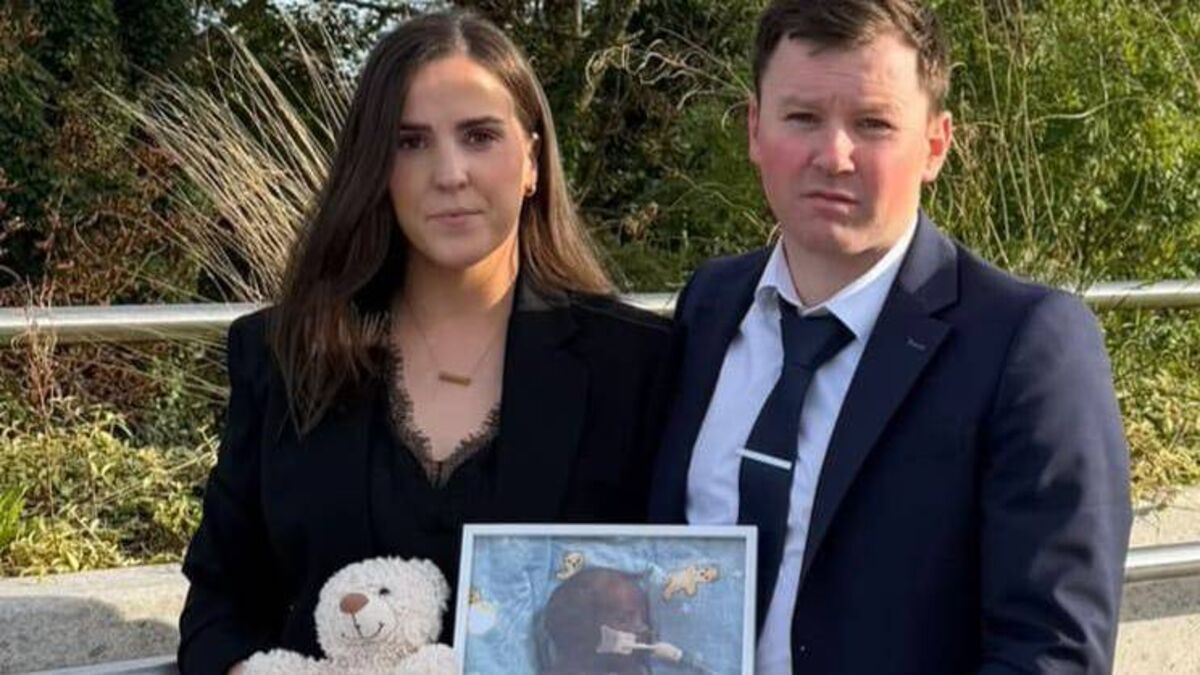
Andrea and Terence Dever holding a picture of their baby boy Ódhran who died shortly after birth at University Hospital Galway.
A coroner has said the death of a Mayo couple’s baby boy was one of the saddest inquests he has ever dealt with.
A verdict of medical misadventure was recorded at Galway Coroner’s Court following the death of Ódhran Dever at University Hospital Galway.
His parents Andrea (nee Barrett) and Terence Dever, from Belmullet and Achill, have called for improvements in obstetric care at the hospital after their beautiful baby died after sustaining injuries following his delivery via caesarean section.
Ódhran, the first born child of Andrea and Terence, was born by caesarean section at University Hospital Galway on October 1, 2025, at 28 weeks gestation. He died two days later.
Ciara Davin BL, instructed by Treasa Norrby of Callan Tansey Solicitors LLP on behalf of the family, told the inquest that Ódhran was in such poor condition that a neonatologist asked his parents what had happened during the delivery. She said he was so badly bruised that a peripheral line could not be inserted into his limbs.
Coroner Ciarán MacLoughlin returned a verdict of medical misadventure. He offered his condolences to Andrea and Terence, adding that it was one of the saddest inquests he had dealt with.
Andrea and Terence welcomed the verdict and expressed their hope that no other family will suffer the heartbreak they have had to endure.
“We welcome the coroner’s verdict of medical misadventure in the circumstances surrounding the death of our beautiful son.”
"Odhran entered a theatre in University Hospital Galway on 1st October, 2025, as a perfectly healthy baby ready to meet the world. He left that theatre with fatal injuries and tragically passed away two days later,” said the heartbroken couple who live in Achill.
“While nothing can undo the pain of our loss or bring our beautiful child back, it is our profound hope that improvements will be made to obstetric care in University Hospital Galway and throughout Ireland, so that no other family must endure the heartbreak we live with every day. Let those improvements be part of Odhran’s legacy, his short life will help to make a difference for other babies and families in the future,” said Andrea and Terence.
“We would like to thank our family and friends for their love and support, our legal team and everyone who has stood alongside us during this unbearably difficult time,” they added.
The inquest heard that an ultrasound at 21 weeks showed that Andrea’s placenta was low-lying and posterior, placing her at risk of bleeding. She was admitted to the hospital as a high-risk patient after experiencing a bleed at 27 weeks.
Following several further bleeds between September 25 and October 1, clinicians decided to carry out a category two caesarean section, the inquest was told.
Specialist registrar Dr Josil Selvi Jothi, who began the operation with consultant obstetrician Dr Nada Warreth assisting, told the inquest that after the amniotic sac ruptured, the baby moved from a head-first position to a transverse lie, making delivery through the incision more difficult.
The court heard that both doctors attempted to deliver the baby by taking hold of a foot and pulled him towards the incision. Their efforts were unsuccessful even after the incision was extended into a “T-shape” incision.
A third consultant obstetrician, Dr Sumita Sarma, was called from the corridor to assist and delivered baby Ódhran. She told the inquest that she did not find the delivery difficult.
Andrea recalled feeling “a substantial amount of pressure and tugging under my right rib” during the procedure. Ódhran was pale, blue and in shock when he was delivered, the inquest heard.
On admission to the neonatal intensive care unit, Ódhran was found to have severe bruising to his hands, arms, leg and back. He developed Respiratory Distress Syndrome (RDS) and metabolic acidosis. Internal abdominal bleeding was suspected, and his haemoglobin level fell despite multiple transfusions.
The inquest heard his kidneys were compromised. Consultant neonatologist Dr Johannes Letswhiti documented his concerns about a possible liver injury caused by the delivery. An ultrasound showed fluid in the abdomen that was considered suspicious for blood.
Despite significant efforts to keep him alive, baby Ódhran suffered a massive hemorrhage and his care was redirected to palliative treatment. He died in his mother’s arms on October 3, surrounded by his family.
His father, Terence Dever told the inquest: “We were living out our worst nightmare.”
Pathologist Dr Laura Aalto said a post-mortem examination found no dysmorphic features or congenital abnormalities, and that Ódhran’s measurements and organ weights were normal for his gestational age.
She formed the view that the cause of death was extensive internal haemorrhage, intracranial and intraabdominal with secondary hypoxic ischaemic injuries.
Dr Aalto told the inquest that the liver injuries were caused during the difficult extraction and may have occurred as a result of external compression, traction, manipulation during extraction or acute increases in abdominal pressure. She concluded that the timing of the injuries occurred during delivery or immediately after. She informed the coroner that she believed the liver injury happened first and the baby’s subsequent deterioration followed from that.