Billy Heffron's lifetime of fighting the good fight
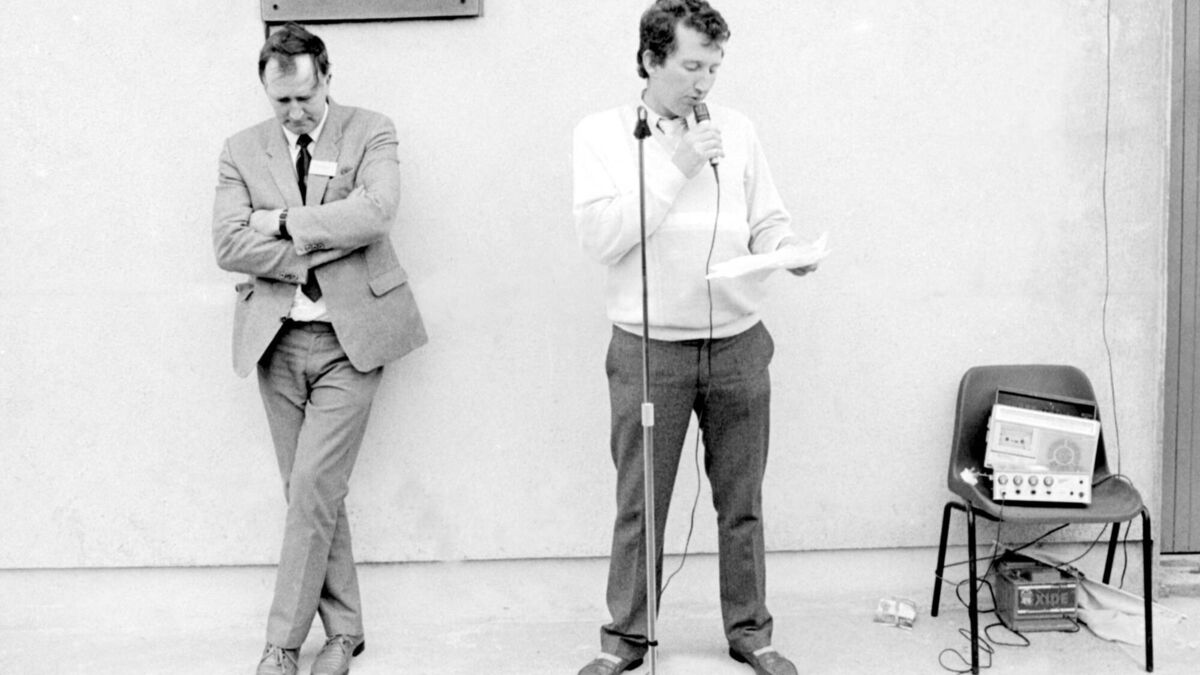
Billy Heffron (on left) at the opening of Moygownagh GAA pitch in 1987. The late Pat Dowling is the man on the microphone.
I think it was a twenty-pound note.
Dad had business to do elsewhere in Ballina and gave my sister and me the money to get something to eat while he was away. It felt like a fortune. As a young teenager, I never had such freedom to eat in a restaurant. I spent it all in Cafollas. Probably on Chicken Kiev and mashed potato. Such were the heights of my elite culinary tastes and not much has changed since.
My sister had suggested we get something small and keep the change for Dad. I insisted there was no need, even as I had a nagging notion that this was wrong. When we met him later and I said there was no change out of the £20 note, I remember his face with unmasked disappointment. He had needed the change.
Not anger. Disappointment.
It took me years to understand why.
As children, we did not think of ourselves as poor. We had football, school, the community centre, friends, neighbours and the whole countryside around us. I worked on the farm and went to Mayo matches. Later, there were teenage discos. Life felt full.
There were families who had more than us, certainly. There were others with less. But there was no social media to provide a running inventory of what everyone else owned, where they went on holidays or how the inside of their houses looked. We did not expect much materially, so we did not spend time mourning its absence.
There were hand-me-downs and patches on clothes. Appliances were fixed rather than purchased anew. A gap in a fence might be filled with a thorny bush or a wooden pallet instead of new wire and timber posts. Cars were repaired more than replaced. We worked and made do because that was simply what people did.
Mam somehow made summer holidays happen. She saved enough for us to visit Galway, Donegal or even Cork, where her family came from. I remember my first holiday crush on a Northern Irish girl at Trabolgan Holiday Village, and a rain-soaked Bundoran trip when my baby brother was dropped on his head as my sister slipped near the hotel swimming pool. He is fine now. I think.
Those trips felt like grand adventures. I suspect they required far more planning and sacrifice than we will ever know. Though, to be honest, we always preferred time with our Rohan cousins in Ballinasloe, and would have been happy playing on Enniscrone beach on the odd sunny Sunday, while Dad listened to GAA matches on the car radio and Mam shook sand out of our sandwiches.
One memory has stayed with me. When we were small and had likely done something bold - okay, I had likely done something bold - Mam became upset and, through tears, announced that, because of us, she could not buy herself a new coat. I remember her leaving the room and us being confused by this new zero-sum equation.
It was said in a moment of exasperation. But it lodged somewhere in me. It was perhaps the first hint that our ordinary childhood was being sustained by things our parents went without. So caught up was I in my own wants and needs that I had never comprehended our effect on my parents’ lives.
Dad’s new biography, , makes clear how much was being held together. The dairy farm did not provide enough to sustain the family. Mam’s teaching salary from her work at our local primary school was essential. She also managed the day-to-day lives of seven children, the groceries, household budgets and the accumulated work of a busy home.
Dad was working too, of course, but his work stretched in every direction: the farm, GAA, NCF co-op, community campaigns, politics, radio, auctioneering and advisory work. He was often away from home, not just with work but also because he believed that building a life in Mayo required showing up in all those places.
That was the bargain, although I did not see it at the time. Dad’s public life was made possible by Mam’s private labour.
The wider Ireland of that period was difficult too. When Ireland joined the EEC in 1973, it was still heavily dependent on agriculture and afflicted by poverty, unemployment and emigration. By 1986, unemployment had risen above 17 per cent and interest rates soared. Dad remembers their bank overdraft, which seemed to grow even as money was paid into it every week. ‘Like throwing petrol on a fire,’ he says.
The £20 note makes more sense in that light.
It was not an accusation against two children who had just bought dinner instead of sandwiches or sweets. It was the face of a man who had expected the change because the change mattered.
There were heavier burdens as well. In 1984, Dad and Mam moved our family in with his parents, Alec and Bridget, so they could help care for them. As Dad’s father’s Alzheimer’s progressed, we lived through the long confusion, exhaustion and grief of an illness less understood then than it is now.
I remember seeing Dad, after a hard morning milking cows, undressing and cleaning my confused, whimpering grandfather in the hallway of our house. It was very tough on him. He did his best with Grandad and cried when he eventually had to admit him to a nursing home.
He later turned that private pain into action, helping to raise money for Alzheimer’s support in the west of Ireland, including a sponsored walk from Galway city to the Western Alzheimer’s Centre in Ballindine. With characteristic impulsiveness, he did no preparation and was utterly exhausted and blistered by the time he completed the 53 kilometres with his friend John Duggan of Midwest Radio.
That, perhaps, is the thread running through his life. He did not always have money, time or an easy answer. But he had a strong instinct to get involved and to do what mattered, and to do it “right then, right now". He brought that instinct to farming, the farming co-operative movement, on Midwest Radio, GAA, regional campaigns for economic improvement and his 2002 general election run. His story is not really about collecting titles. It is about a generation that believed their communities could be improved by the people who lived in them taking responsibility for the struggle. Dad is one of those people.
Ireland has changed beyond recognition in some ways since. Agriculture now accounts for only a small share of the workforce. But the story of the rural west is not simply one of disappearance. Mayo’s population grew by six per cent between 2016 and 2022, even as it became older than the country as a whole, which complicates the easy story.
The harder question is whether the things that made our childhood feel rich can still be sustained: farms, clubs, schools, local work, community confidence and the willingness to keep showing up for each other.
His name is Billy Heffron. I have called him Dad all my life. His book has allowed me to see more clearly the life behind the name: the work, the public battles, the absences, the care, the humour and the quiet anxieties that he and Mam tried to keep from us.
I will be thinking of that £20 note. Not just because I should have done better when entrusted with it, but because it taught me a small lesson in the invisible work of parents: how they kept a childhood happy while carrying worries we never fully saw.
* Billy Heffron will launch at the Great National Hotel, Ballina, at 7pm on Friday next, August 21, his birthday. All are welcome.