Local Notes: French couple revive Urlaur cottage
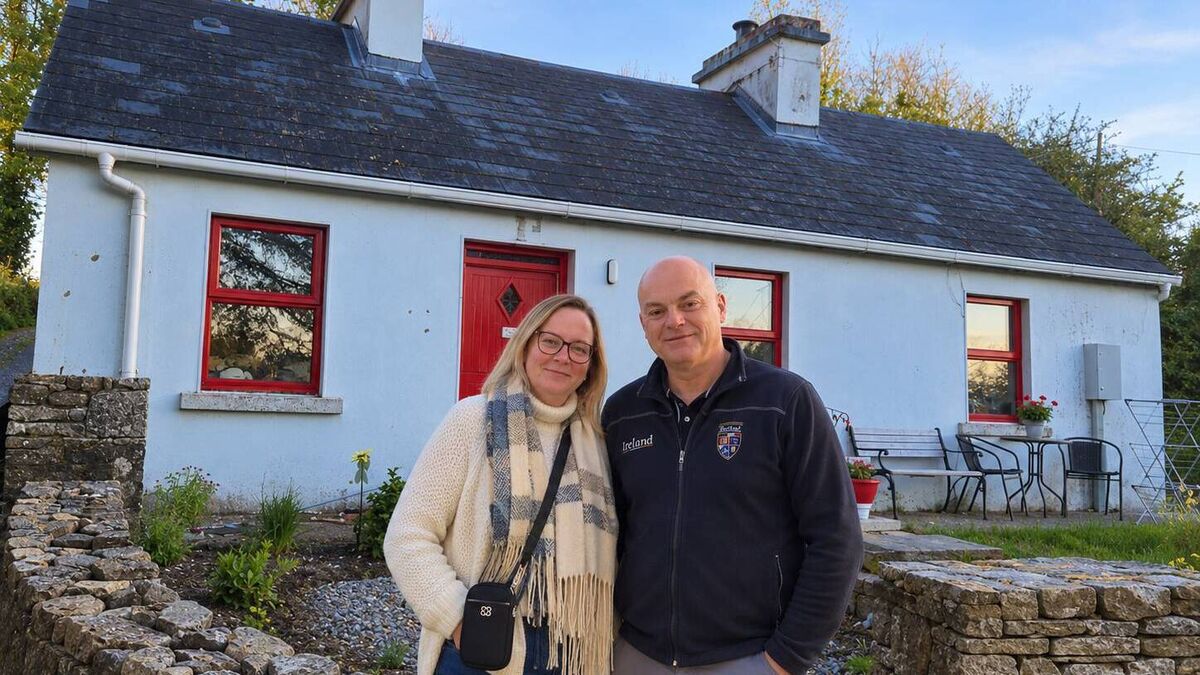
Estelle and Erwan Seznec outside their restored cottage near Urlaur.
With its whitewashed walls and brilliant red windows and doors, Fern Cottage in Carrowbeg near Urlaur is a gentle update of a traditional rural Irish scene.
It’s home to French couple Estelle and Erwan Seznec who have with their own skills and labour turned the cottage into a comfortable home.
The couple moved to Ireland four years ago. For Estelle it was the fulfillment of a long interest in Irish culture “since I was very, very young”. The couple comes from Brittany, the northerly region of France with its own Celtic culture.
They made the move in 2022, living first in Galway city while looking for a rural home, in Mayo or Sligo.
“After we visited Mayo on the second trip we were in Achill and Westport and Ballyhaunis. We found it very rural, countryside like Breton.
"When we visited Kilkelly I thought ‘this is it, it’s here we want to live.’”
After visiting 30 houses they settled on the cottage in Carrowbeg, surrounded by forestry and farmland.
“Two years ago we bought the house, it’s a very old cottage. It needed a lot of work.”
The cottage came with 1.5 acres, home now to the couple’s 12 chickens.
“We’d like to get a bit more,” said Estelle, who works from home.
She continues the work she did in France, training social workers, which she delivers online, but she’s also set up her own pet-sitting business.
“I did this in France," she notes.
Estelle goes to homes to care for cats and dogs while their owners are away and also minds the pets at her home.
“There is plenty of demand for this service here, more than in France.”
Erwan has found lots of demand locally for his specialty of dry-stone walling, using good work and leaflets to draw more customers. Stonework is a family tradition: both his father and grandfather were masons.
He has many clients, “many people with old cottages,” explains Estelle.
There’s also plenty of demand for his gardening work.
“It was his profession in France,” she adds.
He has also done most of the work on Fern Cottage, from internal refurbishment to the handsome drystone walls that frame the building.
“Erwan had renovated two houses before moving here from France, so he has experience,” explained Estelle.
He also replaced the floor in the old cottage.
“We were cooking one day and the kitchen floor collapsed," says Estelle.
An electrician was required however to get the electricity supply re-connected to the cottage.
“We were living on solar panels for eight months,” said Estelle.
Heating the cottage on electric heaters has been costly however.
“The first electricity bill was a shock!” she says.
The cottage was affordable because the couple was able to complete most of the work themselves. Irish home prices are higher than those in France, according to Estelle.
“France has its own housing problem – it’s very difficult, because many houses are now rented on Airbnb. But house prices in France are lower than Irish prices.”
The nature of the market aside, the nature of home selling in Ireland also differs from that in France.
“One of the things however that’s different is the bidding system,” said Estelle. “In France you buy the house at the price it’s listed but here it’s possible to bid above that price.”
Estelle recently purchased a Toyota car.
“Breton [Brittany] too is very rural, you need a car."
She had been used to driving around the country roads of Brittany but the roads in east Mayo are much narrower than in Breton, she observes. The couple enjoys visiting the pubs of Aghamore, Ballyhaunis and Charlestown.
A rare example of a mature elm tree and a number of old beech trees were praised by ecologist Dr Karina Dingerkus who spoke on the Ballyhaunis GAA Club’s biodiversity action plan during a Climate Action Week event at the club recently. Ireland’s majestic elm trees were largely wiped out in the 1970s and 1980s by Dutch elm disease, a fungal infection.
Dr Dingerkus outlined the existing biodiversity at the club grounds and recommendations for enhancement of the natural world on the club grounds. The GAA’s Green Clubs programme encourages actions at club grounds to protect biodiversity and the climate.
Dr Dingerkus outlined plans for native tree and hedgerow planting around the club grounds, suggesting smaller native tree species such as hazel, birch and rowan as ideal replacements for larger non-native conifers. She also praised an ivy wall at the grounds as ivy being late to flower and produce fruit offers a source of winter food for birds and other wildlife.
Club chairman William Nestor said the biodiversity plan was the latest in a series of measures taken by the club which included a cycling promotion event and an audit of the energy use at the.
Chair of the Ballyhaunis green club committee, Mary Prenty invited those with an interest in implementing environment measures to join the committee to carry out the actions recommended by Dr Dingerkus.
A poor railway service for pigs was a major gripe of Ballyhaunis businesspeople when they gathered 110 years ago as the Ballyhaunis Fairs, Market and General Improvement Committee.
Meeting in April 1916, the committee was chaired by JJ Waldron JP [Justice of the Peace] and attended by Thomas Cunningham, Pat Freely, JF Coyne, EJ Murphy, James Murphy, James Waldron and Patrick O’Brien. All present agreed to send a letter to the Great Midlands & Western Railway (which ran the line servicing Ballyhaunis) to complain that “wagon accommodation at the last pig fair was, as usual, very short". This shortage of cars for Ballyhaunis was leading to the “diversion of trade” elsewhere which was “very injurious to our interests,” wrote the committee.
A report of their meeting in this newspaper at the time was read at the fortnightly meeting of the Heritage and Genealogy group organised by Ballyhaunis Community Council which puts up digitised newspaper archives on the large cinema screen in the Community Hall for all to read.
Another report from a 1922 edition of the detailed a special train service for a giant Castlebar rally attended by Michael Collins and key pro Treaty political leaders. The train collected passengers in Ballyhaunis but also in Ballinlough and Bekan, two stations long since closed.
The group will be meeting again on October 27 for a second talk by former political representative Jim Higgins on electoral days of old in Mayo.
Many thanks to all who have submitted material for , which is due to be published at the end of November. Editing and preparation will continue over the next few weeks before going to print. Every effort will be made to include material received late, but cannot be guaranteed inclusion due to expected space limitations.
The Government will from January double the number of places on a pilot reform of the rural social scheme. There will be 500 places nationally for the Rural Dwellers Scheme which gives a position similar to the Rural Social Scheme to those who live in rural areas but who don’t have a herd number.
The reform aims to address a sharp fall in applications to the Rural Social Scheme (RSS), which has traditionally employed low-income farmers to work on services of value to their local community. RSS workers have been key to the maintenance of community facilities in Ballyhaunis such as the Friary and grounds.
Abuse of tourist visas will be subject to prosecution, according to the Department of Justice, in response to a query from this column after a reader suggested in one case family members of a person on a work permit in Ballyhaunis were visiting on tourist visas but staying for up to a year and working in casual labour.
The Department of Justice in a statement to the said: “Any visa-required national who wishes to enter the State and remain for up to 90 days must have a Type C short-stay visa, while those intending to reside for longer than 90 days must have a Type D long-stay visa. Non-EEA [European Economic Area] nationals wishing to take up employment in the State are, in general, required to hold an employment permit issued by the Department of Enterprise, Tourism, and Employment and must also hold an appropriate immigration permission.
“Any non-EEA national who comes to the State as a visitor is expected to leave Ireland before the expiry of their visitor permission. A member of An Garda Síochána may arrest a person without a warrant where they have reasonable cause to suspect that that person is unlawfully in the State or working without an employment permit.”