Bog oak – timber from our ancient past
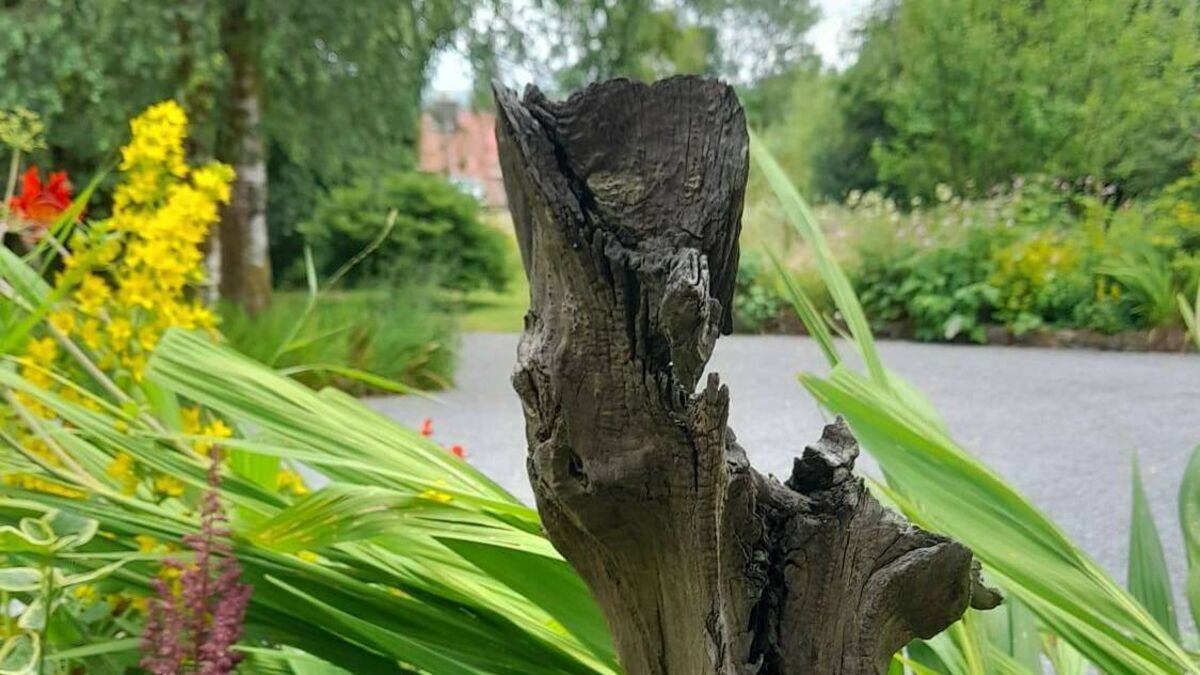
The pieces of bog oak in my garden have come from bogs that have grown steadily and witnessed countless changes over a lengthy period of time.
I have a few pieces of bog oak strategically placed in the flower beds around my home. I found them here and there over the years, on reclaimed ground and in various bog holes. They are nothing fancy, just unusual shapes that I thought added character to my garden.
Apart from their sculptural shapes, what I like most about bog timber is its age - most pieces are about 5,000 years old. This puts me in mind of what the Ox Mountain region might have been like at that time and all that has happened since the day such trees sank into the boggy ground that was fast forming around their roots.
Bogwood is formed from trees that have been buried in peat and preserved from decay by acidic and anaerobic conditions, sometimes for hundreds or even thousands of years. The wood is usually stained brown by tannins dissolved in the acidic water. Bogwood may come from any tree species that grew in or near bogs, but mostly include oak, pine, yew, birch and alder. Generally, the harder the original wood, the better the bogwood.
Chris West, writing for the International Oak Society in 2025, says that bog oak is a catch-all name for partially fossilised wood, although most of it, as its name implies, does indeed originate from oak trees.
This centuries-long process, often termed 'maturation', turns the wood from its original colour to various shades of brown and black, while increasing its hardness to such a level that it can only be carved with the use of specialised tools.
The pieces of bog oak in my garden have come from bogs that have grown steadily and witnessed countless changes over a lengthy period of time.
Some 8,000 years ago, our early ancestors were slowly populating an island that had just emerged from under the weight of the Ice Age. As the ice melted, pools and ponds and lakes began to form and around them woodland and forest began to grow. An ever-warming climate provided the perfect growing condition for moss and weeds and grass, and soon parts of the island became lush and green while basins and lowlands became waterlogged.
The first coat of moss that crept into the first pond began to form the first layer of peat in the first bog while ever-enlarging oak woods formed ranks to pay witness to this passage of time. As these trees grew, they saw the arrival and the merging of a succession of our earliest inhabitants. Reaching old age, some trees toppled and were subsumed into the bog that was expanding around them. Lying there, they heard the footsteps of the first hunter-gatherers and later, the eager conversations of our first farmers.
As time passed, the fallen trees were eventually covered by the growing blanket of peat as they surrendered to a world of silence; a world without air or light. During this time, the Bronze Age and the Iron Age came and went. The great Irish elk bellowed its last breath as a pack of native wolves laid bare its mighty bones.
Christianity arrived, dismissing the ancient gods of forest, fen and field, replacing them with just one God, who could manage everything on his own. The learned writers, the saints and scholars, of this new Christian era recorded the stories of prehistory and presented us with the joint gifts of art and literature. And still the old oaks lay in the growing bog, preserved, protected, petrifying slowly. Overhead the invasions continued, the Norse, the Danes, the English, blending, terrorising, supplanting. The battles that were won and the wars that were lost echoed for a thousand years above the growing bogs and the sleeping oaks.
And then a new dawn appeared and it seemed that the island would be free again; free to decide its own future, to generate its own power from its own resources, free to generate its own power stations, free to harvest the bogs, free to unearth the ancient oaks. While vulnerable, the oaks were too tough to be milled or crushed as furnace fodder and so, yet again, they seemed to have survived. And now the bogs are struggling, almost worked out, and the mighty roots of the old oaks raise their arms to heaven in one last plea for salvation, fifty centuries after they were wrenched from the earth in some prehistoric gale.
Peter MacSween, writing in , takes us into the world of working with bog oak or bogwood. He describes it as a difficult and unpredictable process.
Monica, of Mystical Bog Oak, is a bog oak sculptor working here in Ireland. Her work explores the transformation of ancient Irish bog oak into sculptural objects and wearable art. She speaks passionately about the process of creating art from this ancient oak wood. I like the way she equates the old timber with buried silence and fragments of history.
“My work is about revealing the forms hidden inside the wood. Not all wood begins its story in a workshop; some of it begins thousands of years ago, buried in silence. Bog oak is not just material, it’s time itself, preserved beneath the earth. When I hold a raw piece in my hands, I’m not just choosing wood. I’m choosing a fragment of history.
“Every piece of bog oak is different. Some are cracked, some are dense and almost stone-like. Others reveal deep black tones that only appear after careful cutting. I spend time studying each fragment - its weight, its grain, its hidden flaws. Using simple tools, I slowly carve, sand, and refine. The process is quiet, repetitive, almost meditative. There’s no rushing, bog oak doesn’t allow it. Sometimes the wood resists, sometimes it surprises me. It forces patience, it demands respect.”
I like the idea of bogwood forcing patience and demanding respect. In a way, bog oak is sacred. It is sacred in the same way that a Stone Age monument or the Book of Kells are sacred. By the same token, if you happen to come across a piece of bog oak, don’t be afraid to take it home. If it is large, make the decision to come back for it at another time when you have a means to transport it.
A large piece will make an interesting and conversational centrepiece for your garden, a smaller piece can be fashioned in some creative way to make a clock perhaps, or maybe a lamp for your sideboard. One of these interpretations of the wood will reflect the passage of time, the other, time spent in darkness.