Ireland cannot afford to rest on its laurels
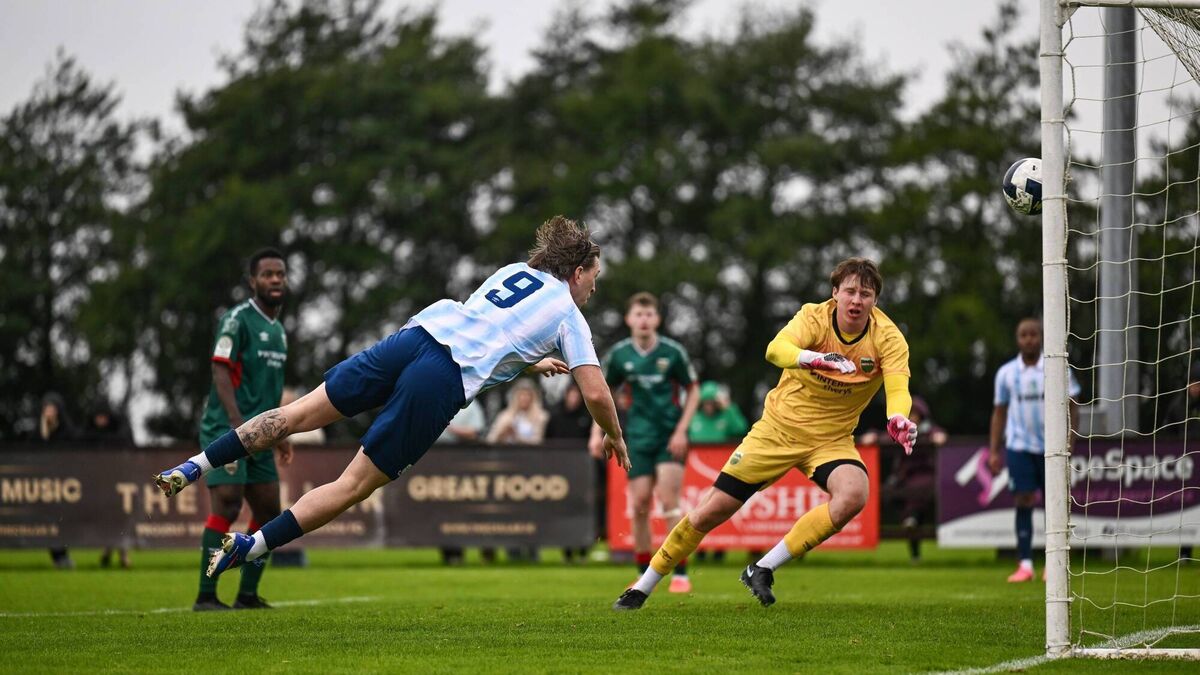
Cole Connolly of Salthill Devon scores his side's second goal during last Saturday's 2-0 win against Mayo FC in the FAI National League Group 2 match at NFP Park, Salthill. Picture: Ben McShane/Sportsfile
For soccer fans with more of a focus on a club team, international breaks tend to be a little bit tedious.
Now, though, it’s about to become even worse for some of those supporters with the Premier League on a three-week hiatus to allow an extended break for countries to play games over the coming weeks.
There will also be a scarcity of League of Ireland action over the next while – in the Premier Division at least – as all focus returns to the Republic of Ireland and their latest Nations League tilt.
Ireland are in something of a strange position where they know they’re likely to be guaranteed a place in the next major tournament regardless of how they play in the coming 20 months. Manager Heimir Hallgrimsson also knows that, barring a horrendous run of form, he will be in situ until after Euro 2028, as will the rest of his coaching staff.
All of that thrown together, then, and it would be reasonable to assume that there’s little riding on the outcome of the Republic of Ireland’s matches over the course of the remainder of this year as they embark on yet another Nations League campaign in a group that will include fixtures against Austria, Kosovo and, controversially, Israel.
Hallgrimsson and his coaching staff, though, will be keen to use the time that they have been afforded to nail down a couple of things when it comes to their style of play, and how the squad functions, ahead of Euro 2028 on home soil.
The public supporting the national team cannot be led into a lull because the matches may not take on as much meaning as a fully-fledged qualifying campaign without the safety net of being a host nation and, therefore, an increased chance of getting an automatic spot.
Ireland can ensure this does not become the case by building on the hype that was created in November of last year and, earlier this year during their two-legged play-off against Czechia. Crucially, supporters currently feel like there's something there to cling onto – results, and performances, will ensure that remains the case over the next two years.
The last qualifying campaign saw Troy Parrott emerge as the star of this current generation and his stock has only increased since then off the back of his move to Real Betis, where he has hit the ground running with a couple of big goals since his arrival in Spain. His winner against Real Madrid – and his former manager Jose Mourinho – was the perfect tonic so early on in his time at his new club.
How to build the side around Parrott’s ability as a finisher is likely to be one of the key considerations for Hallgrimsson over the coming months. On that front, there are two possible scenarios.
The key question there is whether a fully fit Evan Ferguson starts in an Irish side alongside Parrott, with two strikers up front. Is it possible for this to work?
Both players offer an undoubted ability to score goals and the pair have also become much more adept physically in recent seasons, too.
Whether they can play up front with the likes of Finn Azaz also in an advanced position, to provide some creativity in engineering chances for the front pair, is a consideration Ireland must look at. From a local viewpoint, the inclusion of ex-Sligo Rovers prodigy Owen Elding is just rewards for a player that has hit the ground running at Hibernian since the turn of the year.
There’s also an outside chance – a very outside chance, perhaps – that Liam Delap, who has just joined Nottingham Forest from Chelsea, could declare to play for Ireland like his dad, Rory, did all those years ago. That would add another layer of possibilities in the final third.
Midfield remains a problem area for Ireland, where there is a distinct lack of depth. The squad named last week points to those problems, with Josh Cullen still absent having sustained an ACL injury in action for Burnley last Christmas. The recently Irish-declared Harvey Vale, who plies his trade with QPR, could be shoehorned into a midfield rolem though his preference would appear to be further up the park.
At the back, Ireland look secure for the longer term with the Kelleher-Collins axis from Brentford a major platform on which to build, albeit Collins sits out this window through injury. Dara O’Shea and Jake O’Brien are now also well-established options, while the return to form of John Egan is a welcome boost. James Abankwah has also earned more game time at Udinese, which should help him in realising the talent he has displayed since his days as an underage player.
But Seamus Coleman is coming towards the end of his playing career and, although he has stated that he’s keen to keep things going, he remains unattached having left Everton at the end of last season and therefore is not included in the current squad.
That presents a major gap in terms of leadership within the group, because Coleman has been the go-to man on that front for the guts of a decade.
In that sense, this window offers an opportunity for players to step up to the mark and take on a sense of ownership within the squad.
Coleman is undoubtedly one of Ireland’s best-ever players and his attitude and application has made him a model pro for both club and country during the course of his career, stretching all the way back to his Sligo Rovers days all of 20 years ago now. But, Hallgrimsson’s eagerness to keep Coleman involved, even with his lack of club gametime, may also point to a sense in the manager’s eyes that this squad requires leadership.
Now is the time for other players to take up the mantle, starting over the next fortnight.