Gentleman Jim and Partry’s link to heavyweight history
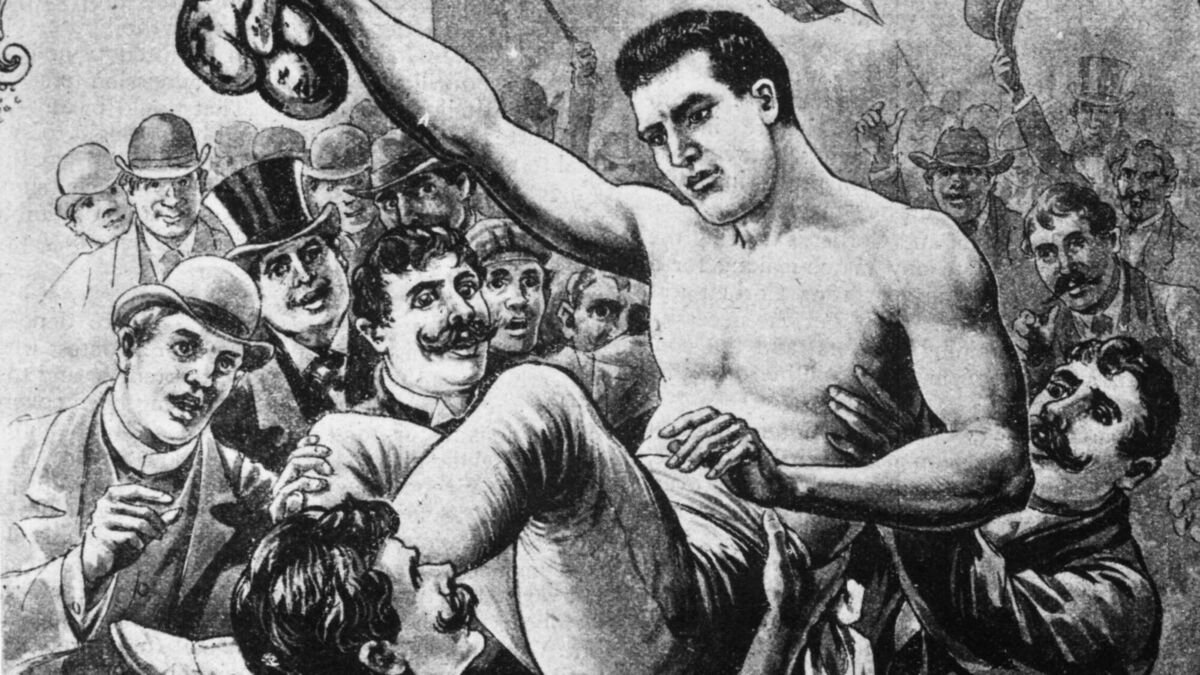
Jim Corbett is carried from the ring by supporters after his third round knockout of Charles 'Charley' Mitchell on January 25, 1894 at the Duval Athletic Club in Jacksonville, Florida, which saw him retain his world heavyweight title. Picture: Hulton Archive/Getty Images
Inside St Mary's Catholic Church in Partry, where coloured saints and biblical scenes sit solemnly along the walls, one window catches the eye. The Virgin Mary stands at its centre in blue and white, suspended in a blaze of crimson and gold, and even before you know anything about the man who paid for it, your eye keeps returning to it.
Then, you notice the inscription at the bottom of the stained glass window: GIFT OF JAMES J. CORBETT USA.
This particular James J. Corbett was once heavyweight champion of the world.
There are, of course, easier places to imagine a great fighter leaving his mark. A boxing club in San Francisco. A theatre in New York. Some smoke-darkened hall where men once stood in hats and watched two other men beat years off one another. And yet here his name sits on the wall of a rural Mayo church.
Corbett was born in San Francisco in 1866, but Mayo was already part of his story. His father, Patrick, had come from Ballycusheen near Kilmaine. His uncle James remained in Ireland, entered the priesthood and would become parish priest in Partry. One brother crossed an ocean and made a life in America. The other stayed among the fields and grassy roads of Mayo.
By 1894, Corbett was no ordinary Yank returning to his homeland with a good suit and stories from across the Atlantic. Two years earlier he had beaten John L. Sullivan to become heavyweight champion of the world, thus becoming one of the most famous sporting men alive at the time. His face appeared on posters. Crowds paid to see him. His name travelled ahead of him.
And somehow he ended up in Ballinrobe.
Corbett arrived at the Town Hall in the South Mayo town for an event that was helping to raise money for the church where his uncle served. From that visit came the stained-glass window that still looks down upon the Partry congregation today.
The people who gathered to see him in Ballinrobe are long gone now. The world Corbett inhabited is gone too: the smokey theatres, the great ocean liners, the prize rings surrounded by men in waistcoats, the curious new machines that could capture a fighter moving on film. Even the championship he carried has passed through so many hands.
But the window remains.
And on the right afternoon, sunlight still finds its way through the crimson and blue and spills across the floor of that little church, with few knowing the man responsible for the sight.
Corbett learned his trade at the Olympic Club in San Francisco, where boxing was treated less like a bar-room quarrel and more like something that could be studied. He was quick on his feet, clever with distance and unusually interested in what happened before a punch was thrown. Where many heavyweights of the age regarded defence as an unnecessary delay before violence, Corbett approached a fight as a problem to be solved.
Outside the ring he looked the part, too. He dressed well, carried himself easily and possessed the sort of manners not generally associated with men who earned money rearranging other men’s faces. He was living proof that a man could break your nose and still know which knife to use at the dinner table. And so he was christened with the name Gentleman Jim It was more than a nickname. It became part of what Corbett represented.
Boxing was still trying to persuade respectable America that it was a sport rather than organised assault when, in September 1892, Corbett stepped into a ring in New Orleans opposite John L Sullivan. Sullivan was the great colossus of the old age, a champion built on intimidation and raw power, a man who had once travelled around America offering money to anybody capable of lasting four rounds with him.
Corbett was something different.
For 20 rounds he moved, feinted, waited and made Sullivan chase shadows. Then, in the 21st, he knocked him out and took the heavyweight championship. The bout was fought under the Marquess of Queensberry rules and the contrast between the two men has come to look almost too perfect with the passing of time: Sullivan the last great monument to boxing's rough old world; Corbett pointed towards the sport that was coming next.
There had been scientific boxers before him, but few had carried the idea onto such a stage. Corbett made footwork, timing and defence part of the heavyweight vocabulary. He showed that the biggest man in the room did not necessarily need to fight like a falling wardrobe.
But there was also value in being Gentleman Jim even when he wasn’t fighting.
He had already appeared on stage before winning the heavyweight crown, but the championship transformed the possibilities before him. Long before sportsmen spoke solemnly about building a brand, Corbett had grasped the basic idea.
He toured theatres in America and Europe and soon found himself involved in a new form of entertainment. On September 7, 1894, he boxed Peter Courtney for six one-minute rounds inside Thomas Edison’s Black Maria studio in New Jersey. The contest had been arranged specifically for the cameras and essentially became boxing's first-ever pay-per-view event.
There is something strikingly modern about Corbett in all of this. He understood that a champion could sell more than victories. He could sell his presence.
And so when he crossed the Atlantic that same year, heading towards the country his father had left behind, he did not arrive merely as a boxer with a belt. He arrived as a celebrity.
That said, he lived long enough to see the world he had helped create move on without him. Boxing became bigger, richer and noisier. New champions arrived, each announced as the future until the future found somebody else. Theatres changed. Moving pictures stopped being a curiosity. Gentleman Jim became a name from another age.
He died in 1933, 41 years after beating Sullivan for the heavyweight championship. Sport is ruthless with memory. It builds monuments quickly and forgets them almost as fast. Records fall, belts change hands, photographs fade into sepia. Pugilism has a graveyard full of immortal men.
Corbett spent much of his life learning how to attract a crowd: inside a ring, on a stage, in front of a camera. Yet one of the most durable things he left behind asks for almost no attention at all.
There is no statue of him inside the church in Partry. No gloves. No portrait of the champion in fighting pose.
Just the stained glass, and beneath it the small inscription: GIFT OF JAMES J. CORBETT USA.
For a man who understood spectacle better than most, it is an unusually quiet way to be remembered.