Enhanced Games to test audiences’ true values
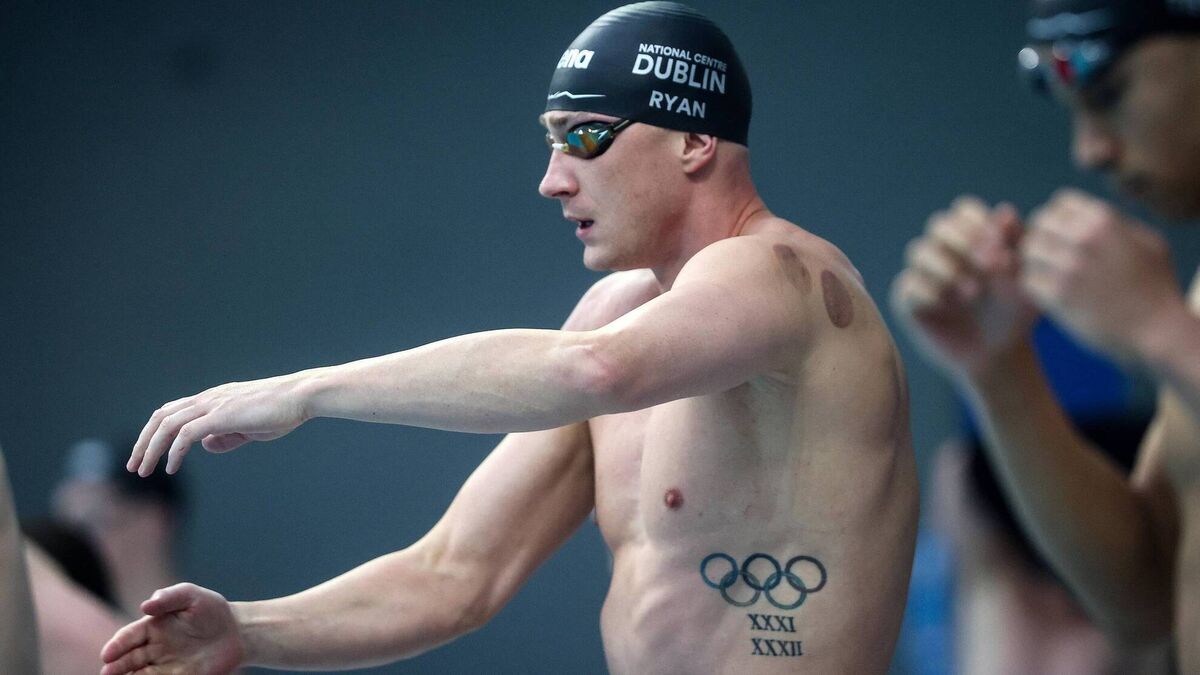
Shane Ryan at last year's Irish Open Championships in the National Aquatic Centre, Dublin. The swimmer caused controversy when he became the first Irish athlete to declare for the Enhanced Games. Picture: INPHO/Bryan Keane
In the mid-noughties, Tommy Tiernan took to a stage and proposed something wonderfully unhinged, as is his wont: the Olympic Games in Galway. But this wouldn't be your average bid where athletes from every nation in the world descended on the city to represent their country with pride.
Tiernan’s vision was a crazy carnival where competitors could take whatever drugs or steroids their chemically adventurous hearts desired. The premise was simple. If we’re going to gather the fastest and strongest humans on earth in Lycra, why not remove the brakes entirely? Why pretend the ceiling exists?
Tiernan, with that glint in his eye that always has a hint of mischief, pushed it further.
“If somebody wants to run the 100m in half a second, let them,” he mused.
“I want to see them slow down before they get to the bendy bit.” It was a ridiculous image. An athlete covering the straight in the blink of an eye, then desperately windmilling as centrifugal forces threaten to fling him out of the stadium and into a Salthill car park. The joke landed because it was so gloriously excessive. Athletics as Looney Tunes.
But like all the best comedy, it had a small shard of honesty buried deep within it. We say we cherish purity and pluck and Corinthian spirit, but what truly makes us lean forward towards the TV is the spectacle. Back then, the suggestion was satire. Not anymore, it would seem.
Tiernan must be looking back now and wondering if he should have patented the idea while he had the chance. Because somewhere between the punchline and now, the idea stopped sounding entirely like a joke.
It acquired a name.
The Enhanced Games is not a thought experiment anymore. It has a founder, investors, a venue and a start date. The brainchild of London-based Australian entrepreneur Aron D’Souza, first floated in 2022, it bills itself as a competition where performance enhancement is permitted, supervised and declared openly.
The pitch is blunt. Elite sport, D’Souza argues, is already awash with pharmacology, only inconsistently policed and publicly denied. Athletes, he says, are adults. If they wish to explore the outer limits of their bodies, that choice should not belong to federations or anti-doping agencies.
And so the inaugural Games are scheduled for May in Las Vegas, at a purpose-built complex within Resorts World, with a programme of three sports - athletics, swimming and weightlifting.
There is money, too. Every athlete receives an appearance fee. Each event carries a purse of $500,000, with $250,000 for the winner. A $1 million bonus awaits anyone who breaks the world record in the 100m sprint on the track or 50m freestyle in the pool, events marketed as “the definitive tests of raw human speed”.
Organisers insist there will be medical oversight with only FDA-approved substances allowed, which means Class A drugs will still be forbidden. But the real experiment will happen elsewhere. For if the stopwatch flashes a number never seen before, the real experiment will be analysing the behaviour of the rest of us.
Elite sport has never been a monastery.
We watch rugby knowing what we know about concussions. We watch boxing aware that every punch could cause irreparable damage. We admire gymnasts whose spines compress before they are old enough to rent a car. The knowledge is not hidden, and yet it does not empty the stands.
Risk, in sport, has rarely been a deal-breaker. It has been part of the fabric. The cracked rib. The torn hamstring. The fighter who takes too much punishment. And so an uncomfortable thought begins to surface.
When we say we care about athletes’ wellbeing, what exactly do we mean? There is a reason slow-motion replays exist. There's a reason broadcasters linger on the collision, the strain, the body pushed to its red line. We tell ourselves we are marvelling at skill. And often we are. But we are also drawn to extremity, to the moment a human being appears to brush against the edge of its limits.
The Enhanced Games, in that sense, does not invent a new appetite. It merely tests its upper limit.
Sport has always been in the business of escalation. The first man to run a mile in under four minutes was told it was physiologically impossible. Now schoolboys chase it on damp Tuesday afternoons. Ten seconds for 100 metres once sounded like science fiction. The extraordinary ages quickly.
And with each frontier crossed, something subtle shifts. What was once miraculous becomes expected. What was once suspicious becomes routine.
There is usually a moment of recoil - raised eyebrows and stern columns. But spectacle has a habit of softening resistance. We are drawn to superlatives the way moths are drawn to lightbulbs. Fastest ever. Strongest ever. Highest ever.
If an athlete in Las Vegas were to shatter a longstanding mark, the initial response might be indignation. But indignation has a short half-life when set beside wonder. None of this is inevitable. But history suggests that brilliance, however it is engineered, exerts a gravitational pull. Sport has always flirted with the edge of the possible. The Enhanced Games simply proposes to redraw the edge.
It is entirely possible that the Enhanced Games will flicker briefly and disappear. That it will struggle for legitimacy, for broadcast partners, for high-profile athletes. It may yet prove to be a curiosity rather than a movement.
If the first edition produces nothing more than modest improvements and awkward optics, resistance will be easy. It is simple to denounce something that fails to dazzle.
But for the vast majority of viewers, sport is not an ethics seminar. It is an hour on a couch and the rulebook is rarely part of the entertainment package.
And when the spectacle is sufficiently outrageous, the justifications tend to materialise on their own.
They’re adults.
It’s supervised.
It was happening anyway.
When the clock stops at a number we have never seen before, will we switch it off - or lean in closer?