China tea sets are an elegant tradition
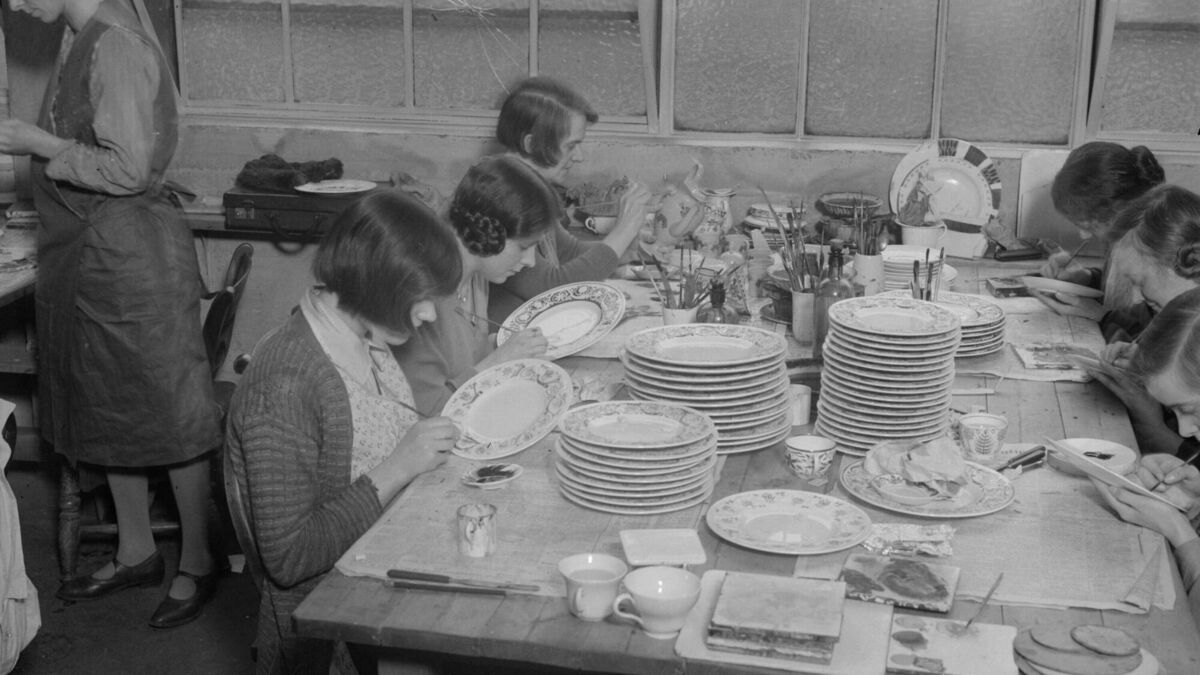
Women painting decoration on to plates by hand at the Wedgwood pottery, Stoke On Trent, Staffordshire, in 1930. Picture: Fox Photos/Getty Images
I spent some time a few years ago doing a piece of work around an old cottage. There were countless artifacts strewn here and there around the old building; old bicycle parts, worn out tools and among then, pieces of broken china. Those coloured scraps of delph were all that remained of a precious tea set, a treasured possession.
Once the wedding gift of choice, a china tea set reflected quality and elegance. The phrase “like a bull in a china shop” so accurately reflected the delicacy of china and the contrast between it and bullish clumsiness.
The tradition of china tableware began in ancient China over 2,000 years ago, progressing from early glazed pottery into a fine porcelain made from kaolin clay. Prized for its translucency and strength, this ceramic art spread along historic trade routes, eventually associating itself with elite dining and craftsmanship worldwide.
The origins of the tea set takes us back to the Han Dynasty (206-220 BC). It was during this era that the first tea sets were introduced, marking the beginning of the tea-drinking culture. Tea was initially consumed for medicinal purposes but these sets laid the foundation for the brewing and a new-found enjoyment of tea.
The progression of the tea set in China continued, with design and material evolving considerably over time. Originally, they were made of crude earthenware but gradually progressed to the use of porcelain. Information provided by Chinese Tea For You, explains further how the use of tea led to the creation of 'teaware'.
The cup and saucer, as we know them today, originated during the reigning period of the Ming Dynasty in China (1368-1644). This era marked a significant cultural shift from the use of simple tea bowls to the innovative implementation of handle-less tea cups, paired with small dishes or saucers. The saucer provided a convenient way to hold the hot cup without burning one’s hand, showcasing a design driven by practicality and consideration for the user experience.
Bone china is a type of translucent pottery, the raw materials for which include bone ash, as well as the above-mentioned kaolin clay. Technically, it has been defined as "ware with a translucent body" containing a minimum of 30% of phosphate derived from animal bone or calcium phosphate. Bone china is rated to be among the strongest of any ceramics, and is known for its high levels of whiteness and translucency. Its high strength allows it to be produced in thinner and lighter than other types of pottery and this is ultimately what makes it unique.
From its initial development, and up to the latter part of the 20th century, bone china was almost exclusively made in England, with production largely based around Stoke-on-Trent. The English firms who made, or who are still making bone chine include Spode, Royal Crown Derby, Royal Doulton, and probably most well-known, Wedgwood. During the 20th century, bone china was also manufactured in other places around the world and, appropriately enough, China itself is once again the world's largest manufacturer.
A variation called 'New Bone China' does not contain bone ash. Instead, it is a white porcelain made from feldspar and kaolin, and its colour comes from the natural whiteness of feldspar rather than bone ash. New Bone China was developed in the 1960s in Tajimi, Japan, and is named 'new bore' to reflect its modern origins. It is more cost-effective and easier to mass-produce than traditional bone china.
A china cup is more than just a vessel for a mouthful of tea; it is an example of craftmanship, an item of heritage, representing an elegant and fashionable tradition. It is not difficult to find such sets, in a thrift shop perhaps or in an antique dealership. Maybe you already have one in your home; sometimes valuable china tea sets remain tucked away in attic corners or in the back of forgotten cabinets, while others are lovingly passed down from one generation to the next. Taking into account the history of china tea sets and their origins, great satisfaction can be derived from owning and, more importantly, using one. If, after reading this, you want to find one, just ask around.
We weren’t posh but we did have a parlour… and a china cabinet. The cabinet was indeed a real china cabinet, one that my grandfather had bought at an auction years before. It was a poor fit for the parlour, which had a low celling, but it was the perfect display setting for my mother’s china. She actually had two sets; one, her very best set and another which was used for… ordinary Sundays.
She was presented with the first set as a wedding gift in 1945 by her businessman brother-in-law. It was both delicate and stylish, in a green and gold floral pattern, made up of cups, saucers, side plates, a serving plate, a cake stand and a jug and sugar bowl. By the time I came along, seven-children-in-a-farmhouse later, most of the pieces in the set had actually survived quite well.
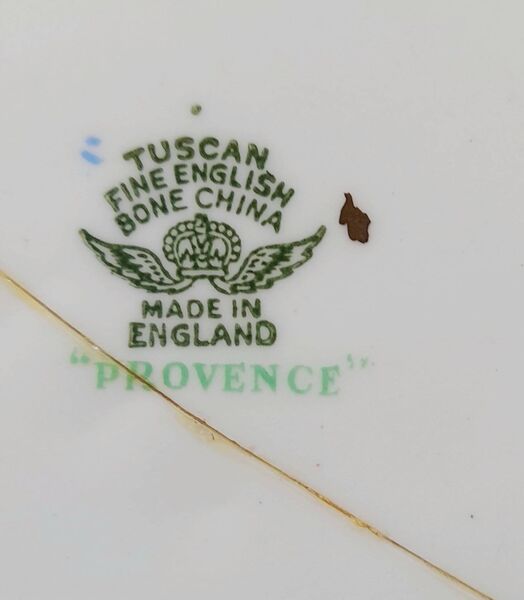
The way I knew we would be having visitors of a Sunday afternoon was when I saw the parlour table laid out in mother’s best china. This pointed to special guests, American cousins perhaps or a visit from the man who had presented her with the china in the first place. My mother went to such trouble entertaining friends and relations over the years – it was one of her great gifts. She needed no help from my father or us children; she just pottered away and inevitably came up with all that was needed for a very pleasant afternoon tea, her china tea set providing the finishing touch.
I still have a plate from my mother’s precious set; it has a crack in it but it still retains its old grandeur. I discovered that the set was made in England by Tuscan and the particular design was called 'Provence'. R.H. Plant founded Tuscan Fine China in 1878 in Staffordshire, the company specialising in decorative bone china that was very fine and light. Despite their reputation for quality, the company suffered the fate of the other potteries with lower sales and higher costs after World War II.
While photographing the plate for this article, I noticed a tiny gold leaf inlaid beside the maker’s name. I am not sure, at the time of writing, if that tiny leaf was hidden on each piece of the tea set but I’d like to think it was not, and that the leaf on my plate is secret sign; a message from my mother saying, “Those special Sundays; those were the days, those were the days.”