Ambulance strike poses 'significant risk to life'
Vivienne Clarke
The President of the Irish Association of Emergency Medicine Professor Conor Deasy has warned that today’s 24-hour strike by 2,000 workers at the National Ambulance Service will pose “a significant risk” to lives.
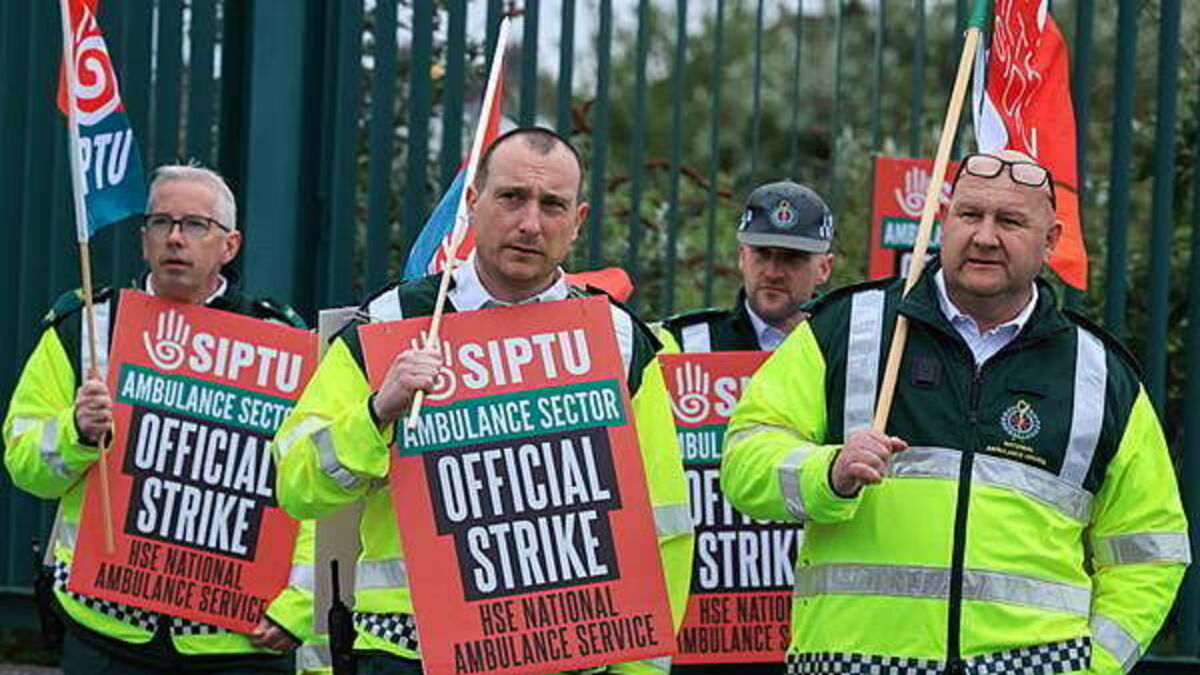
Pickets will be placed at ambulance bases around the country as part of the action by ambulance crews who are members of Siptu and Unite, who are engaged in a dispute over pay.
“Look, we need this dispute to be resolved very quickly. It should never have gotten to this point. It's dangerous for patients. There's no question,” Deasy told Newstalk Breakfast with Anton Savage.
“We wouldn't have provided ambulance services across the world globally with these interventions were they not seen to be evidence-based and seen to produce better patient outcomes.
“We wouldn't have gone to the effort of educating paramedics if we thought that these weren't going to bring better patient outcomes. So it is a necessity now to resolve this strike, to avoid putting patients in jeopardy, avoid playing Russian roulette with our patients. It's not fair to them.”
When asked if the strike posed a risk to life, Deasy replied: “I think there is a significant risk. There is no way of dressing this up.”
Siptu health division organiser Ciarán Sheridan has denied that lives will be put at risk because of their 24 hour action.
The Minister for Health and the HSE need to intervene.
Speaking on Newstalk Breakfast with Anton Savage show, Sheridan called on the Minister for Health and the Health Service Executive to “come to the table” for talks.
“The Minister for Health and the HSE need to intervene.”
Sheridan said his members were disappointed that they had to take such action, but they were “absolutely resolute in ensuring that the additional responsibilities and roles they've taken on, in the interest of enhanced patient care will be recognised.”
His members had been left with no choice and they were also disappointed that the Minister for Health of the HSE did not intervene.
“We removed preconditions to get into the table and resolve these issues. It's with the greatest of reluctance that, with no option our members are actually on strike today.”
Sheridan pointed out that while some of their members were on the picket line others were providing emergency care for the most time-critical, high-acuity calls.
“So we are providing cover to the time-critical, high-acuity calls (1:10) as in the cardiac arrest, the respiratory arrest, the strokes, etc. And that is being triaged through the control centre based in Tallaght and Ballyshannon.
“So critical services are being provided. In addition to that, we're providing the helicopter service and on top of that we are providing cover for emergency paediatric responses. But again, our members do call on the HSE and the Minister for Health to intervene because this has to be resolved.
“Our members in the ambulance service went from a patient transport service to a pre-hospital emergency care service with the expert clinical care provided on scene at the back of an ambulance and during those paid cuts we continued to develop and transform and modernise the ambulance service. And now all the promises were people would be looked after and people would be recognised and that's where the genesis of the independent report which is recommending enhanced pay scales for all the members comes from.”
Sheridan said the ball was now in the court of the Department of Health, the Minister for Health to intervene and resolve this issue.
“We're available for talks.”
The HSE's Clinical Lead for Emergency Medicine, Dr Rosa McNamara, has said she is worried that people will avoid going to hospital today because of the ambulance strike.
999 fully staffed
Speaking on RTÉ radio’s Morning Ireland, McNamara said that emergency departments were open and she urged people who can make their own way to an emergency department to do so. But if anyone feels they need an ambulance then they should call 999 - which will be fully staffed, she added.
“I'm afraid that people will misinterpret the availability of services because of the strike.
"But I would urge people, if you're sick, don't not go to an emergency department. Please do come. We're here, and we're waiting for you.”
McNamara acknowledged that the “reality” of the strike was the number of ambulance son the road was severely curtailed, with 46 percent staffing which meant ambulances would have to travel long distances
“So I would urge people, of course, if you have an emergency, ring 999, but if you have a route to get to a hospital that doesn't involve an ambulance and you feel it's safe to do so, you should take that.”
McNamara said it was her understanding that there would be additional "physician call takers" on duty in the ambulance service today “to support some of the harder trials decisions today. To try and mitigate the risk a little bit, but actually to provide good advice for people who are ringing.”
Plans were in place in emergency departments to try to offload ambulances quickly to allow them back onto the road so that the ambulances that are on the road are freed up as quickly as possible, she added.