100 years on, sports media still fear the next revolution
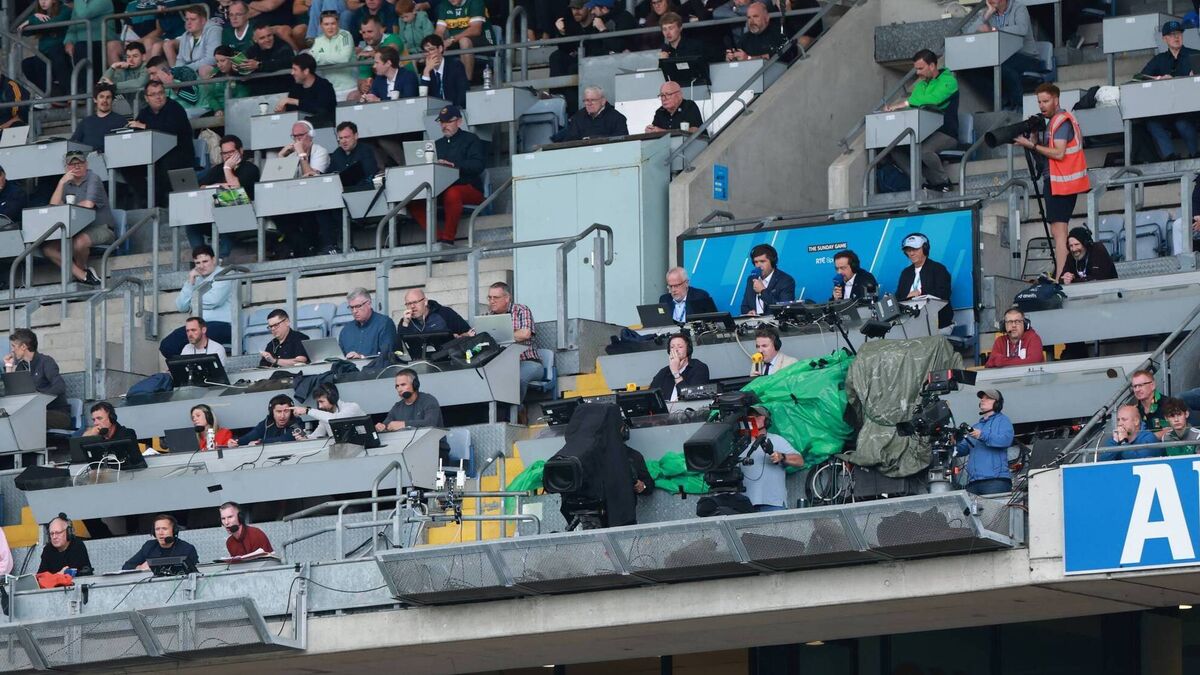
A view of the Croke Park press box during this year's All-Ireland SFC Final. Picture: INPHO/James Crombie
Paddy Mehigan was talking to people he could not see.
In front of him was Croke Park, where Galway and Kilkenny players were chasing a small leather ball across the field, ash striking leather, bodies colliding, the crowd rising and falling with the play.
But Mehigan's audience was somewhere else entirely. They were sitting in parlours and kitchens and gardens, gathered around strange boxes with dials on the front, leaning towards the crackle and hiss and waiting for a man in Croke Park to tell them what he could see.
That was the peculiar assignment handed to Mehigan on August 29th, 1926.
Better known as PD Medigan, or Pat O, he was a newspaper man by trade, the first Gaelic games correspondent at the Irish Times. He belonged to a profession built around the comforting delay between something happening and somebody finding out about it. A match was played. A reporter watched. He wrote. The presses rolled. Vans departed. Newspapers arrived.
There was time in between.
Now there was almost none.
A hurley could meet a sliotar in Croke Park and, through this peculiar new machinery of microphones and transmitters and wireless sets, somebody miles away could know what happened before the ball had arrived at the opposite end of the field.
For most of human history, if you wanted to witness a sporting event you had to go there. You squeezed through the gate, found somewhere to stand and saw it with your own eyes. Otherwise you heard about it afterwards. From somebody who had been there. From a telegram. From the newspaper the following morning.
The technology behind it was still young enough in Ireland to seem like sorcery. The national broadcasting station, 2RN, had first gone on air from Little Denmark Street only eight months earlier. Now its wires had stretched towards Jones' Road and a microphone had been placed in front of a sportswriter for an All Ireland hurling semi-final between Galway and Kilkenny.
There were no pictures.
No replays. No graphics. No score permanently glowing in the corner of a screen. No second commentator explaining the shape of the Galway half-forward line. No camera tracking the flight of the sliotar.
There was only the game through Mehigan's voice.
He had to take everything occurring before his eyes and somehow squeeze it through a microphone so that a listener who could see none of it could construct Croke Park inside his own head.
It was the first live radio commentary on a field sport in Europe. And it was dangerous.
Not physically, of course. The microphone sitting near Mehigan posed little threat to anybody in Croke Park that afternoon. It was merely a piece of equipment carrying one man's voice beyond the walls of a stadium.
But across the Irish Sea, men who made their fortunes from ink and paper had already understood what that voice represented. Newspapers had spent generations owning the interval between an event and the public learning about it. They had printing presses and reporters and distribution networks, an industrial machine designed to carry yesterday into tomorrow morning.
Radio was destroying the interval. And the newspaper industry was terrified of it. The newspaper man viewed this development with the same enthusiasm of a publican hearing about prohibition. But the obituary, as it turned out, was a little premature. Newspapers did not disappear. The presses kept rolling and the bundles kept landing on doorsteps. Radio stole their monopoly on immediacy, but not their reason for existing.
Sport did rather well out of the arrangement, too. The dangerous little box became part of the furniture. Eventually, pictures were added. But television presented sport with a terrifying proposition: what if people no longer had to be on the terrace?
Why would a man button his coat, leave his sitting room and pay through the gate on a wet winter evening if the same match was glowing warmly beside the fire?
As late as 1983, when the BBC broadcast Manchester United against Tottenham in its first live league match, only 33,616 people turned up at Old Trafford - United's lowest league attendance of the season. Manager Ron Atkinson blamed live television; chairman Martin Edwards sought compensation for the missing gate receipts.
Football had seen the future and was worried nobody would leave the house for games. Yet, television did not empty the grounds. In fact, it eventually filled bank accounts.
Then came satellite television, crashing into modern sport with all the subtlety of a nightclub opening beside a monastery. And so the cycle continued. The intruder arrived, endured the suspicion and eventually grew comfortable enough to start fearing intruders of its own.
And now, as Irish sports broadcasting marks 100 years since the first live sports broadcast in Europe, another little piece of technology sits in almost every pocket on earth.
This time the intruders are not broadcasting from Little Denmark Street. They have market capitalisations larger than countries and considerably nicer offices. Amazon has moved heavily into live sport, Netflix has begun acquiring live rights, and Apple is looking to invest heavily in the genre. The television companies that once represented the future now find themselves competing with technology companies for the games around which broadcasting empires were built.
Their anxiety is understandable. Live sport remains one of the increasingly rare things capable of persuading millions of people to watch the same thing at the same time. Lose enough of it and a broadcaster loses more than a few matches. It loses subscribers, advertising and one of the last great reasons for an audience to turn up at an appointed hour.
There is something wonderfully familiar about all this. The technology changes. The incumbent changes. The fear simply changes its clothes.
Perhaps the lesson of the last hundred years is to be less precious about the machinery. The audience has been chasing the same thing all along - to get closer.
That was what the people gathered around their wireless sets wanted in 1926. It is what the supporter watching a last-minute winner on a phone on the other side of the world wants now. Not radio or television or streaming for their own sake, but that peculiar trick sport plays on us: making something happening somewhere else feel as though it is happening to us. The history of broadcasting is really the history of finding better ways to collapse that distance.
A hundred years ago, Mehigan sat in Croke Park with a microphone before him and a hurling match unfolding beyond it. Somewhere miles away, people leaned towards wireless sets and discovered that, for the first time, they could be somewhere they were not.
That microphone has become a screen in the palm of the hand, carrying pictures and sound from almost anywhere on earth. It will become something else again. It always does.
The machinery keeps changing. The distance keeps shrinking. The desire to be there never has.