Rural revival in East Mayo as old cottages come back to life
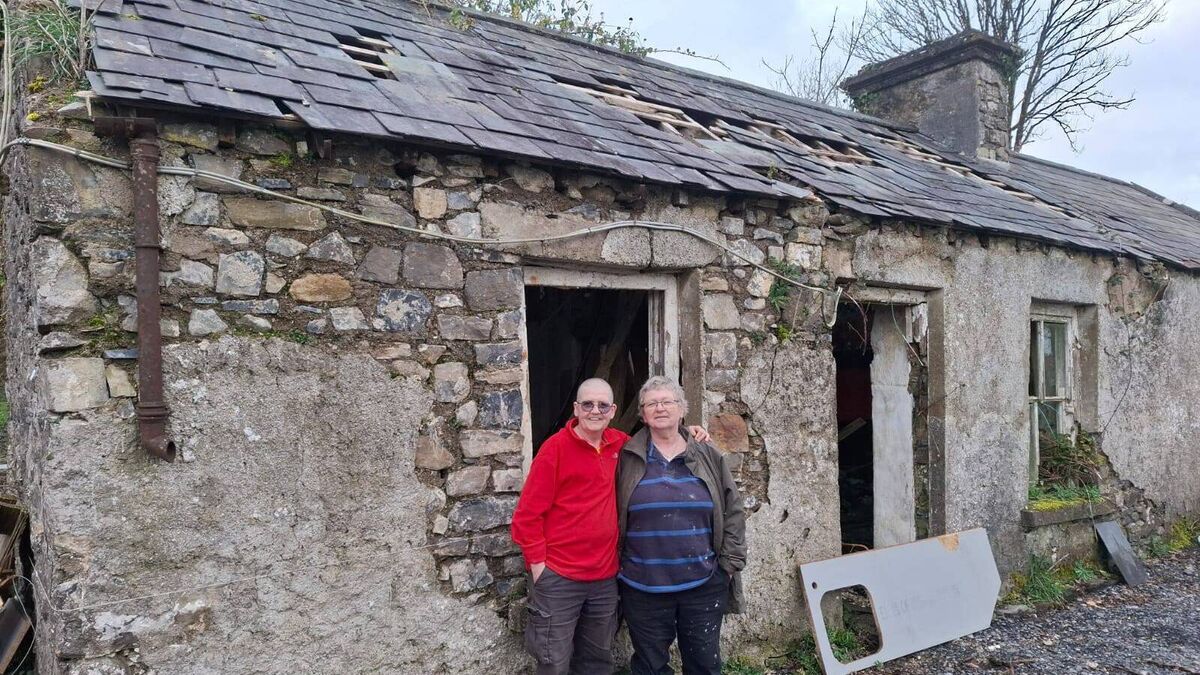
Deb and Pam Mejo outside their cottage at Ballinastoka, near Ballyhaunis.
Much is written about rural depopulation and decline but the lure of life in the Ballyhaunis hinterlands remains strong. Drawn to the peaceful surrounds of Ballinastoka, a townland adjacent to Logboy, English couple Deb and Pam Mejor are refurbishing a cottage built in the early 1800s and vacant for fifty years.
It was April 2025 when Pam first saw the cottage. Back home in Lichfield, near Birmingham, she’d been hunting for Irish rural properties on the property website Daft.ie.
There were three cottages to see during that visit last spring: one in Pettigo (Donegal), another in north Letrim and then the cottage being offered with 12 acres in Ballinastoka.
That same day she was shown the property by Ballyhaunis estate agent Kevin Kirrane she made up her mind and phoned the agent with an offer while on the way to Ireland West Airport for a flight back to England. It was the peace of the site that sold her.
“You barely hear a car pass, just the sound of birds, and there’s a beautiful field at the back.”
The price was fair, she said, and in the summer of 2025 she and Deb moved over.
The once populous village of Ballinastoka, six kilometres from Ballyhaunis, was empty in recent years but the lights are back on after several properties were sold, with a Czech family moving into a small bungalow next door to Deb and Pam. A family from Claremorris are restoring another nearby farmstead.
The couple’s knowledge and construction skills are proof of how much can be accomplished without waiting on a builder or a mains power connection. Since purchasing they’ve built a cabin residence while they work on the house. They’ve also built a handsome wooden barn for their equipment. Solar panels provide electricity, backed up by a generator. Soon they’ll add more panels to boost their power supply.
Pam spent a career advising contractors on the restoration of old castles and historic structures across Britain.
“I’ve worked on many refurbishments of stately homes,” she explains.
From her professional vantage point, Pam thinks a builder would ask €200,000 for the refurbishment from what a sign on the gate announces as Finnegan’s Cottage.
That’s the name of the family to whom the cottage and fields once belonged. Built in the vernacular style with local stone, the cottage had been thatched but the Finnegans availed of a grant in the 1950s to slate it. A few decades later the house was vacated and a small council house built adjacent to it. That house was also sold recently and is now occupied by a young Czech family.
The couple will use traditional lime rather than cement mortar in repairing and pointing the stonework and finish the walls with lime harling, a coating similar to what was originally applied to the stones.
Lintels will be replaced with horse chestnut wooden lintels, chosen for the close grain.
“Timber, unlike concrete lintels, will flex,” explains Pam.
A second chimney added belatedly to the left gable wall will have to come down, having already stressed the wall with a crack.
The walls are two-foot wide but a three-foot-wide wall carries the main chimney in the kitchen. A large wooden beam built into the wall on the reverse of the house marks where the hag, an alcove off the kitchen, was added. The wall was boarded up where the hag once stood but the rotting of the beam has prompted some subsidence in the wall.
Also on the back wall where the anchor of a cattle crush was pulled out, ivy roots are visible, the sinuous plant having worked its way into the middle of the wall. In this section the Mejors plan to take the perimeter walls of the house down to the height of the window lentils and rebuild.
The first thing they’ll do is erect scaffolding and take off the chimney on the gable wall. Then slate by slate they clear the roof. They may opt for a tin roof which, with modern insulation products, offers the same comforts as slates.
They’ve decided not to go for the state's refurbishment grant for derelict properties, which can be worth up to €70,000. This is because they want to do it themselves and don’t want to be under a 13-month timeframe.
“They will let you extend up to 19 or 20 months but still, we’d prefer to work at our own pace,” explained Pam.
There’s plenty of room for their three dogs to roam. Deb plans to continue her practice as a dog behaviourist, taking in dogs for training. She’s already printed leaflets to advertise locally.
Out on the 12 acres, some 690 saplings have been planted by local schoolchildren, partly for biodiversity and partly as a natural means of drainage. As we walk the field, the couple marvel at the primroses in the hedge, the harbingers of spring on the traditional clay ditches that divide fields and offer some space for wildlife lost on larger farms where such ditches have been removed.
Both Deb and Pam grew up on farms.
"Both of my parents were dairy farmers and some of my family are farmers. There’s plenty of rushes and docks too in Darbyshire,” said Pam.
Visiting with them gives one hope that rural Ireland, its vernacular homes and its fauna and flora are, in this patch of East Mayo, in good hands.
A visit by local TD Alan Dillon to Guatemala in the run up to St Patrick’s Day is of interest to a Guatemalan family who fled the country and were resident for a time in the International Protection Accommodation Service (IPAS) centre in Ballyhaunis.
Minister of State Dillon was in the central American state to drum up business for Irish companies, though the country remains one of the most dangerous in the region due to gang violence.
“The current situation is more dangerous than when we moved here, the current government has not improved the security situation,” said Juan Luis Morales who moved to Ireland with his wife and children to escape crime and violence back home.
The family, who now live in Galway with refugee status, were a popular presence at a weekly Spanish language conversation group run by Ballyhaunis Language Café.
During the visit, Minister Dillon met the President of Guatemala, Bernardo Arévalo, along with several government ministers. Minister of State Dillon told this newspaper that he engaged with members of the Irish community, the diplomatic corps, and local government representatives at a St Patrick’s Day reception, which offered helpful insight into the lived experience of Irish people based there.
“Security challenges remain a real issue, but there is also clear interest from Guatemala in strengthening international partnerships. My discussions focused on building stable, transparent avenues for cooperation, particularly trade, investment, and enterprise and assessing where genuine opportunities might safely exist for Irish businesses.”
Ireland’s Department of Foreign Affairs has Guatemala on a ‘Reconsider Travel’ advisory "due to high crime rates", with certain regions under a ‘Do Not Travel’ advisory “due to drug trafficking, gang violence, and limited police capacity".
According to the Department, “violent crime - including armed robbery, murder, and extortion - is common nationwide".
Speaking at the start of the visit, Minister Dillon said: “This visit is about strengthening Ireland’s relationships across Central and Latin America and building new partnerships in trade, investment and diplomacy.”
Local shopkeepers may be able to breathe a sigh of relief with the introduction in July of a levy on the tsunami of small packages landing in Ireland from Chinese e-commerce site Temu.
The EU moved to introduce the levy after complaints from member states that taxes and retail jobs were being lost to sites like Temu, which operate under the World Trade Organisation’s rule whereby packages of goods under a certain value are not subject to customs duties. Irish youths in particular have been enthusiastic shoppers on Chinese sites like Temu and Shein.
Nearly six billion such packages entered the EU in 2025, up 20% on the year before and four times the level of such arrivals in 2022. Some 90% of the packages originated in China whose retailers Temu and Shein have become valuable clients of An Post.
Ultra cheap consumer goods and clothing ordered online have been a source of annoyance for retailers here unable to compete with those prices.

Congratulations to Cathal Conlon of Ballyhaunis Boxing Club who won his first All-Ireland title in the Junior One 63kg category at the National Stadium recently. Cathal continues a long tradition of boxing prowess in the Conlon family.
St Patrick’s Day was celebrated with local talent and tradition in Ballyhaunis this year with a performance at the Community Hall after morning mass.
A large attendance was treated to dancing by the Mary Elwood School of Dancing whose students of different ages danced several reels and jigs. It is one of the dancers’ last public performances before they depart to the US for the Irish dancing world championships.
There was a solo dance performance by Eva Grace Kilcourse, accompanied by a group of local traditional musicians that included Waldron brothers Paul and Richard as well as fiddle player Michael Plunkett. Musicians Moira Delaney and Ita Fahy also joined in playing popular tunes for the celebration.
Dressed as Saint Patrick, John Morley sang a traditional song of Ballyhaunis before he was joined by Father Stephen Farragher to cut a large Saint Patrick’s Day cake baked by Breege Keogh.
Violinist Lorna Morton played the traditional airs and . Lorna’s father Bernard Lyons came from Bridge Street where her uncle Michael Lyons ran a bicycle shop.
Kevin Henry, principal of Scoil Iosa National School, recited the with precision and theatrical flair. One of his students, Hussein Shawi, meanwhile drew a great applause for his rendition of the song , made popular by the band Kingfishr.
The event was organised by Ballyhaunis Community Council in conjunction with the Parish Pastoral Council.