Real-life experience inspires Gina’s music
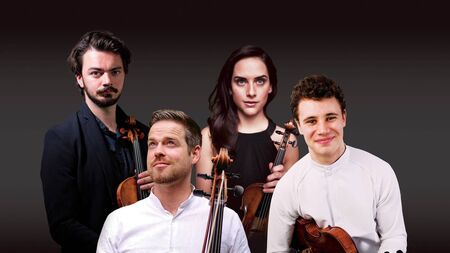
The Gealán Quartet, from left: violinist Eoin Ducrot, cellist Paul Grennan, violinist Gina Maria McGuinness and viola player Fiachra de hOra.
The Gealán Quartet, a wonderful new string ensemble, is coming to Ballina Arts Centre on Wednesday, November 8, as part of their second tour for the National String Quartet Foundation.
Founder member and violinist Gina Maria McGuinness, who lives with her partner Cormac in Spiddal, Co Galway – “an old farmhouse, very remote, up a rural dirt track, overlooking Galway Bay” – explains that “gealán” is Irish for “ray of sunshine”. The quartet was born just as Ireland was emerging from Covid, so she feels it is “the perfect name”.
The violin has been Gina’s life since she was three years old and sat on her mother’s knee during her sister’s violin lessons.
“My parents were both surgeons but loved music – everything from Johnny Cash to the classical pianist Glenn Gould. Most of my siblings (she’s the youngest of six) play guitar, but my older sister Meena, when she was 12, asked to learn the violin.”
Meena’s teacher – a “determined Hungarian” by the name of Maria Kellerman – saw that Gina’s sister was naturally talented but considered her, at 12, too old to become a name in the classical musical world. Instead, Kellerman turned her attention to three-year-old Gina, who despite being diminutive “had large hands” and hopefully the same musical talent as her sister.
It turned out that she did. By the age of five, she was playing concerts. By six, she was beginning to “fight the practice".
"I was tired of the discipline, I wanted to run wild.”
And her mother would say: “Fine, give up, call Maria, tell her you quit.”
But Gina never could bring herself to do it. She needed the adrenaline rush; the magic.
When she was eight, she won her first international competition – the International Violin Competition in Estonia.
"That was when it was decided I would go professional. Suddenly, I was a musician and everything outside music was secondary.”
Her studies and international performing career continued through her teens, including ten days every summer at the West Cork Chamber Music Festival, where she discovered the delights of chamber music: “So much less lonely than being a soloist."
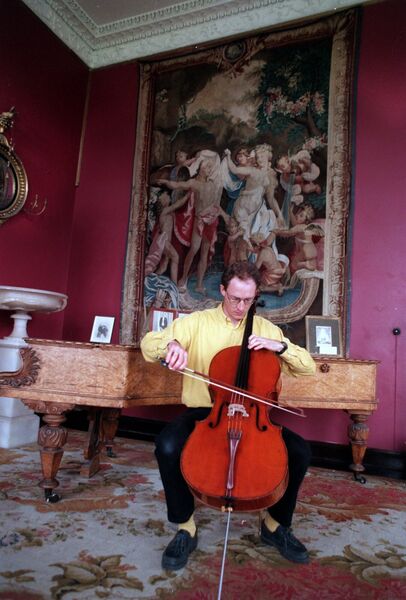
It was there she first met the festival’s co-founder, Christopher Marwood, who is director of the National String Quartet Foundation.
At 18, she left Ireland – where opportunities for classical musicians were still very limited – and went to study and play first violin in Germany, then Chicago, and then Lausanne in Switzerland where she did her master’s in performance. Afterwards, she based herself in Zurich, while travelling regularly to play co-principal with the Brussels Philharmonic – an incredibly prestigious position, sharing the stage with the world’s most famous soloists and conductors.
Yet a few years later, Gina had an epiphany. She was lonely and lost. In 12 years, she hadn’t spoken with another Irish person. She was homesick.
“In the classical music world, if you’re a musician, that’s all you do. You practice locked in an isolated room and emerge only to perform. But I was the youngest of six. I was used to noise and bustle.”
So, to the absolute horror of her violin teachers, she took a job in an Irish pub in Zurich, as a server.
On top of that, having tired of “music snobbery”, she started playing concerts she wouldn’t have countenanced playing before. In the KKL concert hall in Luzern, the 21st Century Orchestra plays soundtracks from films, while the film is projected above them on a vast screen. (“which was amazing”), and suddenly instead of playing to a half or even quarter-full auditorium, she was doing 10 performances in a row to audiences of nearly 2,000.
Working in Kennedy’s pub gave Gina life experience and a sense of perspective, and more than that, she says, “it genuinely made me a better musician”. She became less competitive and fearful of failure; she “started to play more like me, to be the musician I wanted to be, and if anyone had a viewpoint on me playing the way I wanted, I didn’t care, because I was paying my bills.”
There was another bonus to working at Kennedy’s: the bar manager, Cormac, became her life partner. Not long after the birth of their son, Seán, Covid hit. In 2021, when Seán was two, they moved home. To her own roots at first, in Dublin, which the young couple found “excruciatingly costly and unforgiving” and then to Colm’s roots, in Spiddal, Co Galway, where two months later their son Colm was born. Gina loves the “immense wildness and beauty” and also “the community feel” of the west of Ireland. Despite the remoteness of their cottage, she says she got to know more people in a couple of weeks than she’d met in a year in Dublin.
Of course, it’s tricky at times, and involves a lot of travelling, because all the classical work is in Dublin – the National Symphony Orchestra, the RTÉ Concert Orchestra, the Irish National Opera, though the Irish Chamber Orchestra, thankfully, is based in Limerick, which is a lot more accessible.
And then there’s the Gealán Quartet, which brings us back to the West Cork Chamber Music Festival, and that backbone of chamber music in Ireland, Christopher Marwood. He offered Gina the chance to set up her own quartet, and two years ago the Gealán Quartet was born, with three other brilliant young Irish musicians, all living abroad, but delighted to come home to tour.
There’s violinist Eoin Ducrot, originally from Cork, but now living in Basel and playing with the Tonhalle; viola player Fiachra de hOra, from County Dublin but now studying in Amsterdam; Paul Grennan, cello, from County Wicklow and now with the Hallé in Manchester.
This second tour starts in Galway on November 7th and finishes in the National Concert Hall on November 12th, and Ballina is very privileged to have the four of them here on Wednesday, November 8th.
The performance features a brand-new composition commissioned by Gina from the Derry composer Michael Doherty. His is based around two traditional Ukrainian folk songs and explores separation and reunion.
“Fifteen years ago,” says Gina, “I premiered his second string quartet, which I loved. I’ve been wanting for years to ask him to write something else for me, and when I did, he delivered more than I’d hoped for: his third string quartet!”
The programme begins with the “very optimistic, upbeat, loving” Quartet in A-minor by Schumann but, after Michael’s three-movement work, it closes with Shostakovich’s darkest, most intense quartet, No. 8 in C Minor, describing the horrors of war.
“It’s a thought-provoking programme,” says Gina quietly. “In respect to what is going on today.”