World Series shows richest don't always win
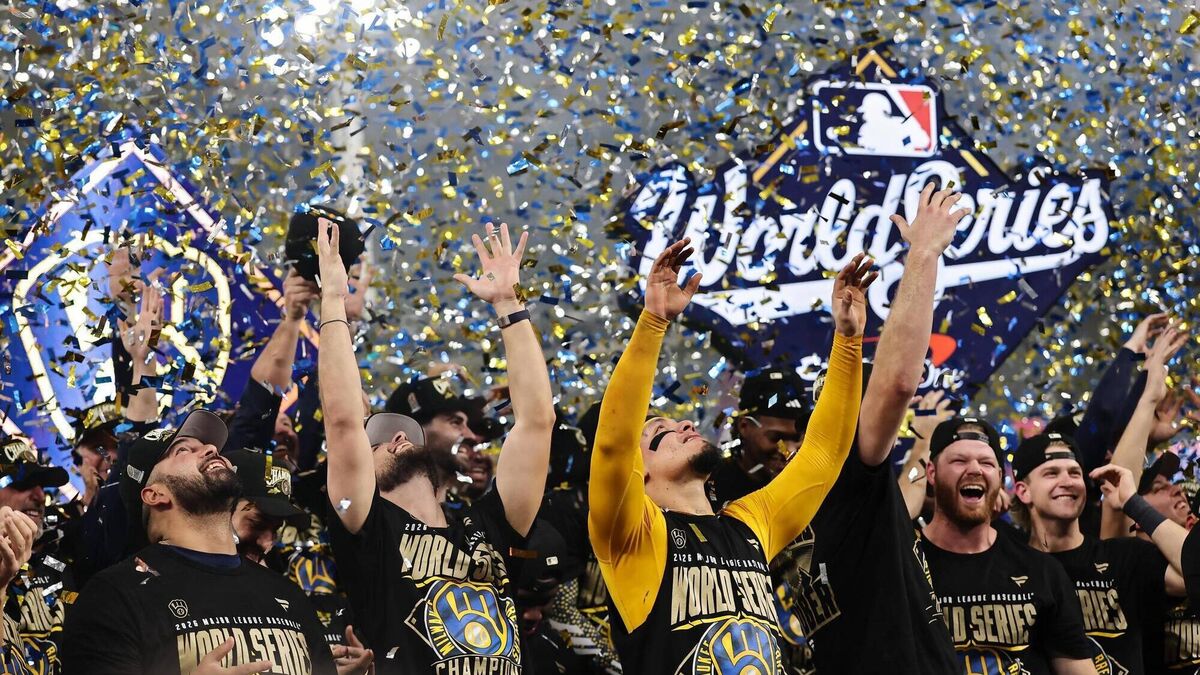
The Milwaukee Brewers celebrate their first World Series triumph after defeating the Tampa Bay Rays in Game 5 at Tropicana Field in St Petersburg, Florida. Picture: Carmen Mandato/Getty Images
In the summer of 1970, a 69-year-old man moved into a trailer above the scoreboard at Milwaukee County Stadium and declared that he wasn't coming down until 40,000 people turned up to watch a baseball game. His name was Milt Mason. He wore lederhosen, cooked legs of lamb on a gas stove and had a bathtub 81 feet above the outfield. For a man staging a protest against empty seats, he had made himself remarkably comfortable.
The Milwaukee Brewers were new to the city, having arrived from Seattle in a hurry, with little history and even less of a following. Across their opening 37 home dates, they'd averaged barely 11,000 spectators. Mason, a retired aviation engineer, watched the empty rows from his balcony and waited. One game went by. Then another. The weeks slipped past. And he stayed where he was.
Finally, on August 16, a promotion giving away baseball bats brought 44,387 people through the turnstiles. The Brewers even beat the Cleveland Indians and, to celebrate the achievement, Mason descended from his lofty perch on a rope, badly burning his hands in the process and ending his stunt. But the rather peculiar vigil would become the legend of Bernie Brewer, the club's famous mascot.
Fifty-six years later, the franchise that once needed an elderly man living above its scoreboard to attract a crowd has conquered baseball by winning the World Series. The franchise has also done so without the financial muscle of the biggest beasts in the game.
It's the manner of that triumph that makes the journey all the more remarkable. Milwaukee is the smallest television market in Major League Baseball, with a payroll of approximately $146 million, ranking 19th among the league's 30 teams. The Dodgers, meanwhile, spent roughly $339 million assembling their collection of superstars. For all that expense, they couldn't win a single game against Milwaukee in the play-offs.
In an era when sporting success increasingly seems reserved for those with the deepest pockets, the Brewers have delivered a delicious reminder that money, however plentiful, cannot buy a monopoly on brilliance.
Milwaukee's secret wasn't hidden in some secret bank vault. It was an extraordinary ability to survive losing the very people who had made them successful. Josh Hader was traded. So was Corbin Burnes. Willy Adames departed, followed by Freddy Peralta. Even Craig Counsell, the manager who had turned them into perennial contenders, jumped ship for the Chicago Cubs. At most clubs, such an exodus would signal the beginning of a long and painful decline. Milwaukee simply carried on winning.
Behind it all was Matt Arnold, the architect of a recruitment operation that became remarkably adept at finding value where others saw little. The Hader trade eventually helped bring All Star catcher William Contreras to Milwaukee. Jake Bauers arrived from the Yankees with little fanfare and became the National League Championship Series MVP. Jacob Misiorowski, a second-round draft pick, developed into one of baseball's most formidable young pitchers.
And when Counsell departed, Milwaukee resisted the temptation to pursue a glamorous replacement. They promoted Pat Murphy, his long-serving assistant, who fashioned a team built on collective intelligence rather than individual brilliance. The Brewers hit fewer home runs than almost anyone in baseball, yet scored more runs than all but one team. They ran hard, exploited gaps, worked their opponents into mistakes and found ways to win that didn't require someone launching the ball into the stands.
None of it happened by accident. Milwaukee reached the play-offs eight times in nine seasons, repeatedly reinventing itself without losing its identity. While richer clubs went shopping for superstars, the Brewers built an organisation that didn't need to depend on them.
These lessons can stretch far beyond the shores of Lake Michigan. In European football, the wealthiest clubs have become so accustomed to buying their way out of trouble that spending has almost become a substitute for thinking. A season goes wrong, another cheque is written. And European football isn't alone in this regard.
Milwaukee could never afford such extravagance. Every departure had to become an opportunity, every overlooked player a potential asset, every dollar made to work that little bit harder. Their triumph doesn't mean money has suddenly lost its power. It means the most expensive solution isn't necessarily the smartest. And there is an important difference between being unable to spend and being unable to compete.
That's worth remembering in a sporting world where financial muscle is increasingly mistaken for sporting intelligence, and where smaller outfits are often expected to know their place. Milwaukee has shown that ambition need not be measured by the size of a bank account, nor success reserved for those who can afford to buy it. Intuition, patience and a little imagination can still upset the established order. The richest team in the room doesn't always have to have the last word.
To call Milwaukee's triumph a miracle would almost do them a disservice. Miracles require little explanation, whereas this was the product of years of difficult decisions, shrewd judgement and an organisation that refused to confuse limited resources with limited ambition. The Brewers haven't made money irrelevant, nor have they dismantled baseball's financial hierarchy. But they've shown that the richest clubs don't have to own the future simply because they can afford to buy so much of the present.
The old man in the trailer never lived to see any of this. He died in 1973, leaving behind a mascot, a peculiar little legend and the memory of a man who perhaps had more faith in Milwaukee than Milwaukee had in itself. But he would surely have appreciated the stubbornness of it all. He climbed above County Stadium armed with an improbable idea and the determination to see it through, however long it took.
Such is the peculiar cruelty of sport - the people who begin its greatest stories aren't always around to discover how they end. But something of the old man survived in Milwaukee. His obstinacy, it seems, was rather harder to bury.