World Cup remains a wonderful spectacle
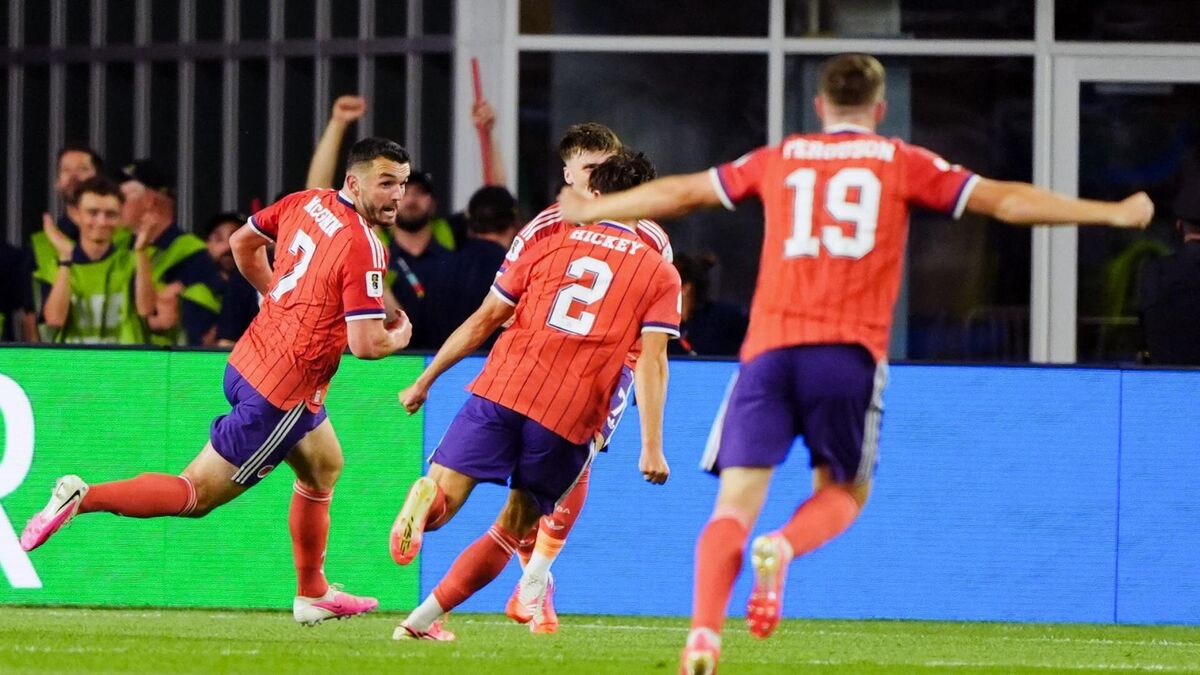
Scotland's John McGinn celebrates scoring the game's only goal during the FIFA World Cup Group C match against Haiti at the Boston Stadium, Foxborough last Saturday night. Picture: Andrew Milligan/PA Wire
In an era where there is so much in the way of televised sport, something hits that little bit different when it’s the World Cup. There’s football – and then there’s World Cup football.
Ireland may not be there this time around, but you still get yourself drawn in and wondering afterwards why you cared so much as to whether or not the Curacao centre-half could get to grips with such a potent German attack. (The answer, by the way, was a resounding no.) It’s why the World Cup is the greatest show of them all.
Away from the politics of the World Cup – and that has been well documented elsewhere – the host countries and venues have been doing their best to drum up some enthusiasm for a tournament that was roundly criticised in the lead-in for the extortionate ticket prices, the cost of which has gone into the thousands for a single ticket in many instances. Donald Trump himself said he probably wouldn’t stump up the cash to watch the United States.
Empty seats have been a feature of a few games so far. At South Korea versus Czechia there were thousands on view and in the game between Qatar and Switzerland in San Francisco the same was the case. In both instances, organisers were fortunate the seats, coloured red, were of the same hue of some of the competing teams, making the fact that the stadiums were half-empty less obvious.
They do things differently in the States, too. The culture of sporting occasions is that fans go for the day out as much as the match itself. The entertainment and hospitality around the game is as important as the result.
Fans have been particularly slow at this World Cup to re-emerge from the concourses at half-time, and the pre-match pageantry also attempts to try and drum up some enthusiasm in the stands in typical American fashion.
The main talking point in a sporting sense about this World Cup has been the expansion from the 32-team format to 48.
The safety net of eight third-placed teams advancing means we're unlikely to see a major nation exit at the group stage as has happened so often in the past; think of France's capitulation in 2010, which was the subject of a recent Netflix documentary.
The expansion also means we have teams there that we've never thought capable of reaching this stage before. Curacao, a small island nation located close to South America about half the size of County Louth, have reached the world stage for the first time. So too the islands of Cape Verde, while Qatar, who performed dismally as hosts in 2022, reached the finals on their own merit this time around. The fact that Italy aren't there, and those nations are, is as incredible as it is beautiful.
And so, to the football itself. For the most part, it has been turgid enough thus far, with some sprinklings of quality mixed in.
Take Switzerland’s dour 1-all draw with Qatar on Saturday night, a game in which the Swiss dominated from start to finish, save for one big chance for Edmilson Junior of Qatar early on.
If it’s possible, the Swiss were nearly too dominant in possession that it became too easy and then carelessness crept in. Granit Xhaka – so impressive for Sunderland in the Premier League last season – passed the ball straight off the park on a couple of occasions.
They led for almost 80 minutes after Breel Embolo’s 17th minute penalty, but coughed up a 95th minute equaliser to drop two vital points. For all the quality they possess, the Swiss haven’t been past the last 16 since they hosted the tournament in 1954. Their inability to close out the three points in San Francisco again pointed to something of a mental fragility – and perhaps a complacency that isn’t quite warranted based on their major tournament performances in recent times.
As you might expect if you’ve taken in the bulk of the games to date, Brazil’s clash with Morocco produced the best football we’ve seen so far. The two goals epitomised that, with Vinicius Junior’s sublime solo effort for Brazil an illustration of the individual flair and quality they possess.
In the baking hot temperatures, Brazil may have an advantage, but the high-tempo that will inevitably arrive in the latter stages is unlikely to suit an aging midfield, which included Casemiro last Saturday night, while Igor Thiago, despite his excellent form at club level for Brentford, is a player of which perhaps too much is expected at this level. But time will tell. Morocco, on the other hand, look poised for another lengthy run after the heroics of their 2022 campaign.
Scotland got off to a winning start, though their performance left a lot to be desired against Haiti where a deflected strike from John McGinn was the difference. Their remaining group matches, against Morocco and Brazil, will require a far better level of performance. Germany, too, looked slick and sharp against Curacao on Sunday night but the gulf in quality and resources of the two countries means it’s hard to look too much into a 7-1 victory.
This week, we’ll get to see the likes of England and Spain for the first time, with both sides having eyes on the big prize next month.
There’s lots to be uncomfortable about around this World Cup. The fact that it is taking place in the midst of a world in turmoil brings it into a proper perspective.
Yet, at the same time, it means so much. For those aforementioned smaller countries, it’s a chance to take a place at the top table amongst some of the biggest nations in the world. Ireland remembers what that felt like for the first time and those nations are now getting a similar experience.
For all its failings, the World Cup is still the World Cup.