My father Jackie Carney: the man who won Sam with Mayo three times
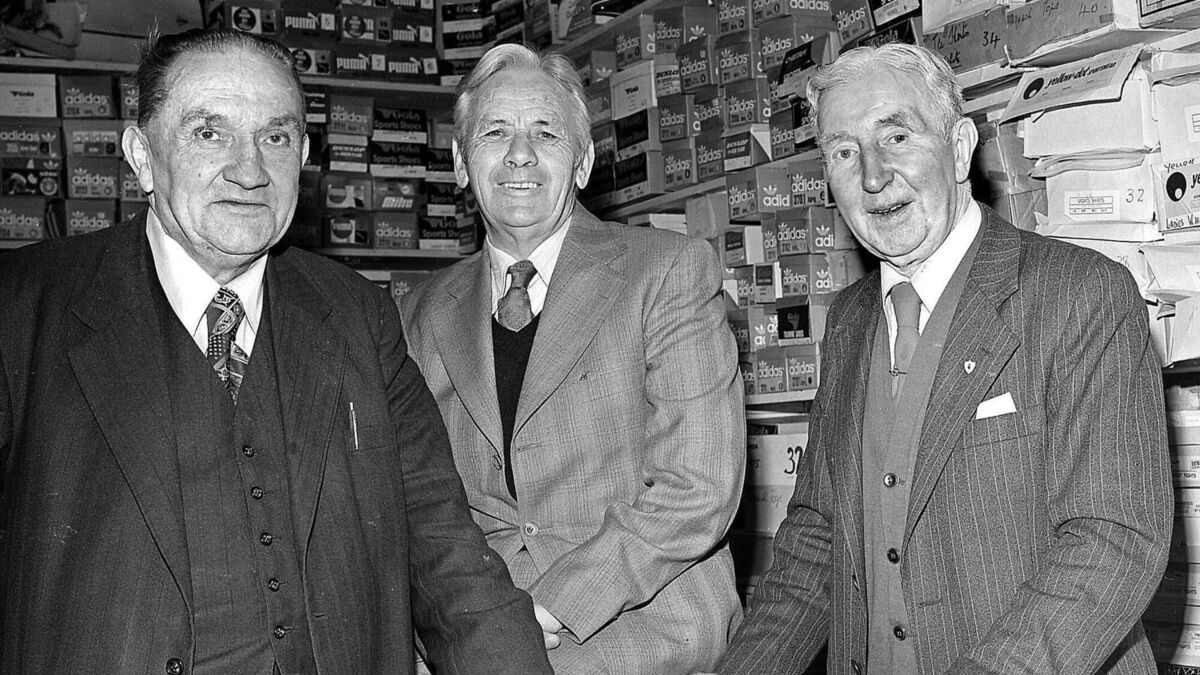
Three Mayo GAA legends, from left, Paddy Moclair, Jackie Carney and Gerald Courell in Gerald's sports shop in Ballina. Picture: Henry Wills Archive/Western People
Mayo has won three senior All-Ireland football titles. Jackie Carney had a hand in every one of them, first as a player in 1936, then as trainer in 1950 and 1951. He and his great friend Gerald Courell are the only two men to have done that.
Born in Lahardane in 1906, he was John Carney to his family and Jackie to the county. He played right wing-forward for Ballina Stephenites. He was spotted by the panel putting the Connacht team together and played for Connacht and won his first cup in 1931. He may be one of the few players to ever play for their province before their county. Mayo picked him for the senior team in 1933 on the strength of his play for Connacht and he won an All-Ireland junior medal. From there, he did not leave the Mayo team for eight years.
Mayo were the dominant league team after 1933, and Carney was central to it. He won seven National League medals, from Mayo's run of victories between 1934 and 1939 and another after a WWII interruption in 1941. He added five Connacht titles and four Railway Cup medals with Connacht. But the medal that mattered most to him was the one from 1936 when Mayo beat Laois to win the county's first senior All-Ireland. Carney lined out that day alongside Henry Kenny, father of a future Taoiseach, in a Mayo forward line that brought Sam west for the first time.
He played his last game for Mayo in June 1941 and went home to Ballina, where he ran a pub and grocery shop, Carney & Hunts, a few doors from the dress shop PEMS that his wife Eithne would own and operate.
He might have stopped there. He didn't.
In 1948, the County Board named him co-trainer of the Mayo senior team, alongside Gerald Courell, a teammate from his own playing days. The two had struck up a friendship on the field in the 1930s that Mayo would need again in the years ahead. Their first campaign together ended in heartbreak, a one-point All-Ireland final loss to Cavan. The next brought a semi-final defeat to Meath. Carney and Courell did not change course. They doubled down on it.
Collective training itself was not the norm in Irish football at the time, and gathering a panel together for a fortnight was close to unheard of. Each year the panel gathered at Mrs Gaughan's guesthouse in Ballina, where Carney and Courell ran a full daily regimen. Mornings started early with Mass, then training at the Stephenites club grounds, back for lunch, more training in the afternoon, and the blackboard session after dinner, where each player broke down an upcoming opponent, position by position, strengths and weaknesses laid out in front of the group. Paddy Prendergast, the full-back on those teams, called it more intensive than people realised, seventy years ahead of its time and unheard of anywhere else in the country.
Eithne, Jackie's wife, recounted how Jackie and Gerald brought the team to Enniscrone strand, running them on the sand and up through the dunes. That level of conditioning work would also have been unusual for the era.
It worked. In 1950, Mayo beat Leitrim, Roscommon, and Armagh to reach the final, then held off Louth 2-5 to 1-6 despite losing centre half-forward Billy Kenny to a career-ending injury five minutes into the game. A year later, Mayo did it again, drawing with Kerry in the semi-final before winning the replay, then coming from three points down against Meath in the final on the strength of a Tom Langan goal, to win 2-8 to 0-9. Mayo has not won an All-Ireland since.
Carney's touch went beyond tactics. He spotted John McAndrew, a future All-Ireland winner, after watching him cycle twenty miles from Crossmolina to play a club match.
The discipline of those fortnights in Ballina bred a closeness that outlasted the football. Players who came through the guesthouse camps stayed friends with Carney and with each other for the rest of their lives.
He died of a heart attack in 1984, a fit man to the end, and is buried in Addrigoole Cemetery near Lahardane, overlooking Lough Conn and in the shadow of Nephin Mountain. His nephew Martin Carney went on to play for Donegal and Mayo and later became a familiar face as an analyst on The Sunday Game.
Mayo has come close many times since 1951 and gone home empty-handed. Jackie Carney knew both sides of that story. He also knew what it took to end it, twice.