Time to show respect for GAA’s middle men
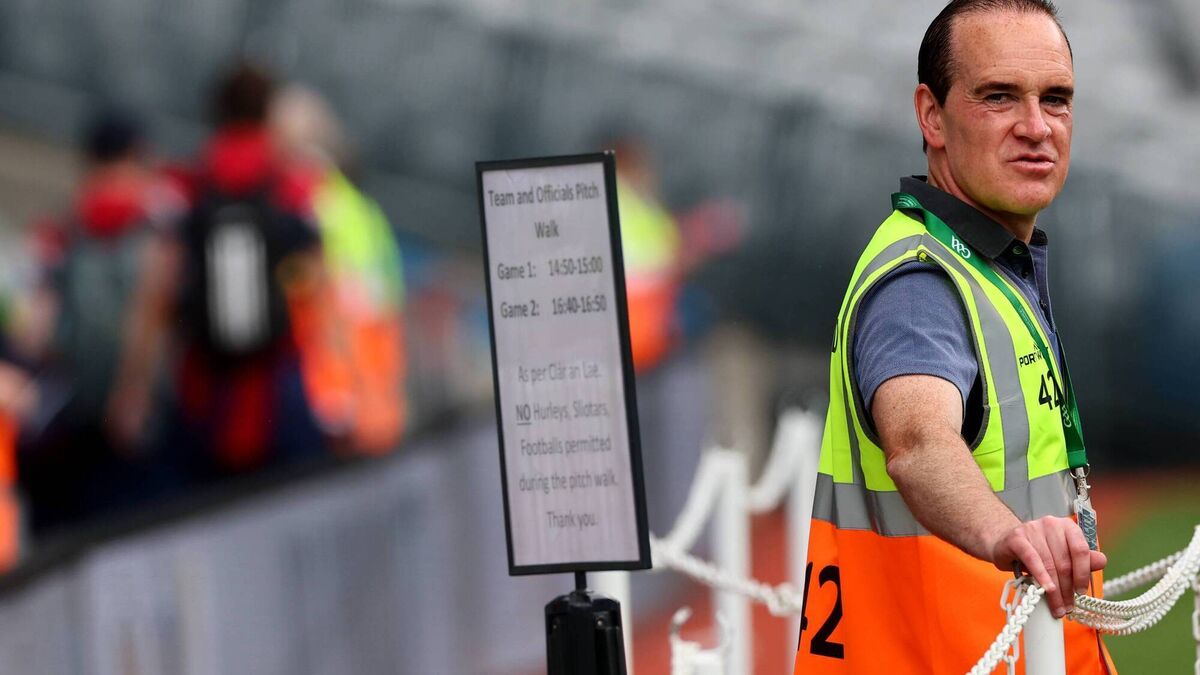
David Coldrick seen working as a steward in Croke Park at Mayo's All-Ireland SFC quarter-final win against Cork. Coldrick will this time find himself in the middle of the pitch as the Meath referee has been appointed to take charge of next Saturday's semi-final between Mayo and Louth. Picture: INPHO/James Crombie
Gaelic football is in a great place right now. Free-flowing football, high-scoring thrillers, comebacks and shocks are now commonplace in a game reborn. The only fly in the ointment? The post-match abuse and haranguing referees get in public fora after nearly every big match.
Last week, David Gough, Paddy Neilan and Sean Hurson were in the line of fire. Next week it will probably be David Coldrick or Brendan Cawley. The only ref who was spared any vitriol after the quarter-finals was Martin McNally, who was in charge of the Mayo v Cork game. Mayo winning so comfortably avoided any intense scrutiny of his performance.
It is becoming increasingly galling how every classic, tight-finishing match is shrouded in negative discourse about how the ref “screwed” one team or another. There is as much talk of botúns by referees as there is of the brilliant, game-defining plays by our star players. Last weekend, my X (Twitter) feed and WhatsApp groups were more inclined to talk about David Gough or Paddy Neilan than Darren McCurry or Con O’Callaghan.
Granted, social media is a cesspit and many posts on it should be taken with a pinch of salt, but some of the commentary about referees was absolutely disgusting. According to some X users, David Gough black-carded Liam Silke and awarded Dublin a crucial late penalty either because of his sexual orientation, his occupation or his Dublin address. Take your pick.
Many of these online trolls are nameless, faceless keyboard warriors who would not be so brave in public for fear of looking like uneducated cavemen. Social media is not real life and should often be ignored. But the problem is that, anonymous accounts or not, this widespread referee-bashing becomes normalised and an acceptable way of talking about officials. That attitude can spill over into the real world and onto our playing fields too, as we saw to disastrous consequences in an Under-15 match in Clare last week.
All of the big, controversial refereeing decisions made on the weekend before last were tight calls. Liam Silke’s black card, Seán Callaghan’s red card and Kerry’s late ’45 were all open to interpretation rather than black and white. Each referee made a judgement call in a split second, without the benefit of hindsight. By the letter of the law, Gough and Hurson probably got their decisions right and deserve credit for that. It did not stop the name-calling or online invective, though.
None of these were egregious errors. And even if they were, to err is human. Every player who graced Croke Park that weekend likely made an error, some big, some small. Referees are never held to the same standards. For some, one mistake by the man in the middle is one too many.
There may be referees in Mayo reading this now and choking on the irony. I have no doubt some will be thinking, “Ronaldson should heed his own advice, he was a mouthy little fecker on the pitch!” The likes of Mel Kenny and Declan Corcoran would be well within their rights to say the same, as in my playing days in Mayo I was an ultra-competitive, chirpy nuisance who would argue the toss.
With time comes clarity, though, and I would like to think I have mellowed. One of the most important lessons I learned came during a league match against Corofin in recent seasons. Austin O’Connell from Caherlistrane, a talented and fair referee, was on the whistle. It was a tit-for-tat game that ended in a draw. In stoppage time, Corofin were attacking when we won a brilliant turnover in defence and launched a full-scale counterattack to try and steal it at the death.
Just as we broke forward, he blew the whistle for full-time and a share of the spoils. To a man, we made an angry beeline for Austin, complaining about not being given the chance to go up the field and win it.
“Get away from me lads. Ye had 10 wides in the second-half and if ye had taken one of them, ye would have won that match.” A fantastic response that cut us to the quick and stopped us in our tracks. There was no comeback. Off we went, tails between our legs. He may or may not have made one mistake at the end. We made at least ten in the second-half. Whose fault was it that we did not win?
I see it also when refereeing school games at lunchtime. If I had a euro for every “Ah ref!” shouted at me during five-aside matches… They are probably the two most common words in GAA parlance and a fitting name for the famous podcast. In truth, I do not mind players and referees having a bit of back and forth. Healthy and robust exchanges between the main actors in the drama are no bad thing. And with the new rules on dissent, any nasty abusive behaviour from players towards referees is now largely eradicated.
It is the bile being spewed from sidelines and on the dark web that gets my goat. I would not mind, but in my view the standard of refereeing has never been better. Referees have had so much thrown at them in recent years with a raft of rule changes, yet they have handled it admirably.
Referees nowadays always look the part, arriving in full kit and in good shape. Look at the likes of Martin McNally, Sean Hurson and Brendan Cawley, big imposing men who cut an impressive figure, communicate clearly and get around the field well. Most referees at adult level now also arrive with a strong team of linesmen and umpires who work collaboratively to arrive at the best decision. I played in a league final in Galway last weekend and was struck by how the linesmen and umpires were all mic’d up and in constant dialogue with their referee.
At the risk of sounding like Roy Keane, it’s their job, but it’s also a fact that they know the rules far better than those moaning at them about their decisions. I’ve heard that when Kevin McStay takes charge of a new team he always gives his players a quiz on the rules. Players rarely get 100%. His point is simple: if you don’t know the rules inside out, why waste energy arguing referee decisions on the pitch?
I once spoke to Mayo and Kilmaine legend PJ McGrath when he was chairman of the National Referees’ Committee. He told me that next Saturday’s referee, David Coldrick, an actuary by trade, aces the refereeing theory test every season. You can be sure he knows the rules better than all of us. Bear that in mind on Saturday.
Our referees are well-trained, well-prepared, diligent amateurs. They get expenses, yes, but not life-changing amounts, and certainly not commensurate with the forensic analysis their performances will be subjected to in the coming weeks. It is a different sport and stage entirely, but at the FIFA World Cup referees receive around a $70,000 tournament fee plus $10,000 match fee for the knockout phase. In many ways, it is easier for those professionals, assisted by technology and working full-time, to dedicate themselves entirely to their fitness and honing their craft. For our referees, the biggest reward is the honour of representing their club and county in Croke Park on the biggest days in Irish sport.
As soccer moves towards excessive refereeing interference from humans and robots there has definitely been a move in Gaelic football officiating away from being too whistle-happy and the emphasis seems to be on letting it flow. This suits a Mayo team that thrives on momentum and the ebb and flow of chaotic championship matches. Looking ahead, it is likely that an Ulster referee such as McNally or Paul Faloon will take charge of the All-Ireland final. If we get there, their low-intervention style would suit Mayo just fine. But that is a discussion for another day.
In this season of thrills and spills, let us hear it for the men in the middle who are facilitating such top-class entertainment. There would be no games without them and we all need to remember that.