From bricklayer to Olympic champion: the Jack Kelly Sr story
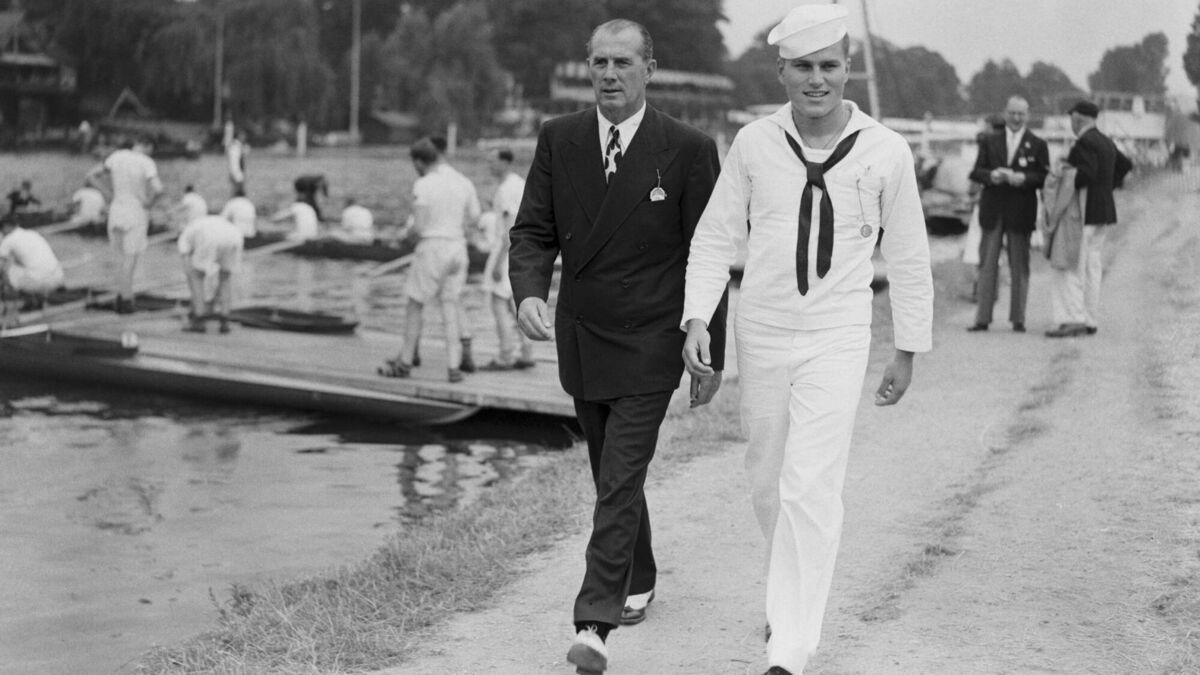
Jack Kelly Sr (left) with his son Jack Kelly Jr at Henley Royal Regatta, Oxfordshire, on July 3, 1946. Kelly Sr had been denied entry to the regatta 26 years earlier before going onto become a triple Olympic champion. Kelly Jr would himself compete at four Olympic Games. Picture: Keystone/Hulton Archive/Getty Images
The cap was tattered and grubby, soaked through by river water and sweat and the dull heat of a long Belgian afternoon. Cotton holds everything – moisture and smell and effort. Jack Kelly Sr. nevertheless folded it anyway, without washing or airing it out. And after slotting it neatly into an envelope, he addressed it to King George V.
Also inside the envelope was a note, written in plain and forthright language:
“Greetings from a bricklayer.” That was it – no context and no attempt to soften the landing. The cap was likely still damp from an intense Olympic rowing final when it arrived in London. You could imagine the envelope being opened with an ivory-handled paper knife in some grand room, the cloth being lifted between two fingers, the smell arriving before the explanation.
The message was meant for Henley, even if the King was the recipient. Earlier that year, Kelly had been refused entry to the renowned regatta because he earned his living laying bricks. The logic was simple and cruel: labour disqualified you from amateurism. Men with soft hands could row for honour. Men with calluses could not.
So, Kelly went to the Olympic Games in Antwerp instead. He raced in the single sculls and won. He then climbed back into a boat for the doubles sculls and won again. Two gold medals, one body. No argument left to make.
The cap arrived without apology because none was required. It carried the smell of labour into a world that preferred its sport disinfected of it.
Kelly's roots run back to Newport, from where his father left in the 19th century, part of the steady outward drift from the West of Ireland at the time. Newport was not a place that produced athletes in any formal sense, but it produced bodies accustomed to work – and minds shaped by it. The land demanded effort before it offered reward, and often offered none at all.
The future Olympic champion may have been born in Philadelphia, but he grew up in a household still organised by those assumptions. His father carried the ways of Mayo with him, not as nostalgia but as habit. Work came first. Endurance was expected.
Kelly left school early and learned a trade, becoming a bricklayer while still a teenager. The work was repetitive, heavy and precise. It trained balance and rhythm, taught him how to distribute force, how to keep going when the body would rather stop. Rowing came later, but it arrived into a body already prepared for it. The river did not transform him; it gave shape to something that was already there.
That background mattered when Kelly encountered rowing’s strict amateur codes. The sport was administered by men who treated manual labour as a disqualification rather than a foundation. Kelly did not share that view, largely because he had never been afforded the luxury of it. By the time he reached Antwerp, Kelly was carrying more than American colours. He was carrying an inheritance that stretched back across the Atlantic, a Mayo understanding of effort as something to be endured quietly and used efficiently.
For a period, Kelly was perhaps the most dominant sculler in the world. Four years after Antwerp, he returned to the Olympic Games in Paris and won again – another gold, this time in the double sculls, confirming that Antwerp had not been a one-off or a reaction to injustice, but the standard. By 1924, he was no longer an outsider forcing his way in. He was the benchmark.
But he didn’t linger in sport for too long. He treated rowing the way he treated everything else in his life – as work to be done to completion. When it ended, he moved on. Philadelphia was expanding, and building itself in brick and steel. Kelly understood that world instinctively. He had learned the trade young, and he scaled it quickly, turning manual labour into a contracting business that thrived on the same qualities that had carried him down Olympic courses: repetition, efficiency and a refusal to waste effort.
By the 1930s, Kelly was no longer known primarily as an athlete. He was a prominent builder and a familiar figure in civic life. America had little difficulty accommodating men who had started with their hands and ended up with influence. Politics naturally followed. He entered public life not as a reformer or ideologue, but as a practical man who believed systems should function. He served as Pennsylvania’s Secretary of Revenue, entrusted with overseeing the state’s finances, an appointment that carried a quiet irony. The same background that had once disqualified him from amateur sport now qualified him to mind the public purse. Competence, it turned out, travelled better than pedigree.
He later ran for Mayor of Philadelphia as a Democrat and lost. But the defeat mattered less than the attempt. The city of Philadelphia had been a Republican stronghold and he had narrowed a margin of defeat that had customarily stretched into hundreds of thousands, turning a one-party town into a genuinely contested arena.
His son, Jack Kelly Jr., followed him into rowing, competing at four Olympic Games and later working within the sport’s institutions, most notably as President of the United States Olympic Committee. Where the father had forced entry, the son belonged.
His daughter, Grace Kelly, carried the story somewhere else entirely. She headed to Hollywood first where she won an Academy Award for Best Actress before later becoming Princess of Monaco. Between them sat the proof of what the son of a Mayo immigrant had really built. And in the end, his story circles back to West Mayo.
Before the medals and the regattas and the elections, there was Newport. Post-famine Mayo was a place that put an emphasis on application over ambition. Strength was a necessity and patience was never praised – it was simply assumed.
Those traits crossed the Atlantic intact and were passed on through generations. They settled into a household in Philadelphia and then into a body that understood effort without needing to dramatise it. Kelly did not row with entitlement. He rowed the way men ploughed a field or laid brick – evenly, relentlessly and without asking to be noticed.
Mayo formed the habits. His father passed them down. America rewarded them. Sport tested them. Politics repurposed them.
The cap he sent to the King was not a gesture of triumph. It was a sort of acknowledgement of origin. It was a quiet way of saying that nothing in his life had ever required him to shed the qualities he inherited from a small town in the West of Ireland.
The rules changed around him. The man did not.