Rugby has been a unifying force in Castlebar for generations
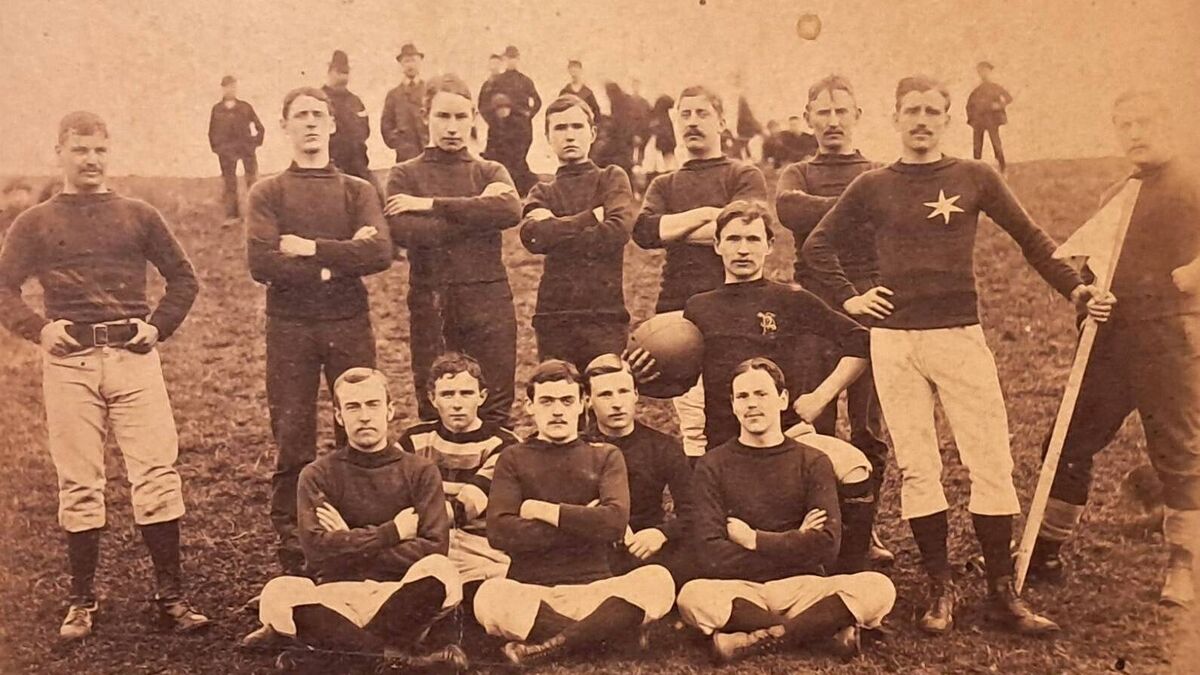
Members of Castlebar Rugby Football Club in 1890 with Dr William De Exeter Jordan holding the ball.
This year marks the 140th anniversary of Castlebar Rugby Club.
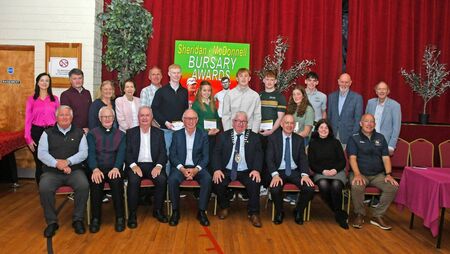
A large crowd gathered in the Linenhall Arts Centre in September for an exhibition celebrating that rich history.
Addressing the guests on the night, Castlebar Rugby Club chairperson Declan Hughes said: “It is great to see so many past and present players, coaches, members, parents, and volunteers here. Like those who have filled those roles before you over the past 140 years, you are the backbone of our club.
“As we look back on our history this evening and share memories, it is fitting that we also remember those associated with our club who have passed. Many of our players who have passed were also members of other sports clubs in Castlebar, and our loss is shared by our neighbours.
"It is also true that our successes are shared by our neighbouring clubs, and theirs are shared by us. Through close relationships among clubs, Castlebar has remained a major sporting centre in Connacht and Castlebar Rugby Club is proud to play our part in keeping it so.”
It's a club which treasures both its past and its progression.
“It is a history we can feel immensely proud of, not least our relationship with Connacht Rugby. We were one of six clubs present at the formation of Connacht Rugby in 1885 and over the years we have supplied Connacht squads with many fine male and female players and Connacht committees with experienced members. Our proudest association with the province was the election of one of our own, Jimmy Staunton, as president of Connacht Rugby for the 2024-25 season.
"Through decades of hard work, scores of dedicated volunteers, hundreds of players and thousands of fundraised pounds and euro, our membership today exceeds 500, with strong growth in our minis and youth rugby. The future is bright. This year, we added a fine spectator stand to our grounds in Cloondeash and plans are in place to extend our facilities,” said Declan.
Sport has long been central to life in Castlebar and the birth of rugby in the town reflected its prominent position.
Castlebar in the late-nineteenth century was a different town to today in so many ways, but it is also true that is was similar in so many ways. For similarities you need only look at sport.
Castlebar was a sporting centre where people from Connacht visited in their hundreds to watch the sailing regattas on Lough Lannagh, the Aughadrinagh steeplechase horseraces on the Ballinrobe Road and Castlebar Cricket Club’s games against the Garrison Club of the Connaught Rangers, the Castlebar Garrison, and Captain Bingham’s XI. Gaelic games were being organised by the newly established Gaelic Athletic Association.
Castlebar Rugby Football Club was formed in 1885 by locals and serving members of the British army in the town. The soldiers’ influence was immediate as the club’s first colours of black and amber were common colours often selected by military teams.
The club welcomed all political persuasions, and Irish nationalists togged out alongside British soldiers. The club’s first captain, and the man who was instrumental in setting up the club, was Dr William De Exeter Jordan. The pallbearers at Doctor Willie’s funeral were provided by the United Irish League, a nationalist political party.
Early games were played on Pigeon Park (present day Scoil Raifteirí) with the permission of Lord Lucan’s agent, Alexander Larminie. The club initially competed with the GAA for members as a result of the latter’s ban on its members playing foreign sports. That ban was lifted in 1971, and local athletes were free to play the sports they loved.
Like many sports, rugby was disrupted by war at home and abroad throughout the 1910s and 1920s. A.V.G. Thornton, T.M. Quinn, Thomas Gavin and several others resuscitated the game in the late 1920s, as did Michael Heverin, Charlie Garavan and others in the 1940s when the club was in decline.
The club played at many venues throughout the twentieth century, but none were home until land was purchased at Cloondeash in the early 1970s.
Johnny McCormack, George O’Malley and David Flood were the club’s original trustees. A clubhouse was added in 1984.
Committees and volunteers have worked on improving facilities and following the recent opening of a new spectators’ stand, the club is now focused on adding an extension to its changing rooms and clubhouse to cater for over 500 members. The club has certainly come a long way from Doctor Willie’s original membership of 48 men.
Doctor Willie steered the course of Castlebar Rugby Club both on and off the pitch.
William Stephen De Exeter Jordan was born in 1863 to Dr Myles Joseph De Exeter Jordan, of Windsor House, Castlebar and Mary Louisa Graham of Westport. He was the eldest of twelve children.
William went through his juvenile training at the academy of James J. O’Dea in Castlebar. In 1881, he commenced his medical career at the Royal College of Surgeons in Dublin. He was an excellent student and qualified in a very short time. After qualifying, he returned to his native town and succeeded Dr H. Bermingham as Medical Officer of No 1 Castlebar Dispensary District in 1886.
Doctor Willie, as he was affectionately known, was a keen sportsman and enjoyed fishing, shooting and was for years the captain of Castlebar Cricket Club. At the inaugural meeting of Castlebar Rugby Football Club in 1885, Willie was elected as the club’s first captain.
In that lead role he grew the team and organised games in Sligo, Athlone and Galway. Owing to his own personal energy, he piloted the club to victory when they won the coveted Connaught Cup. His younger brother Myles, who had followed his father and brother into the medical profession, was also a sportsman and lined out for Castleabr RFC alongside Willie.
The workload of being a dispensary doctor in such a vast geographical area began to take its toll on Willie. In 1895, his duties became so arduous that he had to give up all outdoor activities. His condition worsened two years later and on the recommendation of a London specialist, he travelled to the warmer climate of Madeira. He returned to Ireland in the autumn of 1899, but his condition had not improved.
In his resignation letter, written just before he passed away, Willie wrote: "I may add that my illness commenced while I was acting as Castlebar Dispensary Doctor."
His job, he believed, was responsible for his loss of office and the prolonged ill health he had suffered.
Dr William De Exeter Jordan died in his father’s residence, Ellison House, Castlebar, in the early hours of November 1st, 1899, aged just 36 years. On the day of his burial, his coffin was carried from the chapel to the graveyard on the shoulders of members of the United Irish League, all of whom wore a black and white rosette as an emblem of their sorrow for Doctor Willie.
- If you want to read lots more articles like this, pick up the , available in all local newsagents.