Questions over Taoiseach's St Patrick's Day visit amid Greenland threats
James Cox
Here, we have a look at the topics likely to dominate political discourse in the week to come.
Taoiseach's St Patrick's Day visit
US president Donald Trump's threats of 25 per cent tariffs on certain EU states, along with Britain and Norway, until the US is allowed to purchase Greenland, are threatening an international crisis.
Mr Trump has repeatedly refused to rule out US military intervention in the autonomous Danish territory, putting the future of Nato at risk.
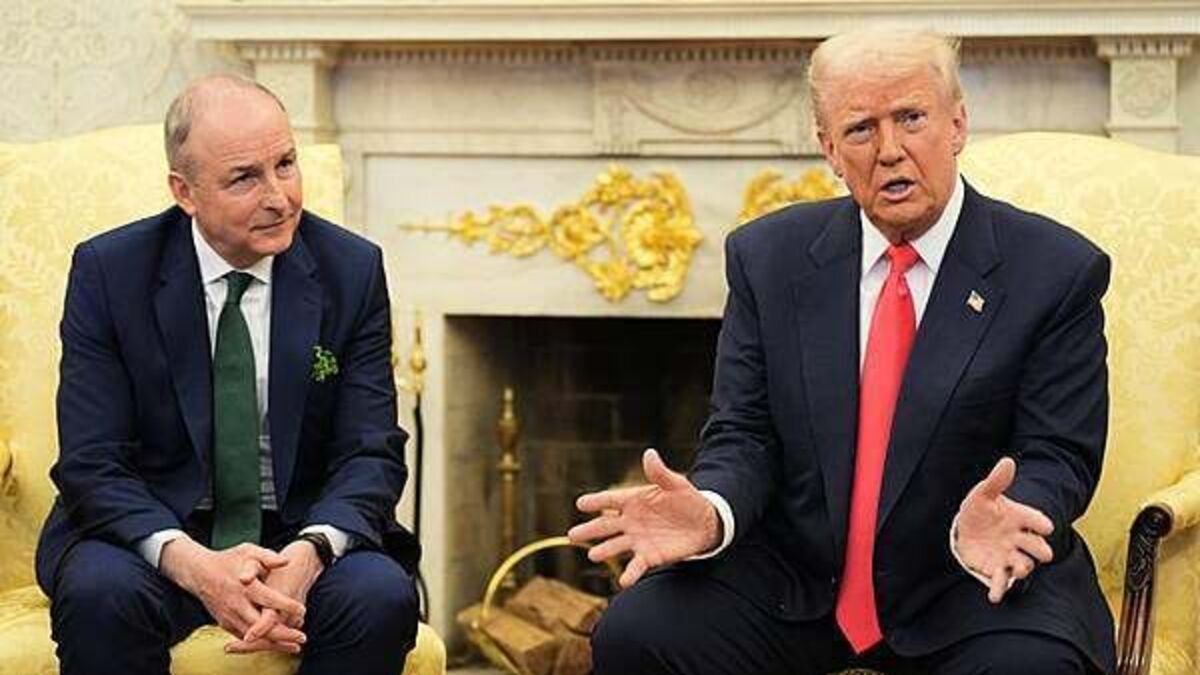
With this in mind, some thoughts are already turning to the annual St Patrick's Day visit to the White House for Taoiseach Micheál Martin.
Mr Martin emerged unscathed from last year's meeting, but there is now more at stake.
People Before Profit TD Richard Boyd Barrett said it's not appropriate for Mr Martin to present Donald Trump with a bowl of shamrock this year.
Speaking in the Dáil, he said: "So please, tell me Taoiseach, are you going to stand up to the bully? You're not seriously going to the White House with shamrock this year to celebrate our national day with him?
"Surely you're going to tell US troops to get out of Shannon Airport, and not going to go along with the militarisation agenda that Trump is imposing on Europe."
Meanwhile, Labour leader Ivana Bacik told Virgin Media News: "There has to be a willingness to stand up to Trump and it does mean from an Irish point of view that the Taoiseach must be prepared not to go to Washington if Trump does not back down in the meantime, because we have to use every lever at our disposal."
Mr Martin has insisted the trip will go ahead as usual.
Speaking today, Minister for Social Protection Dara Calleary said “very few countries get the opportunity” of “access to the president of the United States of America on an annual basis for a number of hours”.
“It’s a chance for him, as he did last year, to discuss face to face with the president various issues.”
Mr Calleary added: “At whatever point those issues will be, in the middle of March, it’ll be a chance for a face to face discussion for dialogue, which is always important at any time, particularly in times of pressure.”
'The only way to deal with Donald Trump is to stand up to him,' Irish MEP says
The only way to "deal with Donald Trump is to stand up to him" over his Greenland tariff threats, an Irish MEP has said.
Fianna Fáil MEP Barry Andrews was recently appointed ‘rapporteur’ for the EU Parliament’s position on EU-Greenland relations.
In an interview with BreakingNews.ie, he said: "There is a realisation on the European side that a red line has been crossed in terms of what Trump has said he's going to do.
"It had a strangely positive impact on the EU member states in bringing them together in a way that happened with Ukraine. It's a really deep solidarity with the people of Greenland and Denmark.
"We need to make sure we exhaust every possible diplomatic pathway before any escalation is considered. There are ways to do that at EU level and individual member state level, including Ireland."
He said the EU's Anti-Coercion Instrument, or 'bazooka', should be considered "in parallel" with the planned retaliatory tariffs worth €93 billion ($108 billion).
"This is an escalation if the threatened tariffs actually go ahead, so it's contingent on that actually happening and diplomatic efforts failing.
"If we do get to that point those tariffs have already been identified, €93 billion worth, they should be proceeded with in parallel with an investigation into the anti-coercion instrument. It puts all those levers on the table for the EU and I think it's clear that the only way to deal with Donald Trump is to stand up to him."
Ireland's defence capabilities questioned over drone incursion during Zelenskiy visit
People called Ireland's defence capabilities "embarrassing" in messages to Taoiseach Micheál Martin over the presence of drones near the flight path of Volodymyr Zelenskiy's plane during a recent visit.
The drones were as close as 500m to an Irish navel vessel, the LÉ William Butler Yeats, however, officers decided they could not shoot them down due to the presence of civilian aircraft in Irish airspace.
They were also spotted in skies over north-east Dublin as the plane carrying Mr Zelenskiy landed at Dublin Airport.
While the origin of the drones is unkown, they were suspected to be Russian by security experts. Discussing the incident afterwards, Minister for Justice Jim O'Callaghan said the drones were "generated for the purpose of putting pressure on EU and Ukrainian interests".
In messages, seen by BreakingNews.ie following a Freedom of Information request, people told the Taoiseach that Ireland's security was "embarrassing" and called for more spending on defence.
One person wrote: "The fact that enemy drones are able to operate freely in Irish airspace is more than a worry, it is embarrassing. As a country, our inability to defend against enemy aggression is frightening."
In one email, someone called the incident a "stark, undeniable illustration of the systemic vulnerabilities that have been repeatedly raised by defence and security experts".
"I am writing to express my profound alarm at the recent incident in which several drones - reported as advanced, non-hobby-grade platforms - entered the temporary no-fly zone established around President Zelensky’s visit and subsequently loitered near an Irish Naval Service vessel off the Dublin coast. Regardless of the origin of these platforms or the intent of the operators, the fact remains that Ireland was unable to detect, prevent, or interdict aerial activity occurring in restricted airspace at a moment of heightened sensitivity and international visibility.
"This episode is not an isolated embarrassment; it is a stark, undeniable illustration of the systemic vulnerabilities that have been repeatedly raised by defence and security experts. Ireland currently lacks the radar, the technical infrastructure, the interception capability, and the personnel capacity required to meaningfully enforce its own jurisdiction—whether in the air, at sea, or around critical subsea infrastructure.
"We now find ourselves in a geopolitical environment defined by hybrid conflict, strategic coercion, and grey-zone operations. Across Europe, hostile actors have used drones to disrupt airports, threaten civil aviation, surveil sensitive infrastructure, and interfere with
undersea cables that underpin the digital economy. These are not theoretical risks—they are documented realities affecting EU partners today."
Abroad
All eyes are on Greeland as the Davos summit continues, with Donald Trump set to address it on Wednesday.
His speech is scheduled for 2.30pm and there will be a collective drawing of breath across the EU, and the wider world.
He said "you'll find out" when asked how far he would go on Greenland at a drawn out press conference in the White House on Tuesday.