Our deserted islands have survived in their own way
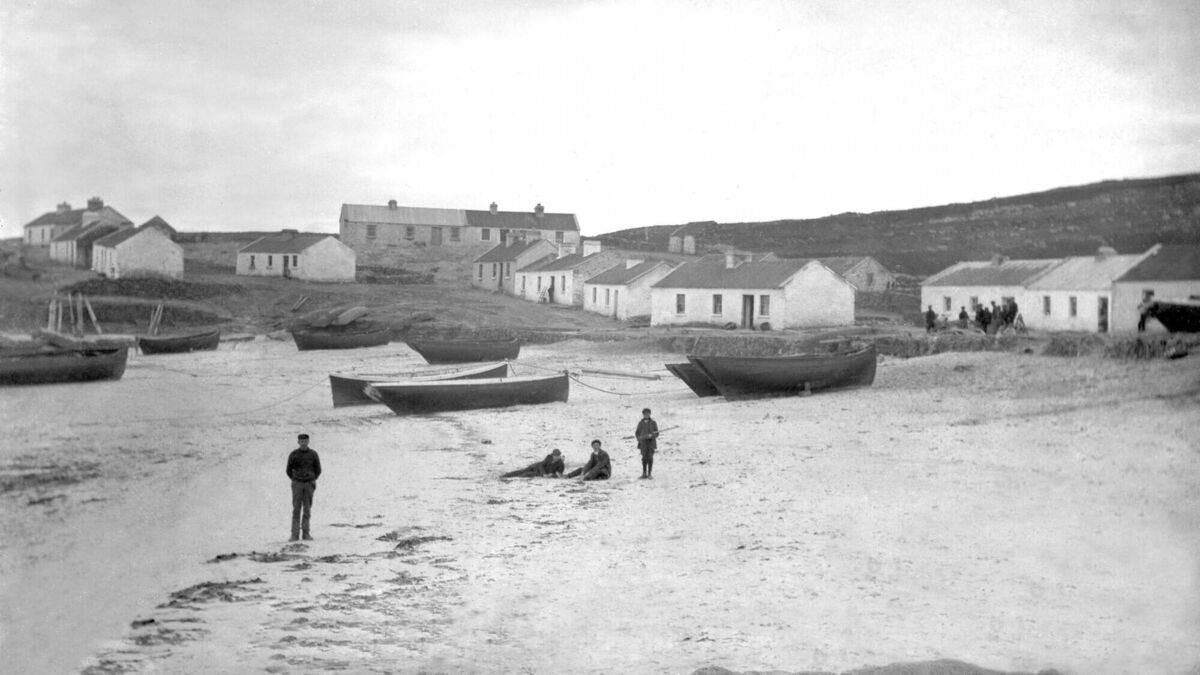
Inishkea South Island in the early 1900s when the two islands had a thriving fishing industry. Picture: Leonard Collection
When you arrive at the Solas Visitor Centre, or Solas - Scéalta an Atlantaigh, in Eachléim and enter the main viewing room, four life-size figures of young men stare back at you. Clad almost uniformly in crew-necked jumpers, faces not smiling but not sad, three with hands comfortably behind backs, one arms folded to his front, an air of acceptance mixed with confidence stare back at you. A transformation takes place. You become the watched not the watcher.
Who are those young men?
They are four Inishkea islanders. I’m guessing that the crew neck geansaís worn by the men may have reflected the whaling station company that was based on the island in the early years of the twentieth century. The names are Tuirleach Ó Raghallaigh, Sean Mag Fhionnachtaigh, Micheál Ó Mhuineacháin and Padraig Mag Fhionnachtaigh. All four were drowned on October 29th, 1927, along with six more of their comrades.
Solas and its excellent team have to be complimented for the work they do. In two years time a century will have passed since the Inishkea sea tragedy but Solas, amongst other projects, has become the repository and centre of what that tragedy actually did, its impact on the island and its impact on the area surrounding Blacksod Bay. The four young men staring down at you from the monochrome print are connected to you via their place on that wall in the viewing room. In essence they remain timeless, a reminder to us all of their sacrifice, yet eternity.
Solas is an appropriate repository for the young men looking down at you. Inishkea Islands, the site of their birth, lays due west of Solas. A two-mile direct line from the monochrome picture lies the shore where John and Anthony Meenaghan, two of the survivors, were washed ashore alive on Glosh Beach. From there they made their way to Paddy Conalty’s pub in Eachléim where they raised the alarm. Conalty’s pub is about two hundred metres from Solas and Teach John Joe stands next to it today. The beach from Glosh to Tirrane and the nearby sand dunes were the receptive sites for the other bodies washed up almost a hundred years ago.
Having the good fortune as a child to have grown up amid the people who came from Inishkea, the faces of the four young men are reflected in many of their descendants that I know to this day. Almost uncannily so.
My own link to island life is via my grandmother who lived in a parallel world up in Gaoth Dobhair, Donegal. Born on an island and only coming ashore at eighteen, speaking only Irish, seeing two of her brothers perish at sea and a third lost with the belt of a spade over a disputed stone wall boundary, the majesty and pain of island life lies deep within my psyche. I understand Synge’s telling Yeats what he loved about the Aran Islands was ‘all that had edge, all that is salt in the mouth, all that is rough to the hand, all that heightens the emotions by contest, all that stings into life the sense of tragedy’. That is the Inishkeas too.
Before the War of Independence, many of the then poets, painters, dreamers and revolutionaries such as de Valera, Collins, Keating, Yeats and Pearse saw the islands off our coasts as the last remaining repositories of what the Gael encompassed. Much of it was a genuine effort to recapture the past, some of it was romantic twaddle and unreal. Ireland was/is an island off Europe, separated by the British mainland. Ireland the island has itself an orbit of islands, its own satellites. Tim Robinson cartographer and historian stated: “Islands, by their very definition, beg the question of beginnings.” Never more than today’s uncertain world is Robinson’s quote more apt.
However, after the War of Independence came the poisonous Civil War. Éamon de Valera and indeed Collins saw a new reality. The islands and their lore, language and ancient people would have to soldier on alone. The heart of a nation had to be fought for first. de Valera, having helped start the Civil War in 1922, then waited, not recognising the Dáil until 1928 when Sean Lemass declared ‘Fianna Fáil is a slightly constitutional party... but before anything we are a republican party’ as they finally took their seats in Dáil Éireann.
Nation building and power shattered the rose tinted views of poetic and dreamy ancient Ireland off our coasts. We agree that island life was abandoned early in the nascent Free State but it started with the ripping up of the rail links to the margins. The lines to Gaoth Dobhair, Killala, West Clare, Valentia in Kerry and Clifden in Galway amongst many others were firstly abandoned. Cut the arterial links and the flowers will wither on the vine.
Diarmaid Ferriter’s excellent book, On The Edge, about Ireland’s islands quoted Seán MacGrath, an official in the Land Commission on reports of distress in Achill island circa 1925: “As much as has been done in that way to better Achill for the islanders as can be done... on the other hand it should be the aim of a native government to even up conditions all over the area of its jurisdiction and put an end to any drain on the Exchequer... it is plain that the island and the surrounding districts is an undue drain on the resources of Co Mayo and of the Saorstát.”
The dry and cold words of MacGrath reflected government thinking. ‘Even up conditions’ was achieved by essentially abandoning the western seaboard in favour of east of the Shannon. By the early 1940s, the de Valera government itself executed some of its own former comrades from the War of Independence.
That radical political - and some might aver, pragmatic shift - rendered issues like island life, ancient lore, language and the ideals espoused by Synge, Yeats and Lady Gregory in the ditch. A terrible beauty had been born but parts of it were already abandoned. That was then and this was now... reality some might say as the West bled its finest youth to emigration to help ‘even up’ the rest of the new nation.
The loss of its young life blood in the Inishkea Disaster was the islands’ demise. In early 1931, the evacuation of the two islands started and was completed by 1934. Again referencing Ferriter’s book, the cost of the operation of moving to the mainland came to £13,000. The Land Commission who oversaw the move then washed their hands of the islanders now on the mainland. Bluntly put, the islanders weren’t given enough land to make a living but still now depended more than ever on the island to fish from, graze cattle and sheep. Ferriter’s account notes dryly that ‘the islanders were left, literally, neither here nor there’. Apt and true.
Into the lacuna of survival came reality. The Celts last great march westward, in this case America, was epitomised by the Inishkea islanders seeking work in the Boston and New York areas of the USA along with the usual migration to Scotland and England. Places like Holyoke and Springfield, Mass, along with the Bronx in New York and Charlestown and South Boston. In turn, they set up home there and for many of the early generation, island life and Inishkea was to the forefront. Amongst Our Own, by local author Tomás Bán Ó Raghallaigh, is essential reading in understanding the Inishkeas.
Tomás Bán’s parents were islanders as were/are most of his his relations and his ability to connect all the dots necessary to understand the islands’ past and present is essential reading for anyone interested in the jewel Inishkea is. Tomás links the connections between the island, the mainland and the Americas and UK in a comprehensive manner.
Tomás gives us a picture of the iron will of its people. An earlier writer, Scottish novelist Innes Shand, circa 1884, and quoted by Ferriter described the Inishkea thus: “Where people form an independent state of their own and must be pretty near heathens. They acknowledge no landlord... pay no rates... elect their own monarch... they have an idol they regularly worship and propitiate before their boats put to sea.”
Shand didn’t understand the islanders. The ‘idol’ they worshiped was a simple old religious icon. The islanders knew the ‘idol’ would stay loyal to the island, the priests and officials wouldn’t. The ‘idol’ bridged that gap between pagan Ireland and St Patrick’s Christianity. It took the rest of the nation another century at least to catch up with the islanders prescient judgement of temporal and pastoral man. They early on realised that the direct line to the Man Above was often the best.
Despite the savage toll the October 1927 disaster took on the islanders, French archaeologist Françoise Henry stated a decade later in 1937 about the Inishkea fishermen: “Those men of Inishkea are the first in Ireland that I have seen put fishing ahead of everything.”
A further decade later, in 1946, she noted: “This dying island. The sea gnaws at it, breaking the granite slabs, throwing them back on top of the cliffs, devouring the sand whenever it can reach it. The wind wears it away little by little removing the dunes. The rabbits undermine it... the sheep gnaw it away.”
But Madame Henry was wrong. The islands survived in a different way. Pat Rua Reilly, a 1927 survivor, in a 1990 interview stated on being asked how the families of the drowned sea men got on, replied: “They got on all right, they had to bear it out.”
Stoic, solid and soulful, Pat Rua’s words are the image of the man himself, an image I saw first hand from my own grandmother. Acceptance and faith. Onwards.
The islands today have a new lease of life. The original islanders’ descendants still fish the area around the islands. I see them steaming towards the fish banks as early as five o’clock on a summers morning. Others ply their trade with taking tourists out, giving them an adventure combining the islands’ history with the seas a round them, replete with dolphins, seals and sharks.
The islands now link with Solas and the lighthouse and Blacksod pier - a combined effort at revitalising the area. The future is bright. Roots long laid down by Irish language college Uisce has seen many of its past pupils return and settle in the area and use the skills they received down there to good effect. From surf schools, island tourism, spreading the language and citing the islands as the jewel in the centre, a tide has been turned in the lower Erris peninsula.
The four young men, monochrome and silent, watch over proceedings at Solas, their present home connecting them with their past. And if you’re lucky and the sun is setting on a late October evening, if you look closely from Tarmon Hill and pick out the Inishkea Islands lying in the declining red sunset you might just pick out the high water mark of its peak on shore beneath the once white-washed little cottages before that fateful storm of October 1927 changed its life forever.