Mayo fire crew recalls desperate battle against ferocious blaze
Mayo fire crew recalls desperate battle against ferocious blaze

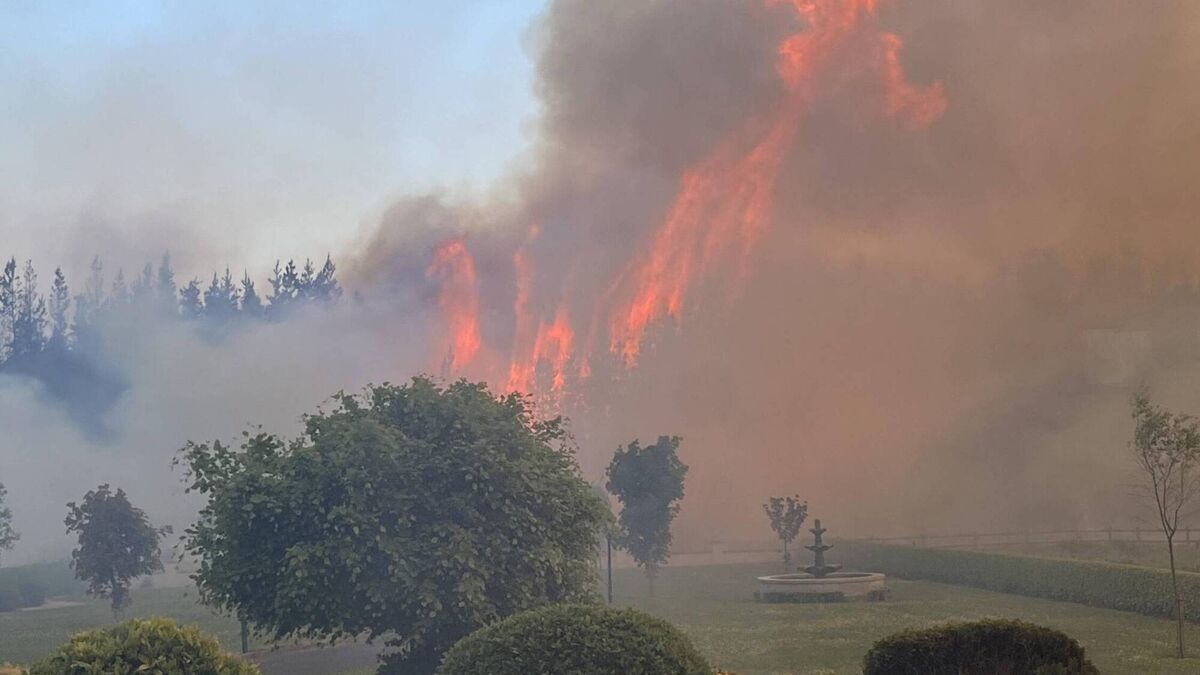
This photograph taken by a local person from the window of their Gorthaganny home in May 2025.

The ferocity of a major wildfire in Gorthaganny last year was recalled by the head of the local fire service and a local officer of the National Parks and Wildlife Service in a documentary on the two-day fire screened in Ballyhaunis last week.


Ballyhaunis fire station chief Enda Caulfield said his team struggled in heat of 1,000 degrees as the fire took a grip on a local forestry plantation.

“The fire was travelling at great speed. We decided to contain the fire to stop it crossing the road,” said Mr Caulfield, who described the dry vegetation and strong breeze in early May 2025 as the “perfect conditions” for a wildfire.

He was speaking on the documentary made by Adam Kaczmarek.

Mr Caulfield called for helicopter support from the national fire service when it became clear that local houses were threatened by the fast-moving blaze on Sunday May 17th.

“It was hard going on Sunday and Monday, I was getting calls from locals who were very worried. They were saying ‘The house is covered in smoke’ and we can’t go out.”

The fire destroyed large parts of the raised bog, a special area of conservation (SAC) which sprawls from Gorthaganny to Ballinlough and Ballyhaunis. Also fuelling the fire were dried-out coniferous trees felled by Storm Éowyn in January, explained the fire chief.

The gradual dying out of turf-cutting may be contributing to a long-term increased prevalence of bog fires, explained Mr Caulfield.

“People used to burn off a small area of bog for cutting turf but now there’s less turf cutting and bogs are reverting to nature so there’s more vegetation.”

Liam Cribbon, an officer with the National Parks and Wildlife Service, explained that rewetting of bogs will aid their preservation and reduce the ability of a fire to spread.

“After the fire I was filming the bog with a drone to assess damage and I could hear the call of a curlew, possibly seeking it’s chicks lost in the blaze.”

The consequence of the fire on local wildlife will last decades, said Mr Cribbon, who detailed the destruction of wildlife in the bog.

“Everything that couldn’t fly, 90 percent of them were killed. The hares and the pine marten probably were able to escape but frogs and lizards would have been burnt alive.”

Remarkable drone footage captured by Adam Kaczmarek showed the fire moving rapidly through the bog. In the film, Mr Caulfield explained how fire is capable of jumping 150 metres due to sparks carried by the breeze. The drone footage also showed the fire burning in two circular shapes.

Newly ignited fires often burn in a circular shape because the flames spread evenly in all directions before gaining momentum. If the wind is light, the fire can continue burning in a circle for some time.

More in this section