How a Mayo man became the Mayor of New York
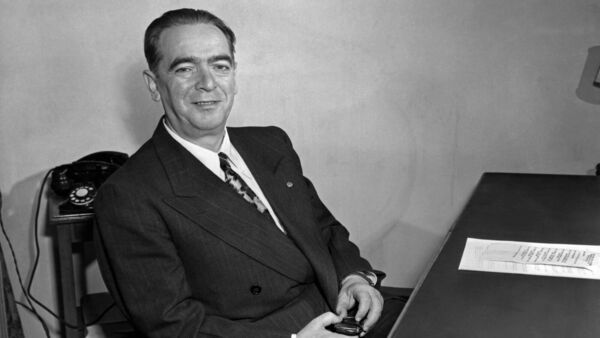
Undated picture taken at New York showing the New York City's Mayor-elect William O'Dwyer. (Photo by - / AFP) (Photo credit should read -/AFP via Getty Images)
A Mayo man who was lauded by New Yorkers ended his days mired in allegations of corruption.
Bohola native William O’Dwyer was the last Irish-born Mayor of New York and the city’s 100th Mayor. His is the remarkable story of an immigrant who arrived from Ireland with $25.35 in his pocket and became the mayor of America’s biggest and richest city.
The eldest of 11 children, his parents Patrick and Bridget O’Dwyer ran the local national school in Bohola.
William seemed set for a career in the priesthood but abandoned his seminarian studies in Spain and set sail for the United States in 1910.
For seven years he worked a series of jobs on construction sites, in bars and hotels and on boats and ships before he obtained his naturalisation papers and joined the New York Police Department. As a cop, he once shot and killed a man who raised a weapon at him. It has been reported that wracked with remorse, he then fed and educated the man’s son.
While working as a clerk for the city’s Police Commissioner, he did night classes at Fordham University law school. He earned his law degree in 1924 and soon after passed the bar exams and began practicing law privately from 1925.
In 1932, O’Dwyer came to prominence when he sponsored an American tour by the Mayo Gaelic football team, then Connacht champions. This afforded O’Dwyer to mix with the influential and elite and cemented his name in Irish-American circles.
As Brooklyn’s district attorney between 1940 and 1942, O’Dwyer earned a reputation as a crime-busting hero - a fearless ex-cop who had the courage to take on the mob. The former police officer turned Brooklyn prosecutor hit the headlines when he helped send members of the infamous Murder, Inc. to the electric chair.
In the wake of Pearl Harbour, O’Dwyer enlisted in the US Army in early 1942. He was first awarded the rank of major, but later rose to brigadier-general and was appointed by President Roosevelt to lead the economic section of the Allied Control Commission in southern Italy in February 1944. His role was largely a humanitarian one and he ensured the people of the region remained fed and food production was increased. He became the executive director of the War Refugee Board in January 1945 and remained in that role until the end of the war, earning the Legion of Merit, a military award given to US service personal for exceptionally meritorious conduct. He was responsible for supplying food to the recently liberated concentration camps among other duties.
During the war, O’Dwyer was awarded a general’s star for investigating corruption in Air Force contracts. As Roosevelt’s under secretary of war, Robert Patterson wrote in an internal letter: “Bill O’Dwyer, I firmly believe, has done more than anyone else to prevent fraud and scandal for the Army Air Forces.”
O’Dwyer ran for Mayor as a member of the Democratic party in 1941. He was unsuccessful but polled well and lost by a relatively narrow margin to legendary Italian American Fiorello La Guardia.
O’Dwyer easily won the 1945 mayoral election. After his first term as mayor of New York City, from 1945 to 1949, the Daily News called him “100 per cent honest,” while the New York Times proclaimed him to be a civic hero.
At his inauguration, O’Dwyer celebrated to the song, “It’s a Great Day for the Irish”. The Mayo man came into office facing a tugboat workers strike, a looming transit strike and a shortage of city funds and surmounted all these hurdles.
A poetry lover who could recite Yeats and Byron from memory, O’Dwyer became beloved in New York. His wife Catherine Lenihan passed away in 1946 and New York mourned with O’Dwyer. He later married Elizabeth Sloan Simpson, a Texan model 20 years his junior in 1949. They divorced in 1953.
As mayor he was tasked with managing the city as it reverted to a peacetime economy, dealt with the debts accumulated during the war years and oversaw the financing of several large-scale construction projects, including the new United Nations headquarters. His personable nature and willingness to overturn long established traditions, such as doubling the subway fare, helped him bring about his vision.
He remained very interested in Irish affairs and was responsible for bringing the All-Ireland Senior Football Final between Kerry and Cavan to the Polo Grounds in New York in 1947.
Viewed as a champion of the ordinary man, O’Dwyer was re-elected by a landslide in 1949. But months into his second term, corruption allegations began to surface. A betting operation was linked to members of the NYPD and in turn to racketeering and powerful politicians and organised crime figures.
More than 500 New York City police officers took early retirement rather than risk being called before the prosecutor’s grand jury. Seventy-seven officers were indicted, and the police commissioner and the chief inspector were kicked out of the force.
Suspicion fell on one of O’Dwyer’s close allies and right-hand man, who was later convicted of extortion. There were fears the Mayor himself could be called in front of a grand jury.
O’Dwyer resigned from office on August 31, 1950. Upon his resignation, he was given a ticker tape parade up Broadway’s Canyon of Heroes.
President Harry Truman appointed O’Dwyer as US Ambassador to Mexico, despite the pair not being deemed close. This was a post from which he could not be recalled except by the president.
Before taking up his appointment, O’Dwyer denied any wrongdoing and rejected suggestions that he resigned as mayor before the scandal deepened.
“There is no truth in that suggestion,” he told the news agency United Press. “When I left the city I had no notion or knowledge regarding the disclosures since in connection with the police department.”
O’Dwyer returned from Mexico City in 1951 to testify before the Kefauver Committee and answer questions about alleged links to organised crime figures. When he was asked to explain a visit to crime boss Frank Costello’s Manhattan apartment in 1941, O’Dwyer told the commission, “Nothing embarrasses me that happens in Manhattan.”
A May 1951 report by the Kefauver Committee stated: “During M O’Dwyer’s term of office as district attorney of Kings County between 1940 and 1942, and his occupancy of the mayoralty from 1946 to 1950, neither he nor his appointees took any effective action against the top echelons of the gambling, narcotics, water-front, murder, or bookmaking rackets.”
Although no charges were ever brought against the Mayo man, the allegations dogged him for the remainder of his life. He resigned as ambassador on December 6, 1952, but remained in Mexico until 1960.
O’Dwyer later returned to New York City where he died of heart failure at the age of 74. He was buried in Arlington National Cemetery.