End of an era as historic Mayo post office set to close after over 150 years
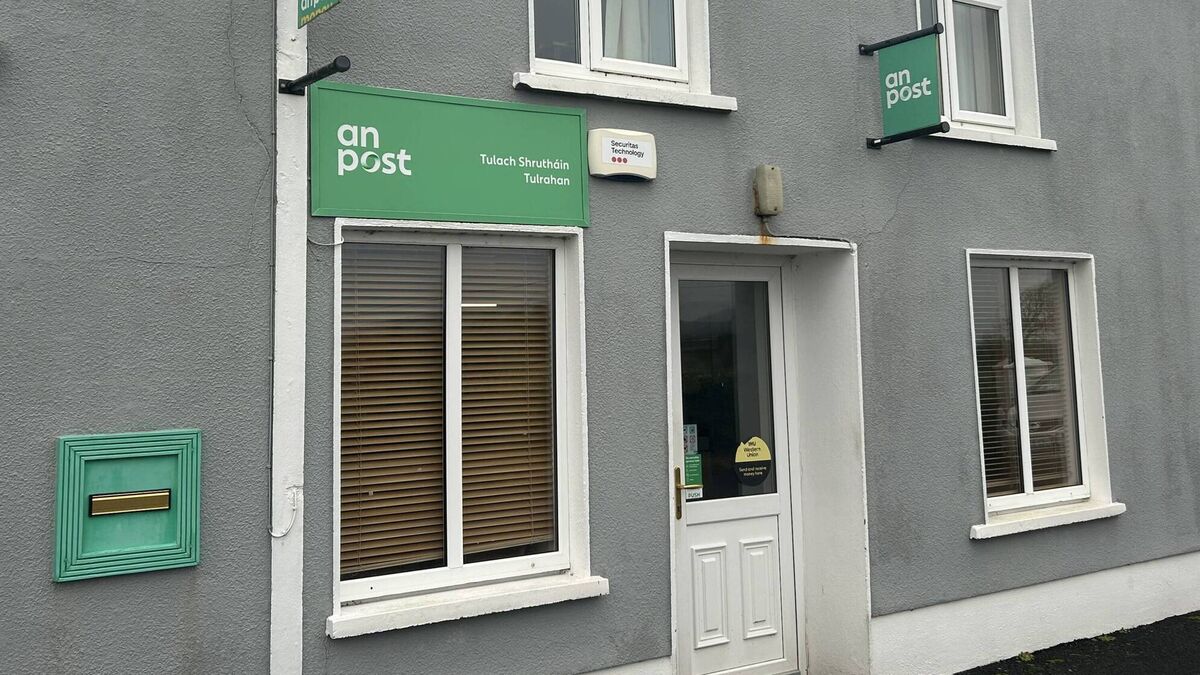
Tullrahan Post Office has been in existence for over 150 years.
Closing on Friday, January 23rd, after over a century and a half of service, Tulrahan Post Office has in recent decades been synonymous with the name of Catherine Delaney. She’s been postmaster there for 71 years, having joined the post office at 14.
“Monica Delaney was here at the time, they made me an assistant to her,” said Catherine as she prepared for her last few days of service this week.
Post offices in Brickens, Ballindine and Irishtown have long closed but this post office, opened in 1867 at the foot of Tulrahan hill, has persisted thanks to Catherine’s long dedication to the community. Now in her eighties, Catherine is long admired in the area for her mild manner and generosity.
Catherine’s maiden name, Murphy, has a long association with the postal service in the Logboy-Tulrahan area.
“My father was postman, he delivered on his bicycle,” she explained while sitting beside a turf fire in her kitchen this week. “He’d always deliver to [Tulrahan] school first, then he’d go down to Cussalough and back to Carramack and then down to Cottage and come up then and through Logboy, then up to Culnaclecha and to Feamore and to Bunduff.
“He’d wheel the bicycle across the field to get to his final calls in Ballybane before cycling back home.
“In those year Mick McCann would bring the post out from Ballyhaunis. After arriving in Tulrahan he’d sit down and have the tea before bringing the post back to Ballyhaunis at 4.30. People would bring the letters, they’d know the time he’d be going back to Ballyhaunis.”
When the post office closes on January 23rd, the adjacent shop will also close. The shop, like the post office, has an illustrious history. Post mistress Monica Delaney’s father Davey Delaney ran a general store selling all kinds of household and farm goods - everything from a needle to animal meal. He was also an egg and wool merchant. A dance hall also operated at the Delaney premises for a time in the last century.
Before the Delaneys, the post office was run by Elisa Nolan, from the land-owning Nolan Farrell clan, who later became Elisa Murphy. Elisa’s daughter Annie took over, marrying Davey Delaney, who was originally from Ballybane near Brickens.
Having handled seven decades worth of post, Catherine has watched the volume of letters diminish in recent years.
“This past Christmas was a disaster, there were not many cards. The old people were great for writing cards.”
Catherine and her son David recall days in decades past when Tulrahan post office would collect one or two large linen bags of post in a day, the bags tied and sealed with a wax seal before being taken to the sorting office in Claremorris.
“Now there might be one or two letters a day,” said Catherine.
The parcel traffic through Tulrahan could also tell a story of how local society has evolved. Christmas parcels from America were once a feature of rural life, sent home by Irish emigrants to excited anticipation in rural homes, often during economically difficult times.
There were also outbound parcels, like turkeys posted to emigrants in England by relatives.
“Local people would buy the turkey and kill it and clean it and we’d have to parcel it up and register it.”
In most cases, the turkey made it to Britain intact, said Catherine.
“The winter weather was colder then.”
Not many parcels are posted from Tulrahan these days though the post office has been a collection point for An Post’s ‘click and collect’ deliveries, which consist mostly of e-commerce purchases by locals.
Yet Catherine’s niece Cathy, who works in the post office in Ballyhaunis, tells her there’s a lot of outgoing parcel volume as immigrants send parcels from Ireland home to their families, in some senses a repeat of the Irish migration story.
Letters and parcels aside, the post office has also seen its other services migrate electronically.
“People aren’t coming for the pensions as much, it’s paid into the bank.”
Banks, using smart phone apps, have absorbed much of An Post’s work from processing utility bills.
Some of her older clientele have held on, preferring the physical reality of cash and the human contact of paying their bills in the post office.
Her son David points out that Catherine never had a mobile phone or laptop.
But at 72 she was given the ultimatum she’d have to computerise Tulrahan post office or close.
“From being technologically illiterate she took to the touch screen and the computer,” recalls David.
Catherine has watched in recent times as others post offices closed and in recent years was twice given the option (by An Post) to retire but turned down both, wanting to keep the service open and herself busy.
While being subsidised by government to retain a rural network, An Post hasn’t incentivised the preservation of smaller branches, which are paid according to their volume of transactions, making them less attractive to new entrants.
“It’s a pittance,” concedes Catherine good naturedly, clearly more motivated by community service than monetary gain.
Continuing the post office isn’t an option as An Post rationalises -to borrow a management term – its network. The contract was with Catherine so they won’t renew the contract, David explains.
For many year, the only phone in the locality was at Delaney’s but in other ways too the post office was a communications hub for the pre-Internet age.
Ireland’s post office and telephone networks were until 1984 both operated by the Department of Posts and Telegraphs.
The phone box under the stairs became a link with the outside world, with Catherine dialling out to the outside world through the Castlerea exchange.
It was to the post office that local farmers came when artificial insemination became an option.
“They were asking how would it work,” recalls Catherine.
“Would they have to bring the cow to the AI man.
“I told them I’d find out…Then they’d come to ring the AI man to come out when they needed him.”
Long a leitmotif of Irish rural life, emigration also sent plenty of locals to the phone at the post office.
“We used to get a lot of calls,” Catherine recalls.
“People would send messages home from England when someone died.
“Then they might bring their mother to the phone to talk to someone abroad.”
The social aspect of life in a rural post office is also being consigned to memory as outposts like Tulrahan close: David and Catherine both recall nights when there would be eight or nine people playing cards in the kitchen off the shop.
Now deceased local men Mick Caulfield, Tom Lyons, Jim Leonard and Pat Curran would call a few nights a week to play cards. Batty Tully would come too.
For former customers of Tulrahan PO, the post office in Cloonfad will now be listed as the nearest alternative while others will inevitably head to Ballyhaunis or Claremorris where the post offices have for some years been absorbed into the local SuperValu supermarkets.
Catherine meanwhile is ready for a well-deserved break.
“If it was six months ago I would have cried, I’d have missed it more, but now I am ready,” she remarked.