Barbers reflect a Mayo town's changing face
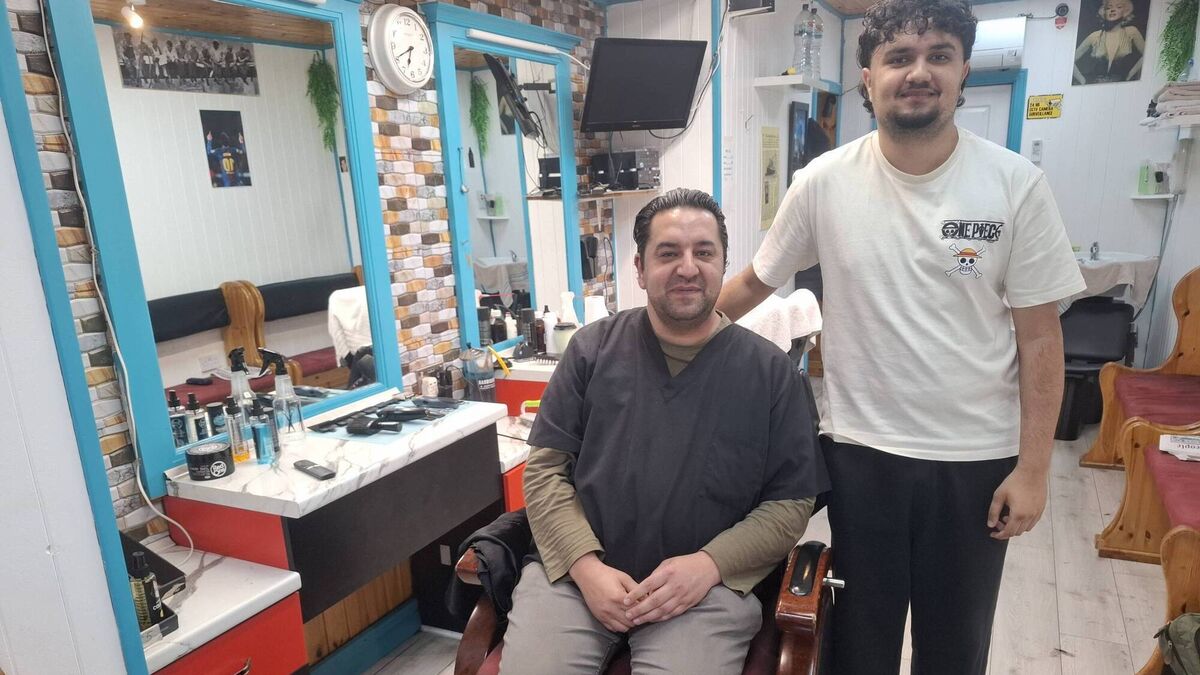
Erjan Ahmedov and his son Dan in their barber shop in Ballyhaunis.
It’s mid-morning on an early summer's day and the benches which line the wood panelled walls of Ali’s Barbers are full with locals waiting for haircuts.
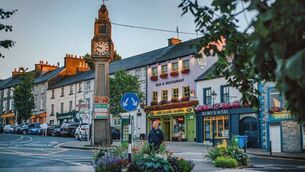
It’s been thus when you pass the red door on Main Street in Ballyhaunis for the 15 years that Erjan Ahmedov has been cutting hair here. Known to many as 'Ali', his Turkish heritage fits the sign over the door and hasn’t changed since the original Ali sold him the shop several years ago.
Erjan’s moved to Ballyhaunis from his hometown in northeastern Bulgaria after a series of chance encounters.
Erjan –“people also call me Eric, it’s easier” - had been barbering in his father’s shop in Silistra, a town of 50,000 on the Danube river, when he got a phone call.
“I got a call from a Bulgarian guy from my town who was working at Dawn Meats in Ballyhaunis. He had been into the barbers when he was home on holidays and he knew I was interested in working abroad. And when he went into Ali’s barbershop in Ballyhaunis Ali had asked if he knew any Bulgarian barber looking for a job.
"He [Ali] had heard that Bulgarian barbers were good. So this guy called me and asked ‘do you want to come to Ireland?’
“I arrived in September 2011. I was three months in Galway because Ali opened a shop on Eyre Square. Then he said ‘Ballyhaunis is better for you, the rent is lower, it’s more of a family place.’”
Erjan moved his wife and two young children to Ballyhaunis in January 2012, fully taking over the barber store from Ali in 2017. When the building came up for sale in 2020, he secured a mortgage and bought it.
Walk further up Main Street, take a left and another left and you’ll find one of Ballyhaunis’ newer barber shops. Inside, Lukas De Sousa is an ambitious and innovative 30-year-old who has embraced social media and digital apps to grow his clientele.
De Sousa is one of several new openings which has doubled the number of barbers in Ballyhaunis to eight in the past decade. He opens on a Monday but if the shop is quiet that’s because the customers are coming by appointment. De Sousa has a booking app linked to his Instagram page.
“That means no one is waiting an hour for a haircut, there’s less waiting around.”
De Sousa accepts card payments in store but is also looking at online payments.
He was ten when his father moved the family to Ireland in 2006 at the peak of the Celtic Tiger’s roar. De Sousa spent half his life in Athenry before moving to Castlerea.
"I was born in Sao Paolo but we moved to Annapolis, the city in the centre of Brazil."
De Sousa saw an opportunity in Ballyhaunis even though the town has seen an explosion of barber shops in the past decade. After finding a space on Barrack Street, a back annex of the building which once housed Ryan’s supermarket, De Sousa spent days last autumn with a friend, Patrick Donohue, fitting out the interior with panels, chairs and marble-effect countertops he purchased online from a factory in Turkey that specialises in barbershops. The gold trim on the drawers and on his barber chairs lend the shop an air of aspiration while the hexagonal tubed LED lighting providing a futuristic look for the youthful clientele.
He was drawn to Ballyhaunis, said De Sousa, because it’s “a very busy town…I did look around different areas, other towns, because in Ballyhaunis there are so many barbers, but I think I can make it here, there’s enough business for everyone".
De Sousa went from school into the meat trade.
“I was five years butchering in Kepak [Athleague], in Gilligan’s of Roscommon and in Divilly’s of Oranmore.”
But even when he was butchering, he was planning a transition, moving first to a manufacturing job at Harmaq, the medical devices factory in Castlerea, while doing some casual barbering.
“I was working in Harmaq and barbering on the weekends and in the evenings… when I was 14 or 15 and was cutting my own hair and my friends’ hair, I always had a thought to open my own barbers. During Covid I did a course. Then I did three courses online and I did a course with a master barber in Gort, Wesley Luiz.
“I paid for a seven-week programme with him and learned everything. I want to go back to him for a Masters course, to learn how to deal with situations, how to talk to people better, how to improve my scissors skills.”
There are two other Brazilian-run barber shops in Ballyhaunis while at least one other operates from a home in the town. Being home to JBS, the world’s largest meat corporation, Brazil is unsurprisingly the source of much of the labour keeping meat plants in Ireland, like Dawn Meats Ballyhaunis, in operation. Barbering is a source of extra income for some of those workers.
They bring a Latin culture of male grooming with them.
“Barbering is very big in Brazil, they take it very seriously, when you walk in there’s someone there to greet you, they give you coffee,” explains De Sousa.
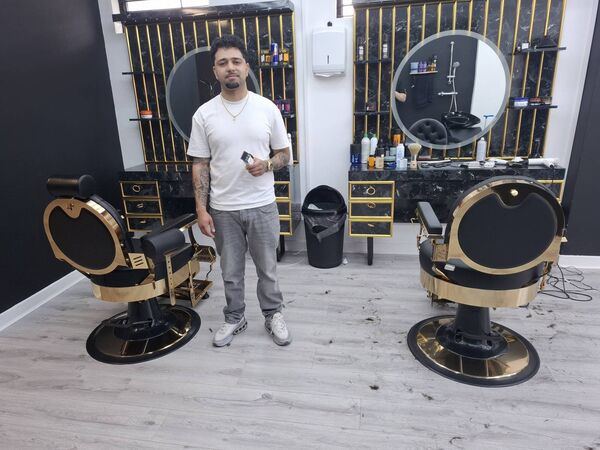
De Sousa is busy now but he endured a difficult first few months after opening in November 2025.
“It was very stressful. On my first day I only had two walk-ins, in the evening.”
Fortunately he had some local clients from four years spent working at Harmaq, which draws a large workforce from Ballyhaunis and surrounds.
“The first couple of months I was just paying my bills.”
Now he has a busy flow of clients, thanks to word of mouth and astute marketing on social media. When he wasn’t cutting hair, De Sousa was growing his business on a smartphone.
“I post my work on TikTok and Instagram. When I do an interesting haircut I take a photo and I post it. Every business needs a social media presence, it works.”
One of those photos captured a stullet - De Sousa describes it as a buzzcut on top and a mullet in the back.
“A young lad asked me for it, he had a photo of it on his phone.”
The mid fade remains a perennial favourite – a bowl of hair on top fading to short sides.
A lot of people came in with a photo on their phone. Footballer Cristiano Ronaldo remains a style icon but kids also come with photos of Brazilian player Vinicius Junior for the afro look.
It was 2000 when Erjan started cutting hair in his father’s barbershop. A photo on a business card shows father and son in white barbers’ gowns looking proudly at the camera.
“He tried to show me, I was doing a good job and I started on his lunch break. So I had to learn as quickly as possible, I was 15.”
And now Erjan is passing the trade on to his son Dan who joined his father in the barber shop every day to learn how to cut hair after completing his Leaving Cert last year.
“Thus far he has learned the machine already, but not the scissors,” explains Erjan.
Erjan’s family forms part of the ethnic Turkish community which makes up ten percent of the Bulgarian population, a legacy of the Ottoman Empire which ruled much of southeastern Europe for several centuries until the early 20th century.
“We speak Turkish and Bulgarian, we mix it up and now with the kids we’re mixing in English so it’s three different languages in the house.”
Bulgaria’s population has shrunk from nine to seven million people in the two decades since the country joined the European Union and Erjan was part of the early waves to move westwards. But it was London, home to a large ethnic Turkish population, that he first sought opportunity.
“I went to London for the first time in 2008 with very basic English, like ‘how are you’? but I needed more because in the barbershop you need to talk with people.
"The first time I went to London was not very successful. The guy lied to me, he had offered low pay but he’d pay my rent and he didn’t. I slept three months in the barbers and then I left, I went home to Bulgaria for a year. In 2009, I went back.”
In the interim he had improved his English.
“I learned from the movies, movies with subtitles.”
In 2009, he was in the Turkish neighbourhood which stretches from Tottenham to Wood Green and Hackney.
“I was working for a Kurdish guy but the wage wasn’t enough to pay the rent. By that stage my wife was pregnant with our second kid. I went back to Bulgaria.”
He was back cutting hair in his father’s shop in Silistra when the call came from Ballyhaunis.
Now that his clientele is growing, Lukas De Sousa is making plans.
“Yes, I’m planning to be fully booked and then I rent a chair to another barber and then if that goes well I’ll rent a second chair.”
He’s also thinking about house calls.
“If I get enough house call bookings I would close on Monday. I have requests for house calls. I have three brothers, builders, who just don’t have time to come in for a haircut.”
Then there’s the additional services he’s planning to offer. Ear waxing, nose waxing. And toupees.
"It’s expensive at the start, the original toupee is €900 or €1,000 but then it’s just a trim every five weeks.”
The World Cup has been good for business, with exotic hairstyles to be copied. The recent sunny weather has helped too, said De Sousa.
“And lads playing matches, they’re in before the match on Sunday, if you look at the teams they’ve all got fresh haircuts.”
He spends 30 minutes on a typical haircut. A beard trim takes another 15 minutes.
“A lot of nationalities are very fussy about the haircuts but Irish people are generally less fussy,” is his observation.
The perma-inflation of recent years hasn’t left the barber unscathed and the rising cost of a haircut has irked some customers.
“The price of everything goes up but everyone expects barbers to stay the same. I had a mom complaining about €17 for a child’s haircut. But there are so many costs, electricity, rent, I have to change the blades every two months. And I have [bank] card fees.”
But do customers, pardon the pun, cut back?
“Yes, people are going to the barbers less. Normally it’s every fortnight, some people every month. But more people keep up with the head cuts. I have one weekly customer, there’s a Brazilian lad, who comes every week for a mid-fade.”
At Ali’s Barber on Main Street, Erjan has also seen clientele cut back, but he has held his price at €15 for a dry cut, one of the lower prices in town.
“In 2011 and 2012, people came back every three weeks, now it’s every five or six weeks. My prices are fair, I come from a family where my mom is a tailor, Dad is a barber, I know the feeling of paying bills…”
His experiences in Silistra and London have helped him understand what the customer wants, said Erjan.
“Haircuts don’t change, it’s a circle, old styles just come around again. It’s just the young generation don’t know them, that’s why they are new to them, like the mullet is back.
"They show me on the phone what they want. Ronaldo remains the top influence. Before it was Beckham. Kids copy Gaelic footballers, that’s where the mullet comes from."
Turkish barbers, long synonymous with luxury, have been losing their lustre as styles change. Every town once had an ‘Ali Barber'. In Galway there are four or five Turkish barbers.
"If I put a sign saying 'Turkish barbers’ it means a standard, it means I do the hot towel, the shave with cut throat blade. Not many people around did that. The Turkish did that. But now young people want machine cuts, not the cutthroat razor or the hot towel… Machines are getting better. More people prefer machine cuts.”
Yet older customers in particular still prefer a good scissors cut, and that’s why Erjan’s shop remains busy even with extra competition.
“I have customers coming because young barbers can’t use the scissors. A lot of young guys are not good with the scissors, you need experience, you need time.”
In his 15 years in Ballyhaunis Erjan has watched from his window as footfall dwindles with the change in the town’s retail traditions as competition from online and supermarkets closes smaller shops.
“My prediction is coming through, I said it would be a commercial town with factories, not many shops and not many on the streets. People go to town only to buy something and then go straight home. Everyone can see the shops disappear in time.”
Every summer Erjan closes the barbershop for a few weeks and takes a four-hour flight from Dublin to Bucharest before driving 150 kilometres southeastwards to his hometown of Silistra where his father still cuts hair.
He has seen the population of his home country fall dramatically, while the population of Ireland has grown to levels similar to that of Bulgaria.
“Everyone has left for Europe or the US. I had an Irish client who saw a Bulgarian guy open a café in Australia. It’s an African style of living, people from small towns migrate to big cities, then they move abroad.”
Erjan hopes to divide his time between the two countries.
“My best dream will be May to September in Bulgaria and the rest of the year in Ballyhaunis. I dream of buying a house in a Bulgarian village. I like the countryside life, it’s quieter, there’s no traffic.”
He thinks it’ll take his son Dan another year to be fully skilled enough to cut customers' hair. Thus a family trade and tradition will continue.
With his obvious hard work and quest for self-improvement, Lukas De Sousa is ambitious for the future, and entitled to his confidence.
“I believe in my skills, in my ability.”
And the work is there in Ballyhaunis for all its barbers, he thinks.
“Ballyhaunis is big enough, busy enough.”