Ballina's ties to US city continue to grow
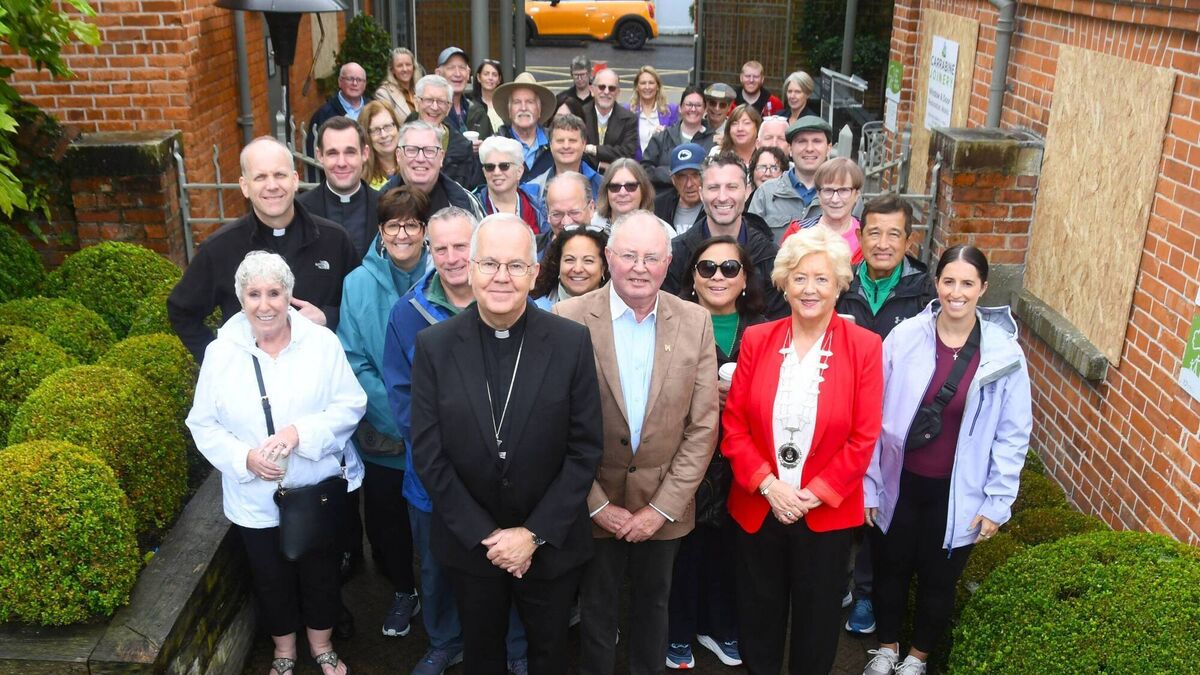
Pictured are the visiting delegation from Scranton Diocese at the Clarke Museum of Irish History with Michael Larkin, Eileen Corcoran, Anna Connor, Head of Ballina Municipal District; Cllr Annie May Reape, Cathaoirleach, Mayo County Council; Bishop Joseph Bambera, Yvonne Corcoran Loftus, Clarke Museum of Irish History; Fr Jerry Shantillo, Anne Marie Forbes, Clarke Museum of Irish History; Cliona Campion, President, Ballina Chamber of Commerce; Fr Andrew Hvozdovic and Fr Jeffrey Tudgay. Picture: John O'Grady
The longstanding relationship between Ballina and Scranton, Pennsylvania was highlighted last week as the Most Rev. Joseph C. Bambera, Bishop of the Diocese of Scranton, visited Ballina with a group of over 50 pilgrims as part of a wider pilgrimage to Ireland.
The visit to North Mayo began on Monday, September 21, when the group travelled directly from Dublin Airport to the Father Peyton Centre in Attymass. The following day, the group travelled to Ballina, where Bishop Bambera concelebrated Mass at St Muredach’s Cathedral at 10am.
Following Mass, the pilgrims were welcomed at The Clarke Museum of Irish History, where they met local representatives and learned more about the deep historical connections between Ballina, North Mayo and Scranton. Among those welcoming the group were Cathaoirleach Cllr Annie May Reape; Anna Connor, Head of Ballina Municipal District, Mayo County Council; Cliona Campion, President of Ballina Chamber of Commerce; Mairéad Melody-Carr, Manager of Mayo North Tourism; Mags Downey Martin, and Michael Larkin, who has played an important role in maintaining the Ballina-Scranton connection, together with Yvonne Corcoran Loftus and the team at the Clarke Museum of Irish History.
The pilgrims also spent time exploring Ballina town centre, experiencing the town and its streets before continuing their journey through the region.
Cathaoirleach Cllr Annie May Reape said: “The relationship between Ballina and Scranton is an important part of our town’s history and has been built on generations of family connections, friendship and shared heritage. It was wonderful to welcome Bishop Bambera and the pilgrims to Ballina and to see this historic relationship continuing to grow.”
Ballina and Scranton formally became sister cities in 1990, building on connections that date back generations. Many families from Ballina, Mayo and the wider west of Ireland emigrated to Pennsylvania, creating strong family, cultural and community links that continue today.
For Ballina, the relationship represents much more than a formal sister-city agreement. It is a living connection between communities, shaped by migration, family history, shared heritage and the generations who have continued to maintain those links.
Michael Larkin said: “The connection between Scranton and Ballina is very personal for many people and goes back generations. To welcome Bishop Bambera and the pilgrims to Ballina and North Mayo was particularly special, and I hope this visit will lead to further exchanges and strengthen the relationship for years to come.”
The connection also has significance for tourism, providing an opportunity to reach people in Pennsylvania who have genuine family and historical links to Ballina and North Mayo.
From a tourism perspective, Mairéad Melody-Carr, Manager of Mayo North Tourism, highlighted the importance of the Ballina-Scranton connection.
“This connection opens a door to a community of people in Pennsylvania with genuine family and historical connections to this part of Mayo. Visits like this give us an opportunity to share that story and encourage people to explore their connections with North Mayo.”
The visit provided the pilgrims with an opportunity to experience some of the places and stories that connect North Mayo with the wider Irish diaspora.
The Father Peyton Centre in Attymass was a particularly significant first stop. Fr Patrick Peyton was born in Attymass in 1909 and became internationally known for his promotion of family prayer. He later spent time in Scranton, where he worked at the Cathedral of Saint Peter before entering the seminary.
In Ballina, the group visited St Muredach’s Cathedral and the Clarke Museum of Irish History, as well as spending time in the town centre. They then continued their Irish pilgrimage to Knock Shrine before travelling onwards to Kylemore Abbey and Galway.
The Ballina-Scranton relationship has also continued to develop through cultural and civic exchanges. In recent years, Ballina Arts Centre and the Scranton Fringe Festival have worked together on cultural initiatives, while representatives from Ballina have travelled to Scranton for community and civic events.
The relationship was formally established as a sister-city partnership in 1990, but its roots reach much further back. For generations, people from Ballina and across Mayo have made their homes in Scranton, creating family connections that continue to bring people back to North Mayo to discover their own history and heritage.
The visit by Bishop Bambera and the Diocese of Scranton pilgrims represents another chapter in that continuing relationship, bringing together the shared history of two communities while creating new opportunities for cultural, civic and tourism connections into the future.