50 years on from a Mayo woman making history at Rose of Tralee
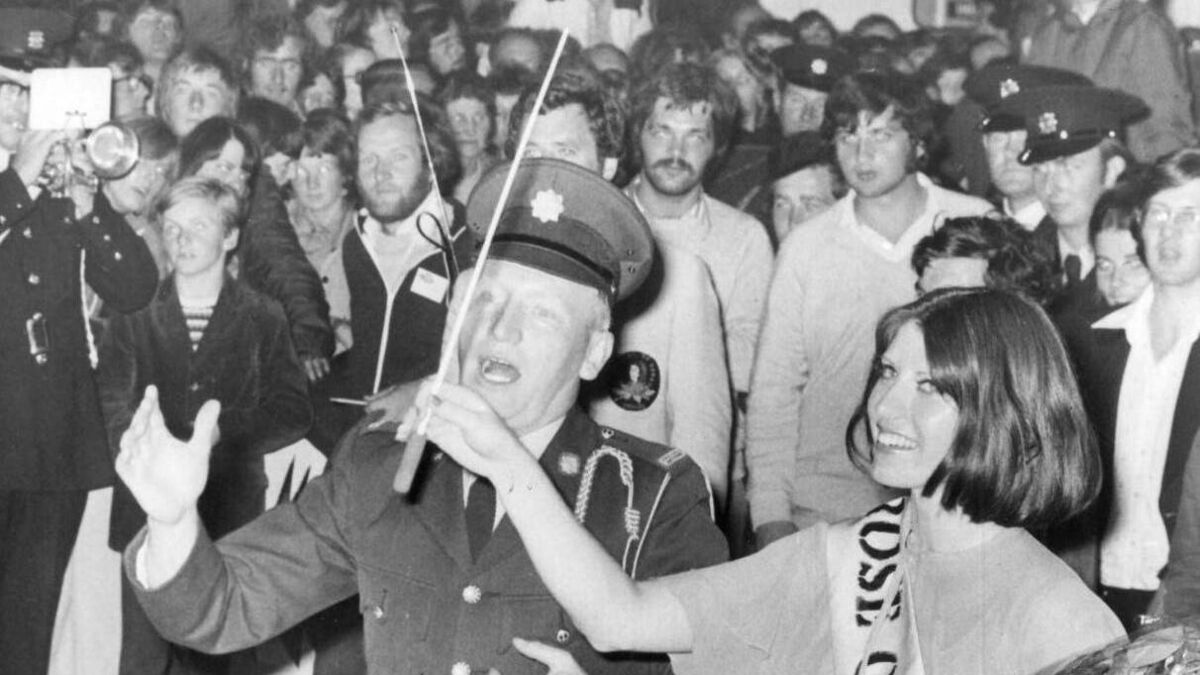
Maureen Shannon from Bohola joins with Inspector Tom Boyle in conducting the Garda Band on Denny Street in Tralee as it played its salute on the night of her crowning as Rose of Tralee on September 2, 1975.
On the opening night of the 1975 Rose of Tralee festival, Richard O’Sullivan did what any self-respecting festival chairman might do. He conducted a ‘personal survey’ of eight pubs in the town. Some guys get all the tough jobs.
The licensees had reluctantly agreed with the festival committee to charge 53 pence for a small brandy and 37 pence for a pint of lager and on that Saturday night O’Sullivan wanted to establish any impact on their takings. And presumably, too, to see were they playing ball on price.
That same night three visitors from Dublin were said to have “infringed the rules of the house in one pub in the region of The Square”, which the Kerryman newspaper reported in its own inimitable style.
“Mine host dispatched one with a Muhammad Ali-like blow, the second met a similar fate at the hands of an irate customer and, not to be outdone, a well-known Tralee football follower completed the job by decking the third disturber of the peace. You could call it a flat finish to the night.”
It’s unclear whether Richard O’Sullivan happened across that kerfuffle during his expedition of the hostelries or indeed if the chairman’s ‘spirited’ committal to his ‘personal survey’ could be connected to him putting out his back from a fall before the start of the novelty donkey race at the Town Park the following day. But thankfully O’Sullivan was in good enough fettle to complete his survey by visiting another eight pubs on Sunday night after which he was happy to report the publicans’ takings were up as much as 30 per cent on the same two days as the year before.
If there’s one thing that taxes the mind as much as the price of drink, it’s the price of butter. And according to an advert on the front page of the Kerryman that week, Guerin’s Supermarket in Listowel was selling butter for a pence cheaper than the pint of lager, which might have interested Vicki Thurston , the 19-year-old Toronto Rose who told compere Gay Byrne in the Festival Dome that she had fallen in love with the taste of Irish dairy and wished to buy a cow. Whether Ms Thurston managed to sneak a Kerry heifer out of Shannon Airport is unknown but I can tell you the cost of drinking has inflated more than the price of butter. The only shame is my own personal survey didn’t involve visiting sixteen pubs.
In fairness to Richard O’Sullivan, you could have forgiven the chairman if wanting a stiff drink on opening night for there had been a very real danger that all his committee’s hard work was about to go up in smoke. If the 1975 Rose of Tralee Festival wasn’t going to cancelled entirely, then the threat that it might be seriously curtailed by events elsewhere was definitely there.
President Éamon de Valera died in Dublin the day before the festival was due to get underway. The government announced a day of mourning and the state funeral was confirmed for September 3 – slap, bang in the middle of Tralee’s five-day carnival. The Wolfe Tones, The Dubliners and Eurovision winner Sandie Shaw were all booked to headline concerts, Junior Jonson had flown in with the 298th US Army Band to perform, acts had travelled from New Zealand, Canada, USA, Denmark, France, The Netherlands, the UK and all over Ireland for a ‘Battle of the Bands’ and of course, 26 young woman had by now arrived from all corners of the globe each with the hope of becoming Rose of Tralee.
Among them was Maureen Shannon, a 22-year-old from Treenabantra, near Bohola, who on the same day that an estimated 200,000 people lined de Valera’s three-mile funeral route from St Mary’s Pro-Cathedral to Glasnevin Cemetery, sat posing for photographs in the Rose Garden at Tralee’s Town Park still trying to comprehend what had happened the night before.
Maureen had not only become the first Mayo girl to win the Rose of Tralee but the first London representative also – because like many an emigrant’s story, this one began in the Galtymore in Cricklewood.
Maureen was working in Archway as a clerk for Lloyd’s Bank and that June her sisters Kathleen and Lena had travelled over to London for a visit. The trio made plans to attend a West End show but Maureen arrived home late from the office so it was decided instead to head for the Galty’ dancehall, not because they were picking the London Rose but since it was Thursday, “nurses were probably admitted for free”. Every girl was a nurse those nights.
It’s 50 years since Maureen Shannon’s life-changing summer and some things remain more vivid than others. But the upshot is that she had been talked by her sisters into trying out to become the London Rose and when they all returned to her flat in Highgate that night, Maureen was £100 in pocket with a ticket booked to the festival of Kerry. And all after nothing more than having a few words with an MC on the stage of the Galtymore.
“The big thing was that it was a free holiday,” recalls Maureen from Lanzarote, where she has since made her home. “Flights to Ireland at that time were very expensive so to have them paid for was huge.”
Except this was no ordinary holiday. Told to tie a pink ribbon to the suitcase which contained all the outfits her £100 was intended to cover, Maureen hadn’t even to collect her own bag upon arrival at Dublin Airport.
“You were being pampered everywhere you went, I certainly wasn’t used to that.”
The Roses overnighted in the Burlington Hotel and proceeded on a coach tour of Ireland which included visits to Cork Opera House and Blarney Castle before arriving in Tralee several days later.
“Everywhere we went there was almost always a reception. We’d arrive into towns and everyone was expecting the Roses, it was so funny, all this meeting and greeting.”
Maureen Shannon wasn’t the only girl of Mayo heritage in the competition. Ohio Rose, Marian O’Donnell, had an Achill-born mother, the Holyoke, USA representative, Marie Donohue, claimed Belmullet and Dingle ancestry while the Chicago Rose, Moira Byrne, had a Knock-born father. Indeed during the International Rose of Tralee Selection that Tuesday night, the 19-year-old student told her namesake Gay Byrne about how she had entered the World Irish Dancing Championships, so the compere lilted into the microphone and according to the Kerryman, “Moria took off her shoes to show a very talented pair of feet.” There was an audience of 2,500 packed into Tralee’s famous Festival Dome.
“When there’s a large group of girls like that, there’s only going to be one Rose so you don’t expect it to be you, I certainly didn’t, so you’re not het up about anything, there was no pressure. You were just having a great time,” insists Maureen, who recalled her own interview with the man affectionally known as Gaybo.
“You weren’t afraid, you were sort of delighted because Gay Byrne was such a big star. Just the fact that he spoke to you, good God… I was a bit starry eyed I suppose.”
Byrne had only compered his first Rose of Tralee the year before and it wasn’t until 1978 that he persuaded RTÉ to televise the event and to introduce a ‘talent spot’, which has remained a staple of the contest ever since.
“I think what we see nowadays is for the purpose of television and entertainment. It was shorter then than it is now; it all happened in an evening,” says Maureen.
But if not having to sing, dance, recite poetry, play the fiddle or bagpipes or perform a card trick, just what was it that the judges saw in the girl from Bohola all those years ago?
“To be quite honest with you, I’m still looking in the mirror wondering that myself,” laughs Maureen.
Sat stunned in the audience, as Festival President Emmett Kennelly announced their daughter and sibling as the 17th Rose of Tralee, were Maureen’s mother Margaret, sister Lena, brother Michael and his wife Maura, a native of nearby Ballybunion.
“It was wonderful to feel that I was not there alone and that I had some of my family to share the great joy with,” she said.
Maureen’s victory was reported at length by the Kerryman who said the new Rose “got the lift of her lifetime” and “floated past many thousands of people in the jam-packed centre of Tralee at midnight”, because her journey of triumph was literally made in the imitation hot air balloon that had won the newspaper the top prize in the Rose of Tralee’s float competition.
“It was a dizzy journey for the gentle girl who suddenly emerged from the group of 26 finalists after a week in which she stayed very much in the background.
“‘Midnight Madness’ somebody called the show that was put on to mark her selection. Every band and entertainment group in town for the Festival, every float and every Rose finalist participated in the midnight parade that climaxed a hectic night and the most successful event ever staged in Tralee.
“At Denny Street corner, Maureen got off the float to be embraced by excited well-wishers and join Inspector Tom Boyle in conducting the Garda Band as it played its salute to her.”
It was the beginning of a whirlwind few days for Maureen, a former boarder at St Louis’ Convent in Kiltimagh.
“People are very excited, it’s really lovely, you couldn’t believe it. It was a great feeling to get such a great reception,” she recalls. “I was taken to visit Kerry Hospital the next day, just like you see the footballers do after winning the All-Ireland. The one thing I distinctly remember is that the first two girls I saw, I recognised them from Kiltimagh. They used to be maids in the convent and must have moved to work with the nuns in Tralee too. I couldn’t believe it.”
And nor could Maureen believe the commercial side of the festival, a world to which the new Rose was introduced throughout the rest of the week when taken to every establishment in the town that had provided sponsorship. This was a festival that offered £1,000 to the Rose of Tralee winner but £12,500 to anyone who in a four-hour window that Sunday might catch a tagged ray that had been released into Tralee Bay. Said ray escaped the tempting bait of about a hundred fishermen, and the insurance man breathed a sigh of relief.
“I was only 22, it was only a couple of years since I had left Mayo and I had no exposure to the world really. I was extremely cautious of everybody,” remembers Maureen now, five decades on.
“You’re invited by all sorts of different people to do all sorts of different things but you don’t actually know who they are. You wonder are these reputable people. I was a bit afraid to be honest.
“At that particular time, the Roses were not given any guidance from the day they won. You kind of just went with the flow.”
Yet while Maureen admits now that nothing could have prepared her fully for becoming the Rose of Tralee, nor did it change her. In fact, the Tuesday after she received the famous sash she was up bright and early helping her parents Luke and Margaret with work on the family farm.
“There is no place for idlers in this house,” she told the Western People that week with a smile. And her immediate plans when she got back to London? “To sleep for at least two days. There is not time for that here.”
This, after all, had been no ordinary holiday.