Local Notes: Turbulent history of Ballyhaunis Friary is revealed
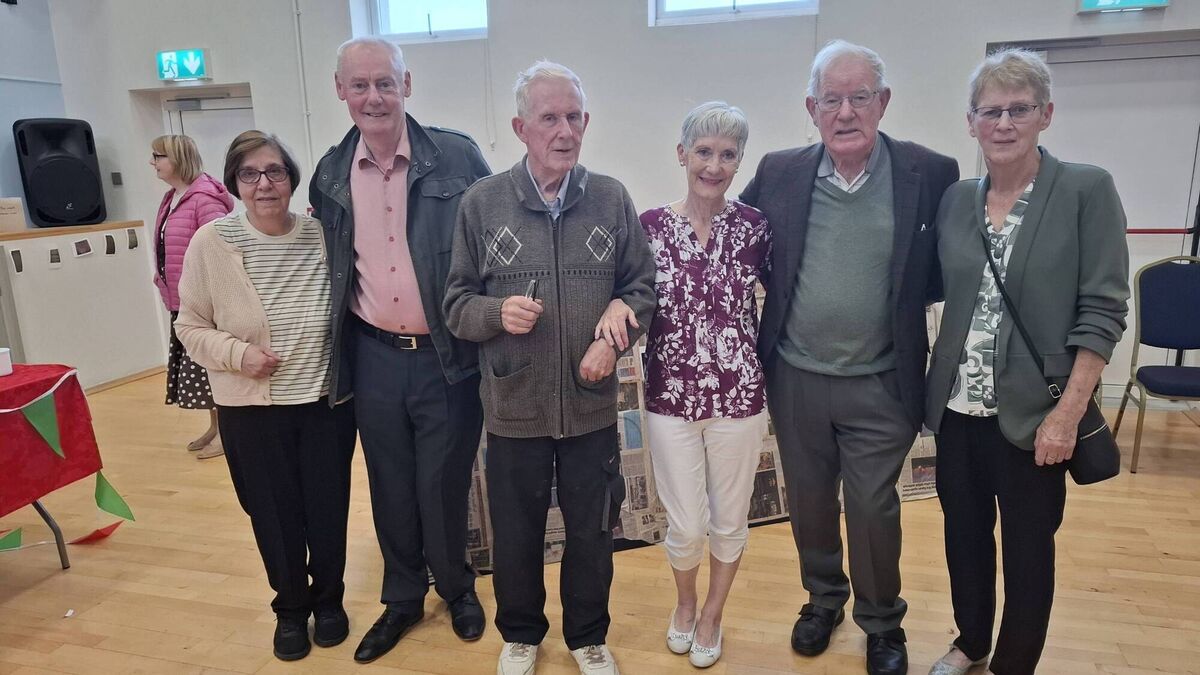
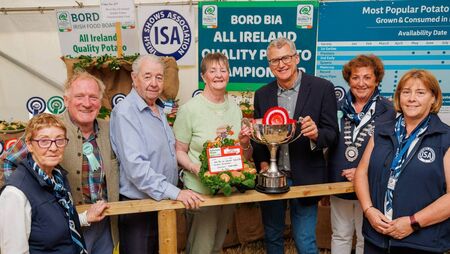
Theresa Sloyan, Eugene Delaney, Tom Flatley Maura Mullins, Billy Lyons and Ursula Waldron at the Windows Into History event at the Community Hall during Heritage Week.
A photo in a Powerpoint presentation on the history of Ballyhaunis Friary at the weekend featured a tall, tanned figure who was immediately recognisable but not in the brown cassock he is wearing. Standing next to Pope Leo is an Augustinian colleague, John Meagher, who was the prior of the Ballyhaunis friary from 1981 to 1985.
The photo was taken in 2005 at an Augustinian property in Co Tipperary and shown by Paul Waldron, organiser of the special symposium on the order’s presence in Ballyhaunis from the 1400s until they departed in 2002 due to falling numbers entering the congregation.
Speaking at the symposium, Bekan native and senior lecturer at University of Galway Dr Nollaig Ó Muráile described the historical context to the founding of the Friary, built in 1432 by Friar Philip Nangle under the patronage of Mac Siúrtáin Dubh, the local chieftain who belonged to a branch of the gaelicised Anglo-Norman family of Mac Goistealbha (Costello), rulers of East Mayo whose name was given to the Barony of Costello, an administrative name for the region up to recent times.
The Friary was founded during a period of medieval Irish history described by O’Muráile as a gory period of much bloodshed as families targeted each other in “all to frequent and often rather vicious” squabbles which pitted Norman against Gaelic but which also saw Normans scheming with Gaels.
In 1422, Mile son of Mac Siúrtáin (Jordan) Duibh was killed in captivity in Mannin Castle near Ballyhaunis by Seafrún, grandson of Tomás Mac Muiris (Fitzmaurice).
In 1432, the first reference to the Ballyhaunis friary appears in Augustinian archives in Rome. The scribe, unfamiliar with the Irish language, recorded the place name as Hanahannassa, clearly an attempted rendering of ‘Béal Atha hAmhnais.
Political turbulence in England prompted by the Reformation led to centuries of persecution for the friars of Ballyhaunis. In 1649, there was a brutal murder at the Friary of the then prior Fr Fulgentius Jordan. Two versions of the story: English soldiers garrisoned at Dunmore dragged the prior from the altar and hanged him on one of the trees outside. In another telling Fr Fulgentius was killed while celebrating Mass at Redpark in Bekan.
Ballyhaunis was one of three officiates tasked with training friars but by 1796 the friary was really run down and roofless. A series of energetic friars in the 19th century had the side chapel re-roofed. By the 20th century the building had been fully re-roofed.
Some friars were restive religious men. O’Muráile detailed the fascinating story of Tomás O’Casaide, an Augustinian, poet and adventurer who after leaving the Friary in Ballyhaunis - he struggled with the discipline of a monastic life - went to the continent where he fought in both the French and Prussian armies before a brief stint in the British navy and a return to the Friary. He is credited with writing a celebrated poem ‘Máire Bhéal Atha hAmhnais’.
O’Muráile praised Patrick Lyons, a sergeant in the Royal Irish Constabulary (RIC) who served in Ballyhaunis at the turn of the 20th century and whose deep interest in antiquity led him to record so many of the field monuments in the Bekan and Ballyhaunis areas, including ogham stones.
A long-awaited review of the car parking situation at Ballyhaunis railway station appears some way off despite overcrowding which has seen train users parking cars on footpaths near the station.
Hugh Creegan, deputy chief executive of the National Transport Authority (NTA), wrote to local TD Alan Dillon recently to explain that “the NTA understands that [Iarnrod Éireann] is nearing completion of this review and is expecting to receive an updated National Car Park Strategy from IÉ in the near future".
“Once received, the NTA will consider the recommendations identified within the updated strategy in the context of wider public transport investment priorities, with the output of that exercise then being used to inform future investment programmes for railway station access and parking improvements."
Irish Rail told this column last year that the review would be published by the end of 2025. Several requests for comment over recent months went unanswered.
Creegan said a 2020 review by Irish Rail had concluded that Ballyhaunis wasn’t a priority for more parking space.
“Iarnród Éireann (IÉ) completed its National Car Park Strategy in 2020 which assessed parking demand and expansion opportunities across the heavy rail network. This strategy formed the basis of the current National Car Park Programme that is funded by the National Transport Authority (NTA) but delivered by IÉ.
“Ballyhaunis railway station was not identified as a priority location for car park investment in the strategy. However, travel and commuting patterns have changed significantly in recent years, and the strategy is therefore currently being reviewed by IÉ. As part of this review, consideration is being given to the needs of railway stations across the network, including Ballyhaunis.
“In line with current transport policy, this review is considering not only car parking provision, but also how people access stations by bus, on foot and by bicycle. Improvements to sustainable access modes are a key priority, but where there is suitable land available and a need is identified, additional car parking may also be considered.”
Illegal dumping remains an issue at the Ballyhaunis bottle banks. Waste, including nappies, are being stuffed into the receptacles for bottles and cans, according to drivers collecting the recyclables.
"We can see the waste when we lift and empty the bottle and can banks,” said a driver.
Recently, Mayo County Council removed clothes banks from the recycling centre after they became a magnet for illegal dumping.
It remains unclear when CCTV cameras will be operational at the site.
Ballyhaunis Cricket Club’s second eleven produced a fantastic performance in the Connacht Junior Cup Final, batting first and posting a competitive 170 all out in 31.3 overs.
Abdullah Ashraf top-scored with a brilliant 53 off 47 balls, supported by Zameer Abbas with 32 and Zia Shafique with 27. Galway Shamrocks fought hard in the chase, but Ballyhaunis kept taking wickets at crucial moments, with Kashif Akbar and Mohammad Saad Asif claiming three wickets each.
“All the lads did really well in the field and kept pressure on Galway Shamrocks, making it hard for them to get any partnerships or get going," said the club. "Galway Shamrocks were eventually bowled out for 141 in 28.5 overs, giving Ballyhaunis a superb 29-run victory and securing the Connacht Junior Cup."
Man of the Match was Abdullah Ashraf for his outstanding all-round contribution with 53 runs and two wickets.
Ballyhaunis’ first team meanwhile lost the Connacht final to the University of Galway recently by seven wickets. Ballyhaunis won the toss and decided to bat first, setting a target of 188 with Abdul Shafique making 33 and Wahab Ul Hassan making 35, explained Hamza Yousaf, public relations officer of the Ballyhaunis Cricket Club.
“In reply, University of Galway came out too strong and finished the game within 20 overs scoring 190 and 3 out. Other top Ballyhaunis players were Kashif Akbar and Hamza Yousaf who scored a wicket each with one run out."
The issue of how resources are allocated across the county is a perennial one aand is as true a century ago as it is today.
Ballyhaunis was ahead of its time when the town got piped water in 1926 but paying for the project was a major source of debate across the county and in the chamber of Mayo County Council.
A newspaper report from 1926 details how Ballyhaunis ratepayers had contributed to hospitals in other towns across the county and felt it only right that the cost of the new water supply be borne by the county coffers. This arose after the government decided that Ballyhaunis ratepayers should pay for the water scheme, even though locals felt the cost should be borne by the council’s general budget. In those days, everyone who owned property paid rates, unlike today when rates are confined to commercial property owners.
The article explains: “The Minister who has a statutory right to fix the area of charge has tentatively decided on the dispensary district of Ballyhaunis though is still prepared to consider representations from the County Board of Health as to a more extended area. The benefiting area not being able to carry the burden of a scheme estimated to cost 8,500 pounds from the extended area to the dispensary district, a stiff tax will be put on the agriculturalists who will never benefit. Ratepayers of Ballyhaunis pay their share for the upkeep of the hospitals of Swinford, Ballina and Belmullet from which they get no benefit...”
In the next edition we'll detail who paid the bill.