DPP appeals leniency of garda killer Aaron Brady’s sentence for perverting course of justice
Fiona Magennis
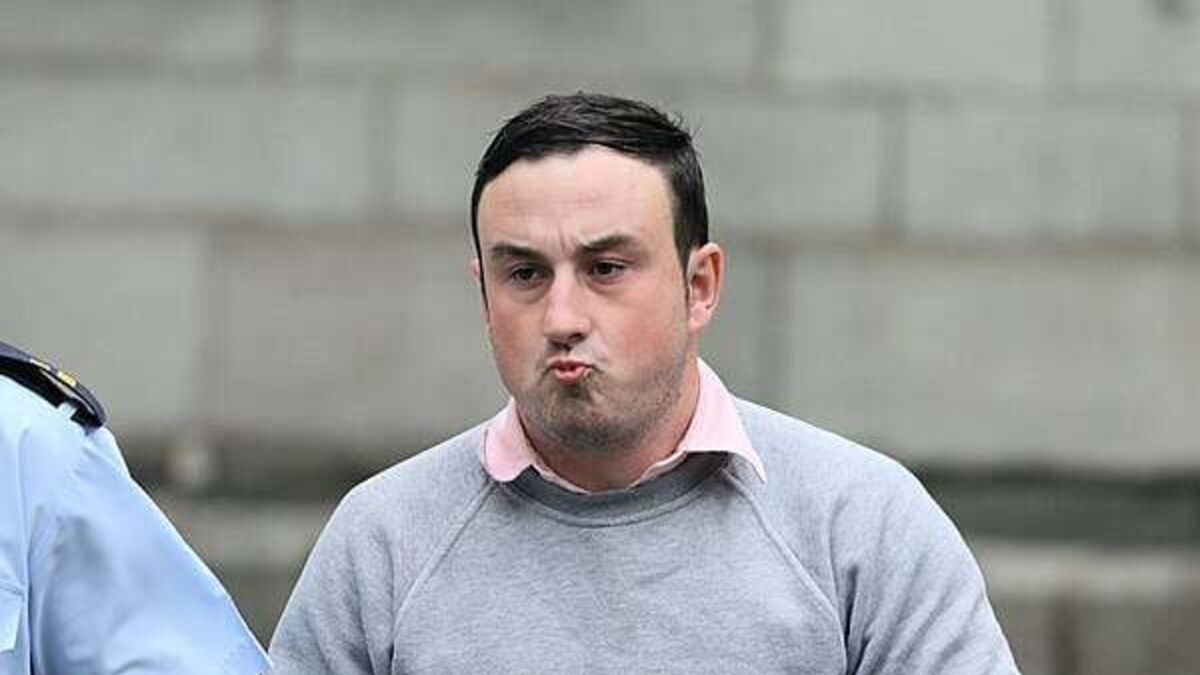
The Director of Public Prosecutions (DPP) has appealed the undue leniency of the three-year sentence handed down to garda killer Aaron Brady for conspiring to pervert the course of justice during his capital murder trial.
The DPP’s legal team said the case raised an important issue of “principle” rather than one of practical consequence, as Brady is already serving a life sentence for the murder of Detective Garda Adrian Donohoe.
They said there are “very few, if any, cases where deterrence would be more important”.
When Brady was brought to the dock from the holding area as his appeal was due to be heard, Mr Justice John Edwards, presiding, noted the defendant was carrying a water bottle and questioned why the 34-year-old had been allowed to bring something into court which could potentially be used as “a weapon” in circumstances where “he could fling it at somebody”.
“It’s not to happen again,” said the judge.
Brady was sentenced to three years in prison by the three-judge, non-jury Special Criminal Court in July 2024 for perverting the course of justice.
As he is already serving a life sentence for murdering Det Gda Adrian Donohoe, the three-year sentence he received will make no difference to the time he serves.
Interview footage
Brady accepted that he was responsible for recording footage of an interview between gardaí and Ronan Flynn, a witness who told gardaí he had heard Brady admit to shooting Detective Garda Adrian Donohoe three times.
The video was later posted on social media, accusing Mr Flynn of "touting" and calling him a "rat".
Mr Flynn did not give evidence at Brady's trial, and Mr Justice Michael White, who oversaw the murder trial, described the release of the footage as "the most outrageous contempt of court" and a clear attempt to intimidate Flynn and other witnesses.
Brady also sent photographs of portions of Daniel Cahill’s statement to Dean Byrne, a violent criminal housed on the same wing of Mountjoy Prison.
Byrne passed the statements on to at least two people in an attempt to get Mr Cahill's family members to persuade him not to give evidence.
Mr Cahill did give evidence at Brady's trial, telling the jury that Brady admitted to shooting a garda on three occasions while Brady was living in New York, having fled from Ireland in the aftermath of the murder.
Launching an appeal against the leniency of Brady’s sentence on Tuesday at the Court of Appeal, Lorcan Staines SC, for the DPP, said this appeal was primarily “an issue of principle”.
Mr Staines said the danger was that if this sentence were to stand, it would be held up as the “high water mark” for this type of offending.
Sentencing
He argued the sentencing court fell into error by setting a headline sentence that was too low and by placing too much emphasis on the fact that no violence or threats of violence were used.
Counsel said individuals who wish to interfere with witnesses can do so “by extremely subtle means”, such as sending a photograph to a witness of their child, their child’s school or their own home.
“No violence, no threats is potentially just as serious as meeting them and threatening them face to face with a weapon,” said Mr Staines.
The barrister emphasised that Brady was on trial for capital murder at the time and was alleged to have shot a detective garda at point-blank range.
While no violence occurred in the witness interference itself, the offence was particularly serious given the gravity of the underlying charge and the importance of the witnesses involved, counsel argued.
Mr Staines said the court had to look at Brady’s moral culpability, the planning involved, and the broader public interest in protecting the administration of justice.
Witnesses
This was an attempt, counsel submitted, by a man charged with the most serious offence to prevent key witnesses from giving evidence against him.
He said the interference with witness Daniel Cahill only emerged after a video involving Ronan Flynn was disseminated, on foot of which electronic devices in the prison were seized.
He said the footage was disseminated “very widely on social media” using the word “tout” in the context of Mr Flynn, who was a witness in the book of evidence.
Aaron Brady was sitting in court when it became clear the footage had been released, counsel said. He knew his cell had been searched and he continued on and committed the second offence against Daniel Cahill.
Mr Staines said we are lucky to live in a jurisdiction where there is respect for the law and respect for the administration of justice.
“A very clear line needs to be laid out pointing out that any attempt to interfere with the administration of justice will be punished extremely heavily,” said Mr Staines.
He noted that had the case been halted or the witness not given evidence, there may not have been another trial for capital murder.
Mr Staines said this went to the “intrinsic seriousness” of how significant Mr Cahill was as a witness.
“There would be very few if any cases where deterrence would be more important,” the barrister added.
He argued too much weight had been given by the sentencing court to the lack of violence.
Mr Staines argued that not only should there have been very little weight attached to the lack of violence, there shouldn’t have been “any weight” attached to it at all when “one looks in the round at how this campaign of intimidation was put in place”.
He also submitted that the sentence was simply too low to take into account the principles of general deterrence.
The barrister said the dissemination of the video of Mr Flynn to a large audience was an important factor.
Mr Staines said remorse was also an important factor to be considered, noting that in this case, there had been a guilty plea to the dissemination of a video with an intent to pervert the course of justice.
Mr Staines said Brady had attempted to move away from his plea by saying he only sent Mr Cahill's statement to one person and claiming he wasn’t responsible for using the word “tout”.
“I say this was calculated to create the most damage possible,” Mr Staines said, adding that after the video was circulated, Brady “continued to interfere with the next witness”.
He said the trial was commencing on the Monday and the plea was entered later that week.
In response, Michael O’Higgins SC, for Aaron Brady, told the court that there was a “significant drift” between the prosecution’s written and oral.
He said the submission presented orally by the DPP was that “Mr Brady put out or was involved in putting out a video out and then some weeks later, that having occurred, compounded his wrongdoing by trying to persuade Daniel Cahill from giving evidence.”
He said this had been presented as a “seriously aggravating factor” warranting a higher headline sentence, yet it didn’t make the list of aggravating factors in the DPPs written submissions. He said the first Brady’s legal team heard of it was in oral submissions today.
He said the DPP were contending that Brady’s actions elevated the offence to something that was “as bad as violence”.
“They are saying what was done here was worse than violence when there is no evidential basis for it,” he said.
He said the DPP recognised that all the relevant factors were considered by the court before imposing sentence, but they are arguing the three-judge court didn’t give all of those factors the weight they deserved.
Mr O’Higgins said this wasn’t a principle in law, but rather a factual context “in which they say their appeal should succeed”.
Mr O’Higgins said the defence had made a “sensible concession” that disseminating the video was “a hazardous thing to do”.
He said his client had expressed his remorse for what he had done through his legal team and accepted that he disseminated the video.
He said Brady had accepted that it was “a hazardous thing to do” but said he was not party to putting it on WhatsApp or the commentary involved.
In relation to the argument that there may not have been another trial, Mr O’Higgins said he wasn’t sure “how my client’s actions could have stopped the trial going on”.
He said neither of these matters precipitated the collapse of the trial and neither were likely to.
“One of those witnesses did not appear but there is no evidence whatsoever to suggest that his non appearance was down to Aaron Brady,” Mr O’Higgins said.
Mr Justice Edwards said the court would reserve judgment.
In August 2020, Brady, formerly of New Road, Crossmaglen, Co Armagh, was convicted by a jury of the murder of Det Gda Adrian Donohoe during a credit union robbery at Lordship, Bellurgan, Co Louth on January 25th 2013.
In 2024, he pleaded guilty to a charge that on a date between February 20th and May 7th 2020, within the State, he video recorded the playing of an interview between Ronan Flynn, a witness at his trial, and An Garda Siochana, thus embarking on a course of conduct intended to pervert the course of justice.
Mr Flynn, who did not give evidence at Brady's trial, spoke to gardai in October 2017 while he was living in New York. He told gardai that while he was sharing an apartment with Brady, he often heard the defendant admit to shooting Det Gda Donohoe.
Mr Flynn said that when Brady was drunk, he would listen to the Wolfe Tones and get "angry and frustrated with himself" and say things like: "Sure fuck it, I shot a guard".
Brady is serving a life sentence with a minimum time served of 40 years for that murder. He was also jailed for 14 years for the robbery of the credit union.